RECENT POST FROM THE BLACK BOX CLUB

Monday, 29 April 2013

PRESS RELEASE: JEREMY IRVINE AND PHOEBE FOX CAST IN HAMMER FILMS 'THE WOMAN IN BLACK: ANGLE OF DEATH'

THE FOLLOW UP TO THE GLOBAL BOX OFFICE SMASH REUNITES PRODUCTION TEAM AND WILL BE DIRECTED BY TOM HARPER

Jeremy Irvine (War Horse) and Phoebe Fox (Black Mirror) have signed to star in The Woman In Black: Angel of Death, the follow-up movie from the team behind worldwide box office hit The Woman In Black, which starred Daniel Radcliffe.


The sequel will continue the story four decades later.

Seized by the British government during World War II, the sudden arrival of a group of evacuated children at Eel Marsh House awakens its ghostly inhabitant. Directed by Tom Harper, The Woman In Black: Angel of Death will be produced by Exclusive Media’s Tobin Armbrust and Simon Oakes, Cross Creek Pictures’ Brian Oliver and Talisman Films’ Richard Jackson, in addition to Roy Lee who will serve as executive producer.

The casting was announced by Oakes, president and CEO of Hammer and vice chairman of Exclusive Media, Guy East and Nigel Sinclair, co-chairmen of Exclusive Media, Hammer’s parent company, and Cross Creek Pictures president Oliver and Xavier Marchand, Entertainment One’s president of worldwide distribution.

Screenwriter Jon Croker (Desert Dancer) wrote the screenplay based on an original story by Susan Hill (The Woman In Black). Buyers will be scared into action by Alex Walton, Exclusive Media’s president of international sales and distribution, during the upcoming Marche du Film in Cannes. Entertainment One Films will again co-finance the film and distribute in the U.K., Spain and Canada.


Director Tom Harper said: "Jeremy and Phoebe are fantastic actors to continue The Woman in Black’s chilling tale.  I’m looking forward to working with them both on the film and can’t wait to start shooting with the pair."

The Radcliffe starrer, directed by James Watkins, has become the highest grossing British horror film of the past 20 years, grossing more than $130 million worldwide.
Irvine is repped by CAA, Hatton McEwan Penford and Schreck Rose Dapello and Adams.
Fox is repped by WME and the Curtis Brown Group.

Thursday, 25 April 2013

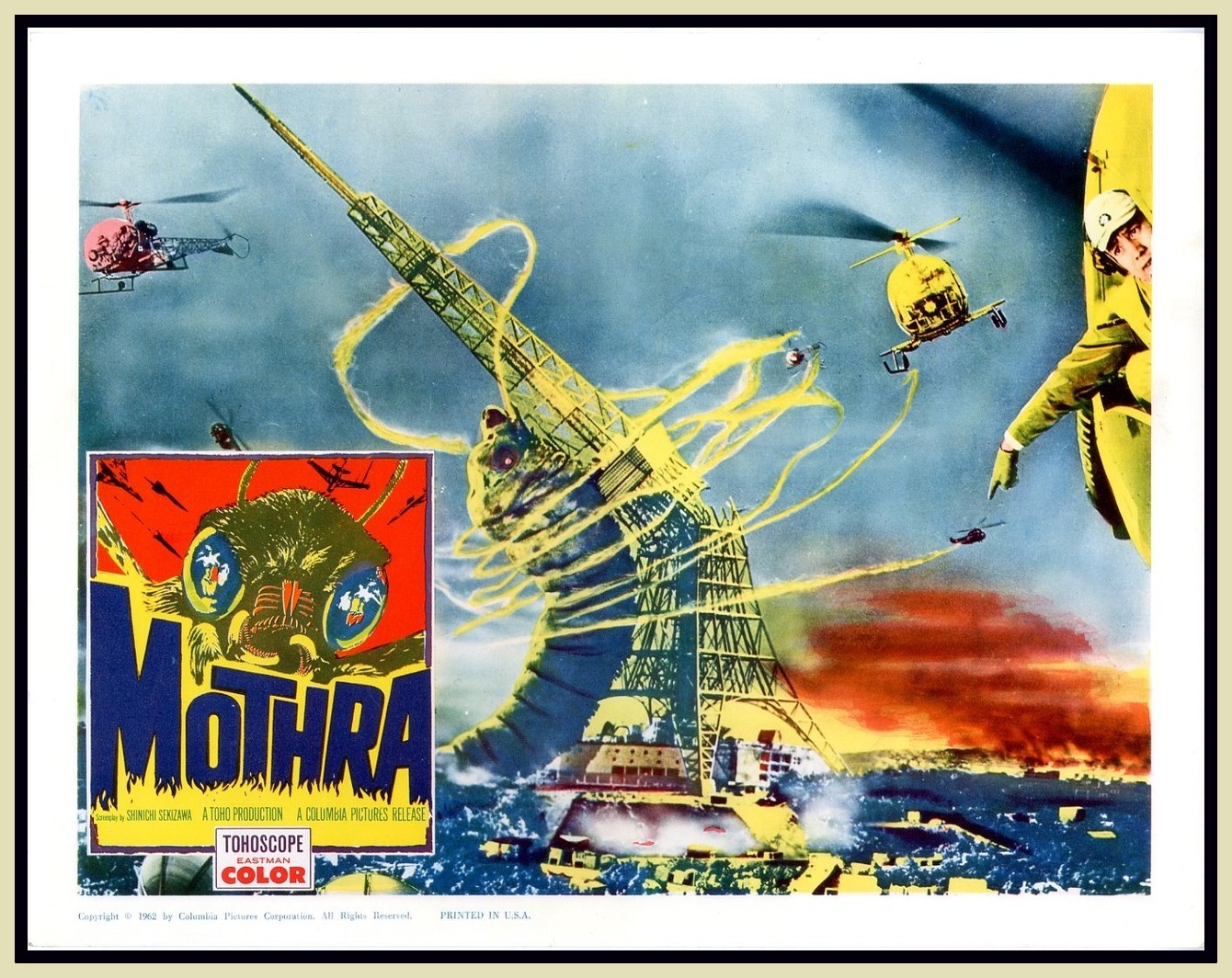
MOTHRA: MIGHTIEST MONSTER IN ALL CREATION : LOBBY CARD GALLLERY AND REVIEW

CAST:
Franky Sakai (Senichiro Fukuda), Jerry Ito (Clark Nelson), Hiroshi Koizumi (Dr Chujo), Kyoko Kakagawa (Michi Hanamura), Emi Itoh & Yumi Etoh (The Aielenias), Ken Uehara (Dr Harada) 

US Version:
Director – Lee Kresel, Screenplay – Robert Myerson, Producer – David B. Horne

PRODUCTION:
Director – Inoshiro Honda, Screenplay – Shinichi Sekizawa, Story – Takehiko Fukunaga, Yoshie Hotta & Shinichiro Nakamura, Producer – Tomoyuki Tanaka, Photography – Hajime Koizumi, Music – Yuji Koschi, Special Effects – Eiji Tsuburaya, Art Direction – Kimer Abe & Takeo Kita. Production Company – Toho. Japan. 1962.


SYNOPSIS:
After a ship is wrecked at sea by a typhoon, the survivors are found on an island that was once the site of atomic tests. When asked how they came to be unaffected by the radiation, they say it is because the natives gave them a special juice. The authorities are surprised because it is believed that the island was deserted. The scheming entrepreneur Clark Nelson then announces an expedition to investigate. On the island, Nelson and his team of scientists discover two six-inch tall twin sisters. Nelson captures the twins and takes them back to Japan where he turns them into curiosity exhibits on the stage. Two reporters try to persuade Nelson to heed the sisters’ warnings about the vengeance of the island’s guardian Mothra, a giant-sized moth that is telepathically linked to the twins. Mothra now hatches from its cocoon and heads to Tokyo to rescue its handmaidens, its wings creating vast winds that destroy all in its path.


COMMENTARY:
The Japanese monster movie (the kaiju eiga) had begun with enormous success with Godzilla, King of the Monsters (1954). Godzilla spawned an industry that has included 28 sequels and is still going strong five decades after the original came out. There were a huge number of imitators from Japan and other Asian countries. For a few years after Godzilla, Toho tried to create other screen monsters with the likes of Rodan the Flying Monster (1956), Varan the Unbelievable (1958), Gorath (1962), Attack of the Mushroom People/Matango the Fungus of Terror (1963), Dogora the Space Monster (1964) and Frankenstein Conquers the World (1966). Mothra was the most successful of these and is the only other Toho film to have spawned its own remakes and sequels. Godzilla still remained Toho’s most lucrative franchise and almost all of the creatures in the above-listed films were eventually pitted up against it. Indeed, Mothra became the first monster from another Japanese film to take on Godzilla in Godzilla vs the Thing (1964). One suspects the reason that Mothra stood out from the other Japanese monsters is that it has more distinctive personality in comparison to any of the other monsters – where Godzilla was a naked force of aggression, Mothra is clearly a more sympathetic feminine force who is identified with nature, with her rampage being more genteel and less intentionally destructive and angry.


Mothra is one of the best Japanese monster movies from the 1950s-70s period and the next best effort that director Inoshiro Honda put out after the original Godzilla. While most of the later kaiju eiga towards the end of the 1960s and especially into the 70s descended to cheap effects and became increasingly juvenile in focus, Mothra is one entry that clearly strives to transcend this. The scenes of model destruction with the Mothra larva rampaging across the countryside and then its emergence in winged form are especially good. Most importantly, the special effects scenes are built into a strong story. At its oddest, Mothra becomes a fairy-tale of the bizarre, where the eye-poppingly attractive Tohoscope colour and the array of exotic dancers, psychedelic jungles and the miniature twin sisters creates a marvellously colourful world all unto itself. The film holds some incredible beautiful images at times – like the emergence of Mothra from its cocoon, spreading its wings and taking to the sky; or a montage that combines the image of the sisters crossing a wire on a model coach with scenes of the Mothra larva duck-diving through the ocean, all scored to the girl’s inhumanly beautiful voices. Even the depiction of a bombing run becomes something magnificently lyrical.


The underlying metaphor is of course the same old atomic bomb fears that informed Godzilla. The country of Rellisica in the story becomes a thinly disguised stand-in for the US, something that is even further emphasised by the inserts shot for the English-language print that clearly include American freeways. (In the original Japanese print, Rellisica was meant to sound like a combination of Russia and America). One can notice a decided uneasiness in Japan’s viewing of US relations – Rellisica seen as wielding both a sinister economic influence over Japan and yet comfortingly able to step in with military aid at a moment’s notice.


Mothra subsequently encountered Godzilla in Godzilla vs the Thing (1964). With the successful revival of Godzilla franchise in the 1990s using better visual effects and animatronics, this was remade as Godzilla vs Mothra (1992). Mothra was subsequently revived for a trilogy of films Rebirth of Mothra (1996), Rebirth of Mothra II (1997) and Rebirth of Mothra III (1998). Mothra also encountered Godzilla in Ghidrah the Three-Headed Monster (1964), Godzilla Vs the Sea Monster (1966), Destroy All Monsters (1968), Godzilla vs Space Godzilla (1994), Godzilla, Mothra and King Ghidorah: Giant Monsters All-Out Attack (2001), Godzilla: Tokyo SOS (2003) and Godzilla: Final Wars (2004).


Inoshiro Honda’s other genre films include:- Godzilla, King of the Monsters (1954), Gigantis the Fire Monster/Godzilla Raids Again/The Return of Godzilla (1955), Rodan the Flying Monster (1956), The Mysterians (1957), The H-Man (1958) about a radioactive blob that can dissolve people, the Yeti film Half-Human (1958), Varan the Unbelievable (1958), the space opera Battle in Outer Space (1961), the space opera Gorath (1962), King Kong vs Godzilla (1962), Atragon (1963) about a super-submarine, Attack of the Mushroom People/Matango, Fungus of Terror (1963), Godzilla vs the Thing/Mothra vs Godzilla (1964), Dagora the Space Monster (1964), The Human Vapor (1964) about a gaseous villain, Ghidrah the Three-Headed Monster (1964), Monster Zero/Invasion of the Astro Monster (1965), Frankenstein Conquers the World (1966), War of the Gargantuas (1966), King Kong Escapes (1967), Destroy All Monsters (1968), Godzilla’s Revenge (1969), the submarine adventure Latitude Zero (1969), Yog – The Monster from Outer Space (1970) and Terror of Mechagodzilla/Monsters from an Unknown Planet (1976) 


Friday, 5 April 2013

DO YOU BELIEVE IN REINCARNATION? AUDREY ROSE: ANTHONY HOPKINS SUSAN SWIFT: GALLERY AND REVIEW


CAST:
Marsha Mason (Janice Templeton), Anthony Hopkins (Elliot Hoover), John Beck (Bill Templeton), Susan Swift (Ivy Templeton), Norman Lloyd (Dr Steven Lipscomb), Philip Sterling (Judge Harmon Langley), Robert Walden (Brice Mack), John Hillerman (Scott Velie) 

PRODUCTION:
Director – Robert Wise, Screenplay/Based on the Novel by Frank De Felitta, Producers – Frank De Felitta & Joe Wizan, Photography – Victor J. Kemper, Music – Michael Small, Special Effects – Henry Millar Jr, Production Design – Harry Horner. Production Company – United Artists. 


SYNOPSIS:
Bill and Janice Templeton become concerned about a stranger who keeps following and calling them and sends presents to their 11 year-old daughter Ivy. The stranger introduces himself as Elliot Hoover and tells them how he has come to believe following a trip to India that Ivy is the reincarnation of his daughter Audrey Rose who was killed in a car crash the same day that Ivy was born. He is able to calm Ivy’s recurrent nightmares down by calling her Audrey Rose. Hoover then abducts Ivy but is arrested. His subsequent attempts to argue a case for reincarnation at his trial become a cause celebre.


COMMENTARY:
Rosemary’s Baby (1968) gave birth to an enormous cinematic occult horror boom in the 1970s. The boom spawned such successes as The Exorcist (1973), Carrie (1976) and The Omen (1976), each of which propagated their own subgenres of imitators. Audrey Rose came near at the end of that cycle when the genre had successfully established itself among A-budget films and where the theme of evil and/or possessed children was its overriding subject.


Both the film of Audrey Rose and the 1975 Frank De Felitta book it is based on give the feeling of a story that wanted to be something more serious that instead ended up pigeonholed in the horror genre. Screenwriter/original novelist De Felitta’s other works show him as a writer who wants to deal with the supernatural as real (or at least the sort of supernatural that becomes the stuff of tabloid magazines – reincarnation, hauntings, ghost rapes). His novel was set up toward the purpose of placing an argument for reincarnation on a courtroom stand, which must surely stand as the ultimate arbiter of Western rationalism. (In reality though, the case presented here probably would be thrown by any court – whether or not Ivy is the reincarnation of Hoover’s daughter is surely irrelevant, the only thing a court is interested in is the issue at hand – whether or not Hoover abducted Ivy). The film does change the balance of the book somewhat. In the book, the court case took up nearly three-quarters of the story but in the film the court case is reduced to only two or three showcase arguments and presented with considerable bias – no contrary arguments doubting or questioning reincarnation are ever highlighted from the prosecution’s side, for instance.


The film cannot escape the basic fact that it is burdened by a wordy and static script. This however does lead to a unique approach from director Robert Wise who uses the dialogue itself as suspense. Wise hypnotically engages us in Anthony Hopkins’s monologues, where one becomes so enrapt that even small movements like the spilling of a teacup or the relatively uninteresting shot of a door opening behind someone eavesdropping on a conversation is made to hold suspenseful power. There are some effective scenes – particularly the one with burns suddenly appearing on Susan Swift’s hands when she places them on a cold window. However, try as Robert Wise might to turn Audrey Rose into an interesting dramatic film, the material remains solidly unmoving.


The first half of the film, set around Hoover’s bizarre intrusion into the family digs into the 1970s Stranger Danger peril. Hoover’s actions are designed with the intent of making the family anxious – their being followed, anonymous phone-calls, mysterious presents left, the child being abducted from school and from the apartment – without any thought placed into why the otherwise relatively rational Hoover is behaving so creepily. When we come to understand where the character is coming from later in the film, such furtive actions fail to make sense. The film’s generation of Stranger Danger paranoia is ironically so effective that it becomes almost impossible to view Hoover’s motivations normally and it is only through turning of him into a passive wimp for the rest of the film and Anthony Hopkins’s performance that the character succeeds in retaining any sympathy. Far better at engendering sympathy is Marsha Mason who gives an enormously convincing performance in what is essentially a passively handwringing role. Young Susan Swift also manages to comes across as mature and intelligent.


Robert Wise directed a number of classic films including Run Silent, Run Deep (1958), West Side Story (1961) and The Sound of Music (1965). Wise’s other genre films are:– The Curse of the Cat People (1944) and The Body Snatcher (1945), two classic psychological horror films made for Val Lewton; the human hunting film A Game of Death (1945); the alien visitor classic The Day the Earth Stood Still (1951); the haunted house classic The Haunting (1963); the Michael Crichton adaptation The Andromeda Strain (1971) and Star Trek – The Motion Picture (1979).


Screenwriter Frank De Felitta has a number of other genre credits. He wrote and produced the overpopulated future film Z.P.G. (Zero Population Growth) (1971); directed/wrote the tv movie Trapped (1973) about a man hunted through a department store by dogs; directed/wrote the supernatural time travel tv movie The Two Worlds of Jennie Logan (1979); directed the American Gothic tv movie The Dark Night of the Scarecrow (1981); wrote the interesting ghost story The Entity (1982); and directed/wrote the worthwhile psycho-thriller Scissors (1991).  

Review:HERE
Images: Marcus Brooks 

Tuesday, 2 April 2013

THE UK PETER CUSHING APPRECIATION SOCIETY INVITES YOU TO CELEBRATE CENTENARY


Now celebrating Peter Cushing Centenary Year: The UK Peter Cushing Appreciation Society founded in 1956, now on Facebook Fan Pages. Updated every day with features, interviews and rare images. Our aim is to celebrate the life and career of Peter Cushing. OBE. Over 4,500 images and 200 albums we invite you to browse! Please join us! HERE

Sunday, 31 March 2013

THE REPTILE: HAMMER FILMS : LOBBY CARD SET

CAST:
Ray Barrett (Harry Spalding), Noel Willman (Dr Franklyn), Jennifer Daniel (Valerie Spalding), Jacqueline Pearce (Anna Franklyn), Michael Ripper (Tom Bailey), John Laurie (Mad Peter Crockett), Marne Maitland (Malay)
PRODUCTION:
Director – John Gilling, Screenplay – John Elder [Anthony Hinds], Producer – Anthony Nelson Keys, Photography – Arthur Grant, Music – Don Banks, Music Supervisor – Philip Martell, Special Effects – Bowie Films, Makeup – Roy Ashton, Production Design – Bernard Robinson. Production Company – Hammer/Seven-Arts.
SYNOPSIS:
Harry Spalding, a captain in the Royal Grenadiers, inherits a cottage in a small Cornish village after his brother Charles dies in mysterious circumstances. He moves into the cottage with his wife Valerie. Harry discovers that several locals have been killed by mysterious snake bites. This is also found to have been the cause of Charles’s death. The origin of the snake killings appears to rest with Dr Franklyn who lives in the village mansion. As Harry investigates, he discovers that these are being caused by Franklyn’s daughter Anna who was abducted by a snake cult that Franklyn was researching in Borneo and that she now periodically transforms into a snake creature.


Wednesday, 27 March 2013

'WHATEVER HAPPENED TO BABY JANE?' : LOBBY CARD GALLERY AND REVIEW


CAST:
Bette Davis (Jane Hudson), Joan Crawford (Blanche Hudson), Victor Buono (Edwin Flagg), Maidie Norman (Elvira Stitt), Anna Lee (Mrs Bates), Marjorie Bennett (Della Flagg)


PRODUCTION:
Director/Producer – Robert Aldrich, Screenplay – Lukas Heller, Based on the Novel by Henry Farrell, Photography (b&w) – Ernest Haller, Music – Frank DeVol, Special Effects – Don Steward, Makeup – Monty Westmore, Art Direction – William Glasgow. Production Company – Associates and Aldrich/Seven Arts.  USA. 1962.  


SYNOPSIS:
It is 1917 and Jane Hudson is an enormously popular variety show child star. She is able to get anything she wants and throws tantrums when she does not get it. She is envied by her sister Blanche who vows to one day get even. Blanche’s opportunity comes in the 1930s when she becomes a Hollywood star and Jane is a has-been who has sunken into alcoholism. As the two sisters drive back from a party one night, one gets out to open the gate and the other slips the car into gear and drives forward at them. The accident leaves Blanche paralysed from the waist down. Thirty years later, Jane is left tending the wheelchair-ridden Blanche. However, Jane’s sanity has snapped and she cruelly tortures the helpless Blanche, keeping her imprisoned and feeding dead rats and her pet bird up to her.


COMMENTARY:

With the exception of Psycho (1960) and to a lesser extent Les Diaboliques (1955), What Ever Happened to Baby Jane? is the film that had the greatest influence on the prolific psycho-thriller genre of the 1960s. It gave an entirely new impetus to the flagging careers of Joan Crawford and Bette Davis, both former Hollywood stars beyond their glory years who subsequently found new careers in horror movies. Indeed, What Ever Happened to Baby Jane?, with its sight of former Hollywood stars over the hill and going round the bend, created a lurid pseudo-tabloid sub-genre of Grand Guignol Hollywood self-devouring (one that had its antecedent in Gloria Swanson’s swan song, Sunset Boulevard (1950), which was almost a horror film). What Ever Happened to Baby Jane? was followed by a cycle of Grand Guignol psycho films featuring over-the-hill female stars – Olivia De Havilland appeared in Lady in a Cage (1964), Tallulah Bankhead in The Fanatic/Die, Die My Darling (1965), Eleanor Parker in Eye of the Cat (1969), Shelley Winters in What’s the Matter with Helen? (1971) and Who Slew Auntie Roo? (1971), Ruth Roman in The Baby (1972), Lana Turner in Persecution (1974), while both Bette Davis and Joan Crawford appeared in several lookalike films – Davis in Hammer’s The Nanny (1965) and The Anniversary (1968), and Crawford in Strait-Jacket (1964), I Saw What You Did (1965) and Berserk (1968). Indeed, Joan Crawford’s own life story was even turned into a Batty Old Dames film of sorts with Mommie Dearest (1981).


When What Ever Happened to Baby Jane? came out, a large part of its success was the shock of seeing the two former stars reduced to monsters. The horror in the film fails to translate so well to today’s teen and twentysomething audiences who often find the film dated and ludicrous because they are not conversant with the film’s context – that it represented a shock trashing of two of the icons of Hollywood glamour in the 1940s. Bette Davis in particular shocked everybody with her completely over-the-top performance. It is a real theatre-rattling barnstormer of a delivery that she gives – and one that garnered her a Best Actress Academy Award nomination. She goes totally bonkers and the results are fascinatingly grotesque to watch. The scene where she in cracked, gargoyle makeup sings a song I’ve Written a Letter to Daddy in a cracked, girl-like voice is a masterpiece of the memorably bizarre and twisted.


Joan Crawford’s fine performance was not unexpectedly overshadowed by Bette Davis but is one that elicits a good deal of pained sympathy. Although such is something that the film seems to misunderstand. The final twist in the ending mutes the horror – seeming to imply that we should forgive Jane for what she has done as Blanche deserved it. A good deal of the venom between the characters was apparently something that existed between the two actresses in real-life with both delighting in spitefully nasty games of one-upmanship on the other on set – there was even a book written about such Bette and Joan: The Divine Feud (1989) by Shaun Considine. The irony that only came out in later years is that the roles were uncommonly close to the truth upon the parts of both actresses – Joan Crawford and Bette Davis were both utterly vain, particularly when it came to their own celebrity, both abused their own family members and both had daughters who wrote books about the cruelty of their parents.


Director Robert Aldrich has the power to shock at his disposal – the dead rat scene always has gross-out impact. There are the odd moments of suspense – the move down the stairs and the balled-up note – although there are also times when the film seems talky, almost too stagy, and needs more drive and tension. Indeed, What Ever Happened to Baby Jane? is a film whose effect lies with the barnstorming theatrics of its two stars rather than as a straight psycho-thriller. (It would make a very interesting revival as a stage play). There is fine black-and-white photography, which only serves to bring out the deliberately unglamorous making-up of its two stars. The other Academy Award nominee among the cast was Victor Buono as Supporting Actor – there is a sly amusement to the scenes with his mother and a piquant charm to his clumsy English mannerdness in the scenes with an outrageously flirting Bette Davis. In recent years, What Ever Happened to Baby Jane? has gained the status of a gay cult classic because of its campy over-acting.


The film was later blandly remade as a tv movie What Ever Happened to Baby Jane? (1991), which was executive produced by Robert Aldrich’s son William. In a piece of freakish stunt casting, the Joan Crawford and Bette Davis roles were played respectively by real-life sisters Vanessa and Lynn Redgrave.


Robert Aldrich later returned with Bette Davis (and it was originally intended Joan Crawford who quit/was fired in mid-production because of the rivalry with Davis) in a follow-up of sorts Hush ... Hush, Sweet Charlotte (1964), which is a much better film, if not as famous. Also of interest is Robert Aldrich’s The Killing of Sister George (1968), which returns to the same Hollywood Grand Guignol as What Ever Happened to Baby Jane? although is not a horror film, and his The Legend of Lylah Clare (1969), where a producer attempts to turn Kim Novak into a replica of his dead wife, which hovers for a time on the edge of being a ghost story. In the Hollywood Guignol stakes, Aldrich also produced a further Batty Old Dames psycho film What Ever Happened to Aunt Alice? (1969) and Bert I. Gordon’s Picture Mommy Dead (1966) where the spirit of Zsa Zsa Gabor haunts her daughter from out of a painting. Robert Aldrich had a celebrated career that stretched between the 1950s and 1980s, making films such as The Dirty Dozen (1967), The Longest Yard (1974) and The Choirboys (1977). He made several other films of genre interest, including the quasi-sf Mickey Spillane adaptation Kiss Me Deadly (1955), which is perhaps one of the finest of all Hollywood film noirs, and the nuclear missile silo hijacking thriller Twilight’s Last Gleaming (1977).


Novelist Henry Farrell, whose 1960 novel the film was based on, also developed a film career as a result of What Ever Happened to Baby Jane?. Farrell furnished the script for Robert Aldrich’s Hush ... Hush, Sweet Charlotte, the novel for the Curtis Harrington-directed Baby Jane copy How Awful About Allan (1970) and the script for Harrington’s What’s the Matter with Helen? (1971), as well as scripts for two tv movies, the haunted house drama The House That Would Not Die (1970) and the clairvoyance thriller The Eyes of Charles Sand (1972). 
       

Saturday, 23 March 2013

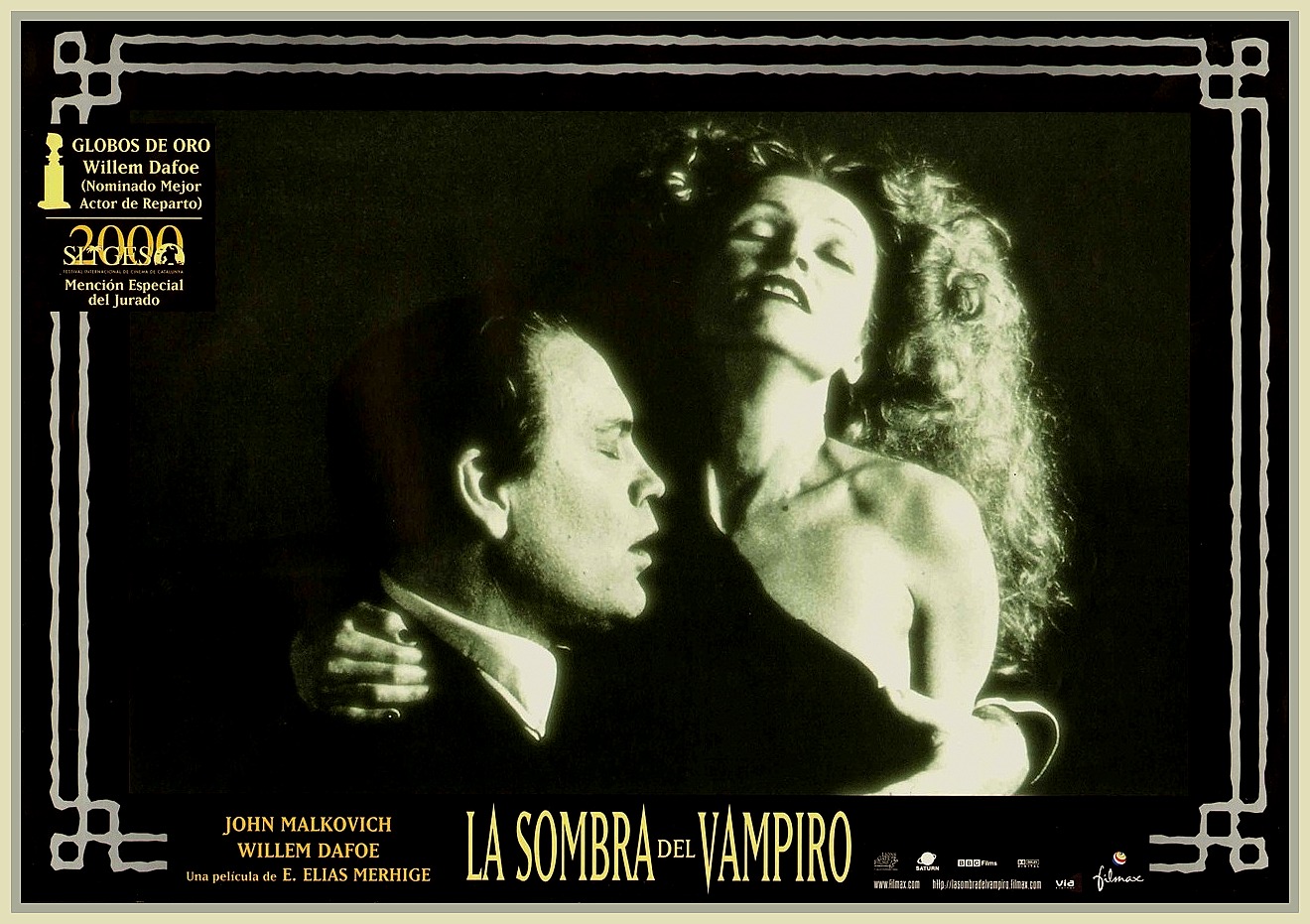
SERIOUSLY SHRIEKY: WILLEM DEFOE PLAYS SHRECK IN SHADOW OF THE VAMPIRE: REVIEW AND LOBBY CARD GALLERY


CAST:
John Malkovich (Friedrich Wilhelm Murnau), Willem Dafoe (Max Schreck), Cary Elwes (Fritz Arno Wagner), Udo Kier (Albin Grau), Catherine McCormack (Greta Schroeder), Robert Aden Gillett (Henrik Galeen), Eddie Izzard (Gustav von Waggenheim), Ronan Vibert (Wolfgang Muller) 

PRODUCTION:
Director – E. Elias Merhige, Screenplay – Steven Katz, Producers – Nicolas Cage & Jeff Levine, Photography (colour & b&w) – Lew Bogue, Music – Dan Jones, Digital Effects/Titles – Cine Image, Special Effects Supervisor – Rick Weissenhaan, Makeup – Pauline Fowler & Julian Meriya, Production Design – Assheton Gordon. Production Company – Saturn Films/Long Shot Films/BBC Films/Deluxe Productions/Shadow of the Vampire Ltd.  USA/UK/Luxembourg. 2000.


SYNOPSIS:
In 1921, the brilliant, highly acclaimed German film director Friedrich Wilhelm Murnau seeks to make the greatest and most realistic vampire film of all time. He calls his film ‘Nosferatu’ after Bram Stoker’s widow refuses him permission to film ‘Dracula’. He takes his crew to the small town of Wismar. In the role of the vampire, Murnau employs an actor called Max Schreck who is so much of a character actor that he even appears in his own makeup. The unnerved crew soon discover that Schreck is a real vampire and that Murnau has promised him leading lady Greta Schroeder to feed upon at the end of shooting. 


COMMENTARY:
Shadow of the Vampire was announced immediately after the critical success of Gods and Monsters (1998), which was based on the life of the real-life genre director James Whale. Indeed, the initial pitch for Shadow of the Vampire had it sounding like it was a similar biopic of silent German director F.W. Murnau. Gods and Monsters was an honest attempt to speculate about true events surrounding Whale’s death. On the other hand, Shadow of the Vampire takes reality as a springboard for a What If story – in this case, what if F.W. Murnau shot Nosferatu (1922) using a real vampire?


The important difference between the two is to realize that Shadow of the Vampire is a work of fiction, not of historical accuracy, even though it mimics such. Max Schreck, although the character has attained a certain creepy mythology, was a real flesh and blood actor and did not die in 1921 as is stated here but went on to make some twenty other films over the next decade up until his death in Munich in 1936 of a much more mundane heart-attack. Nor were screenwriter Henrik Galeen and cinematographer Fritz Arno Wagner killed as depicted in the film – Henrik Galeen went onto write other fantastic classics such as Waxworks (1924), became a director with the remakes of The Student of Prague (1926) and Alraune (1928) and died in 1949 after emigrating to the US to flee the Nazis, while Fritz Arno Wagner filmed more than 100 films including such Fritz Lang classics as Spies (1928), M (1931), The Testament of Dr Mabuse (1933) and did not die until 1958.


There are a few other inaccuracies – the film makes the claim that F.W. Murnau wanted to make the “most realistic vampire film of all time” – but as there had been no other vampire films made before Nosferatu, it seems difficult to make such a qualitative statement. Shadow of the Vampire also calls F.W. Murnau the greatest filmmaker of the German silent era (which is probably true) but most of Murnau’s reputation came as a result of Nosferatu and with later films such as The Last Laugh (1924), Faust (1926) and particularly Sunrise (1927). The film’s characterization of Murnau as a reckless tyrant obsessed with his art to the extent he is prepared to sacrifice human life also verges on the libellous. However, as long as one can get the proper perspective, one can enjoy Shadow of the Vampire for exactly what it is – a work of historical fiction, not of accuracy.


As such, Shadow of the Vampire is rather enjoyable. The sense of verisimilitude achieved is strikingly well done. Most impressive is the haunting and beautiful credits sequence all in a stylised three-dimensional recreation of 1920s art deco frescoes. Director E. Elias Merhige’s recreations of the camera set-ups of the original Nosferatu are striking in their exacting precision. There is almost a sense of watching the original Nosferatu and being able to stop the film you have just seen and walk around the edges of the frame to watch the filmmakers at work. Merhige is only too aware of the effect of this and starts to play into and against audience expectations – when it comes to the scene where Orlock picks up the locket with the photo of Johannes’s wife and Willem Dafoe playing Orlock picks it up and looks at the photo of Greta Schroeder who has been promised to him by Murnau, the expected line “What a beautiful throat” rather wittily comes out as “What a beautiful bosom.” The classic death scene with Ellen luring Orlock to her bed and keeping him until dawn is revealed in reality as being conducted by an actress who is too drug-addled to be able to wield the stake through the heart that was originally intended to be Orlock’s form of dispatch, while the film’s wonderfully cinematic death scene where Orlock is killed by the dawn’s rays is revealed as being Schreck’s death caused by the accidental opening of the set doors. 
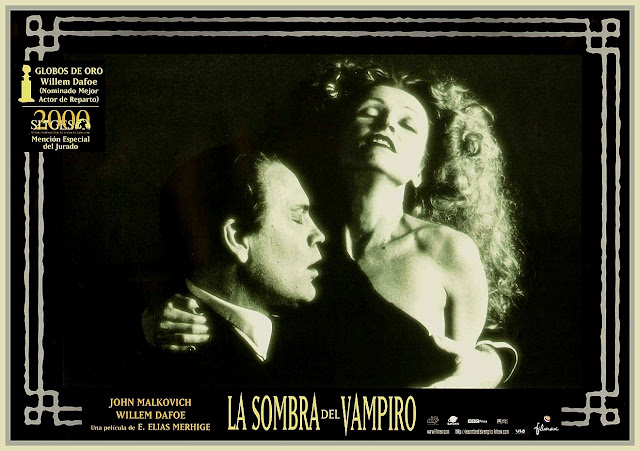

Steven Katz’s script pays exceptional attention to characters and E. Elias Merhige has an excellent cast on hand. Even the smaller parts in the film are filled with excellent, wonderfully nuanced characterizations – especially notable being Cary Elwes’s fine performance as the handsome, gung ho cameraman. Of course, the performance that had everyone talking and received a number of award nominations (the Golden Globes and the LA Film Critics Awards) is Willem Dafoe’s Max Schreck. It is a part where Willem Dafoe completely submerges himself in the role and is totally unrecognisble on screen. His performance has a creepy fascination, although is one that is very different to Max Schreck’s. This is a vampire cast as a pathetic and aged figure that has lost all former glory and lacks anything in the way of classic vampire movie magnetism, evil or dark sexuality. It is a performance considerably abetted by the extraordinary character soliloquies that Steven Katz provides – most haunting of all being the one where he tells how the saddest part of Dracula (1897) is the scene where we see Dracula forced to act as his own servant, a scene where we see the touching sense of an aristocrat (not Dracula, but Schreck) having been reduced to squalor.


Director E. Elias Merhige had previously made the extremely weird art film Begotten (1991) concerning a day in the life of God, who disembowels himself, and Mother Earth. Subsequently, Merhige went onto make the serial killer thriller Suspect Zero (2004). Screenwriter Steven Katz went onto write the ghost story Wind Chill (2007). 

REVIEW:HERE
IMAGES: Marcus Brooks

Friday, 22 March 2013

ANOTHER MILESTONE: SIX THOUSAND FOLLOWERS JOIN THE UK PETER CUSHING APPRECIATION SOCIETY FACEBOOK FAN PAGE


Great to announce that our PCASUK Fan Page has just hit another milestone with another thousand followers! Many thanks to everyone who have joined up in the last month and to everyone for your support and comments! JOIN HERE!
Related Posts Plugin for WordPress, Blogger...