RECENT POST FROM THE BLACK BOX CLUB

Sunday, 10 June 2012

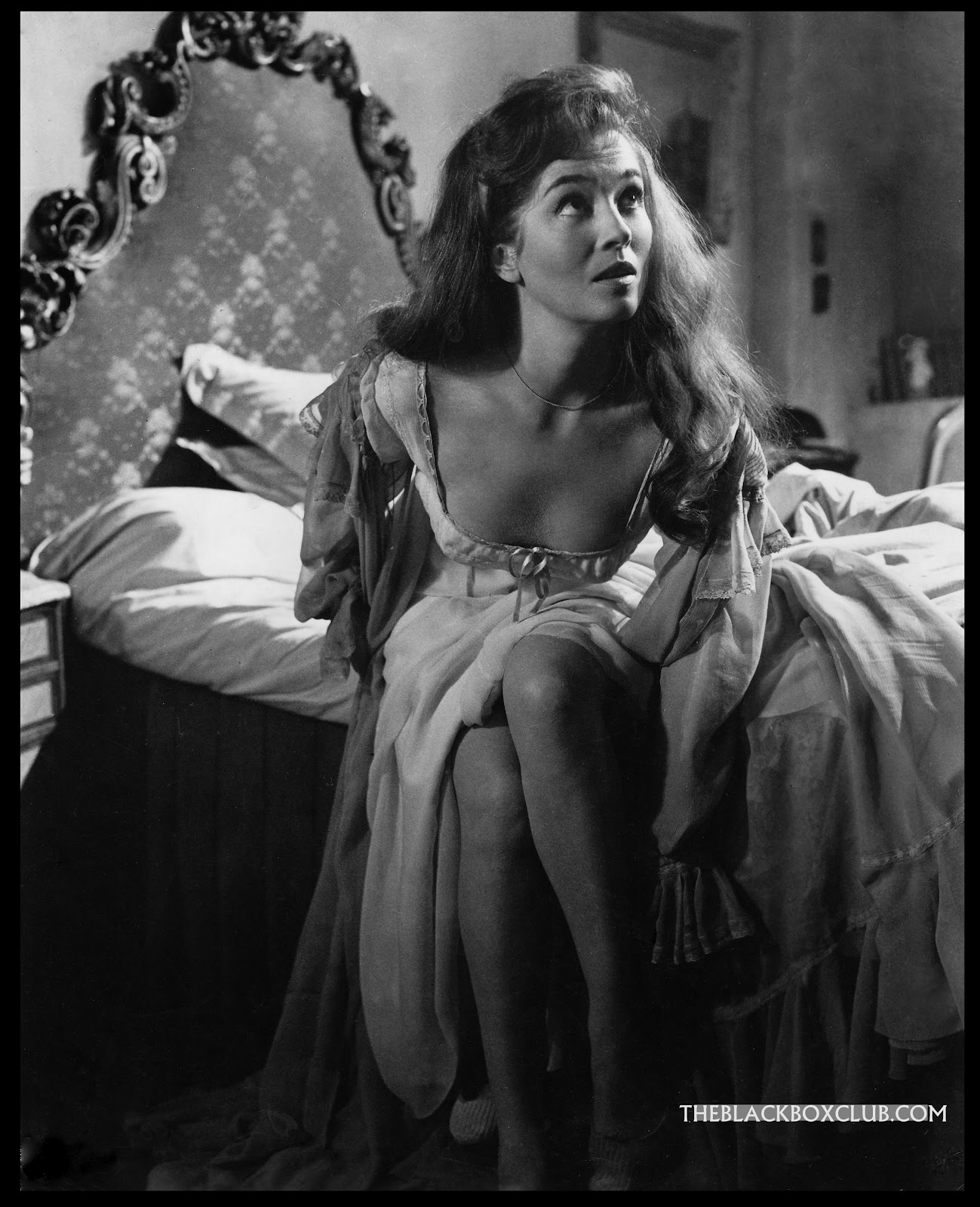
BARBARA SHELLEY AND ANDRE MORELL: 'THE SHADOW OF THE CAT' REVIEW AND STILLS GALLERY


During the 1950s and 1960s, Hammer Films sometimes lent out their facilities and crews at Bray to other independent producers, examples of this arrangement including Val Guest's Up the Creek (1958), Nathan Juran's Siege of the Saxons (1963) and Don Sharp's The Brides of Fu Manchu (1966). Occasionally, the studio would work as co-production partners on these ventures, either under the Hammer banner, or establishing a subsidiary company to accommodate the exercise, as was the case with Shadow of the Cat, made with Jon Pennington, a name normally associated with comedy vehicles.

Arguably the most notable aspect of Shadow of the Cat's production is the presence of director John Gilling. Gilling had worked as a screenwriter at Exclusive, and that company's later incarnation Hammer, from the end of the 1940s to the early 1950s, with titles like Francis Searle's The Man in Black (1949), Godfrey Grayson's Room to Let (1950) and Terence Fisher's Wings of Danger (1952) to his credit. He and the studio parted company sometime in 1952, reportedly in somewhat acrimonious circumstances.

In the intervening years, Gilling had worked as a writer and director, sometimes working in both capacities on the same production, on a varied collection of "quota quickies", among them Old Mother Riley Meets the Vampire (1952), The Gilded Cage (1954) and The Gamma People (1956). Most of these were made for Tempean Films, owned by Robert S. Baker and Monty Berman who, at the end of the 1950s, began producing genre items in the style of Hammer, often using employees from that company, notably Jimmy Sangster who wrote Henry Cass's Blood of the Vampire and Quentin Lawrence's The Trollenberg Terror (both 1958). In 1959 Gilling himself contributed the Peter Cushing gothic vehicle The Flesh and the Fiends, which is probably how he came to the attention of his erstwhile employers.

At first glance, much of Shadow of the Cat seems very familiar, notably the presence performers who are readily associated with Hammer Films, such as Barbara Shelley (The Gorgon (1964)) and Andre Morrell (She (1965)). Also, aficionados of the studio's output from this period will recognise Bernard Robinson's redressed sets from three Terence Fisher productions, The Hound of the Baskervilles (1959), Brides of Dracula (1960) and The Curse of the Werewolf (1961), while the music score from Greek composer Mikis Theodorakis (The Day the Fish Came Out (1967)) is very much the archetype associated with the company.


There are, however, a number of features contained within the work that tend to set John Gilling's picture from the standard Hammer fare. The most obvious is the decision (possibly economic) to shoot the film in monochrome, rather than the lurid EastmanColour, later TechniColor, favoured by the studio, the house style being set by Terence Fisher's two seminal works, The Curse of Frankenstein (1957) and Dracula (1958). In addition, cinematographer Arthur Grant (The Damned (1961)) makes striking use of deep-focus photography and low-angled camera positions, giving Bernard Robinson's sets the impression of being much larger in scale than their appearances in the Fisher ventures, frequently dwarfing the actors.

With the use of shadows and light also proving important in creating a strong visual setting for the movie, Gilling and his crew have moved some way from the naturalistic approach normally favoured by Hammer's other filmmakers, and instead have created an environment that has more in common with the expressionist style of cinema seen in the classic Universal Pictures horror pictures of the 1930s and 1940s, although the expressionism adopted for this work is nowhere near as delirious as that shown in something like Rowland V. Lee's Son of Frankenstein (1939).


Although there are of course exceptions, what is perceived as the Hammer formula for their gothic entries, usually involves frequent bouts of visceral action, together with well-timed shock effects. Shadow of the Cat proves to be a more low-key and deliberately paced affair which, in fact, helps to give more violent or physical scenes more impact, as evidenced by the brutal opening murder of Catherine Lacey (The Sorcerers (1967)) with a mallet, Freda Jackson meeting her death on a flight of stairs and Andre Morrell falling headlong into a giant cobweb.

American mystery writer George Baxt, who had previously worked as an uncredited script doctor on Terence Fisher's The Revenge of Frankenstein (1958), among others, and who scripted what is effectively the first Amicus production, John Moxey's The City of the Dead (1959), here reworks elements from two distinct literary traditions, the "old dark house" mystery, typified by John Willard's theatrical warhorse of a play, The Cat and the Canary, officially adapted four times for English-language cinema in 1921, 1927, 1939 and 1977, and 19th century gothic literature, especially that written by American author Edgar Allan Poe, whose works had recently undergone something of a revival with the success of the first of a sequence of adaptations from Roger Corman in Hollywood, The House of Usher (1960).


The allusions to Poe become apparent almost immediately, with Catherine Lacey seen reciting The Raven to her pet cat, Tabitha, in the film's opening scene. Surprisingly Tabitha is the breed of black cat favoured by Poe in his writing, rather a common-or-garden British tabby (hence the name), but it does fulfil the role of avenging spirit, or the embodiment of certain character's guilt and paranoia, depending on the viewer's point of view, and so connects with two of works from the author's canon, The Black Cat and, to a lesser extent, The Tomb of Ligeia, the latter filmed by Corman, using Hammer talent, in 1965.

Another possible influence on George Baxt's screenplay may be The Fall of the House of Usher. Dialogue implies that the Venable bloodline may be tainted in some way, as Andre Morrell's characters tells the inspector and the reporter that the family has suffered its fair share of scandals in the past. The housekeeper also remarks about the odd, malevolent atmosphere of the mansion that seems to go beyond the mere hostile presence of the cat.


With an obviously very aged portrait of Tabitha hanging in the building's attic, guarding a valuable secret, it is conceivable that the animal actually embodies the spirit of the house in some way, insinuating that it is alive in some way. The cat may not, in fact, be Ella's pet at all, but has rather taken on the role of protecting the head or owner of the house. This impression is underlined in a coda where a new family take over the property, the husband and wife already hatching a nefarious scheme involving their elderly patriarch (Kynaston Reeves, Fiend Without a Face (1958)), as Tabitha looks on.

While the elements taken from Edgar Allan Poe are certainly very important to the overall work, Baxt and John Gilling's real interest lies with the characters, especially the internecine plotting between the greedy relations.

Of course a film like Shadow of the Cat, where character interaction plays a pivotal role in the development of the plot, with dialogue being extensively used to convey information, the importance of the script and the performances should never be underestimated. Fortunately George Baxt's efforts are well served by an outstanding cast of character actors who bring the vicious scheming of the relatives vividly to life, and who give some wonderfully vitriolic dialogue ("Now that I've got that off my chest, I can at least pretend you're human!"), an extra edge.


Particularly notable performances come from Andre Morrell as the frozen-hearted patriarch, whose descent from arrogance to terrified paranoia, works so well because of the he underplays the part, rather than opting for the expected histrionics, while proving to be even more callous is his nephew, played as a particularly slimy individual by William Lucas (X the Unknown (1956)). Frequently descending into quite rampant hamming the more her housekeeper character unwinds, Freda Jackson (Die, Monster, Die! (1965)) does at least grab the viewer's attention.

Barbara Shelley's character, meanwhile, is initially presented as demure, but is later revealed to have a rather haughty side, with a gently mocking tone in her voice, which she uses most efficiently against her uncle and his family. She proves to be an intelligent, resilient woman, not prone to screaming uncontrollably at the sight of a dead body, unlike her cousin Louise (Vanda Godsell, The Earth Dies Screaming (1963)), who despite creating a first impression of being calm and collected, soon succumbs to the atmosphere in the house, in particular the taunting of the cat. Beth also proves very intuitive in determining that something terrible has befallen her aunt, and that her husband has something to do with it. On the basis of this film, it is easy to see why Shelley's screen presence was considered such an important asset by Hammer.

Although Conrad Phillips (Circus of Horrors (1959)) makes for a rather bland leading man, as the suspicious reporter and romantic interest, there are compensations in some of the minor roles, such as that of the inspector (Alan Wheatley, Spaceways (1953)) and John Dearth as a local bobby seen trying to tempt the cat with some sardines, but instead munching them himself.

Seemingly wanting to impress his old employers, director John Gilling goes out of his way to inject Shadow of the Cat with a real sense of style, with a highly mobile camera, notably in the film's opening scene, beginning with a close-up of a portrait and tracking back past a will seen lying on a desk, through the attic to rest at the bottom of a flight of stairs, where Catherine Lacey is seen reading, and the final confrontation between Edgar (Richard Warner, Village of the Damned (1960)) and the cat in the same location, Gilling here employing not only camera tracks, but rapid pans and hand-held shots. The director and Arthur Grant also make use of very tight and strikingly composed static images, often involving the position of performers within the frame and against their environment. Overall, his direction is never less than highly imaginative.

Interestingly, while Gilling proves highly adept with the plot's more macabre moments, including a withered hand shown protruding from beneath the ground, Andrew's mud-caked corpse being dragged from the swamp, and the cat crawling painfully slowly up a petrified Andre Morrell's bed toward his face (seen from the animal's point of view by way of very effective optical distortion), some lighter scenes are among the film's most impressive. Among these are the conspirators gleefully celebrating the capture of Tabitha in a wire cage, and an elated Andrew skipping through the wood with a sack containing the cat, accompanied by a jaunty piece of music from Mikis Theordorakis.


The climax of the picture has Edgar managing to locate the lost will behind the painting of the cat, and then lashing out at her, before being crushed under some masonry. Again there is the suggestion that the house only appears unstable, and is instead protecting itself and its avatar, the cat, by physical means, again another allusion to Poe and other gothic writers.


B.H.P films apparently became a separate entity, removed from Hammer, after this production, with at least two films appearing under its banner, none of them connected to the studio, Roy Ward Baker's Anglo-Italian war adventure The Valiant (1962), produced by Jon Pennington, and Cliff Owen's adaptation of the British stage farce No Sex Please, We're British (1973).

John Gilling continued to work for Hammer as a director and/or writer throughout the 1960s, providing scripts for such productions as Terence Fisher's The Gorgon (1964), and helming movies like The Reptile and the minor classic The Plague of the Zombies (both 1966), before quitting the industry at the end of the decade and relocating to Spain. There, he made a single film, the rarely seen La cruz del Diablo (1973), retiring shortly after to concentrate on painting.


Review: Iain McLachan
Images: Marcus Brooks

Thursday, 7 June 2012

MARTINE BESWICK: SLAVE GIRLS / PREHISTORIC WOMEN HAMMER FILMS 1967 REVIEW AND STILLS GALLERY PART ONE.

While One Million Years B.C. spawned a plethora of copy cats, not even Hammer itself could seem to recreate the cult success of Raquel Welch in an animal skin bikini.  Hammer's multiple attempts at regaining the cult status in some of it's "prehistoric" adventure films didn't seem to pan out too well. One such film was Slave Girls, filmed with the title Prehistoric Women, produced in succession with and completed prior to One Million Years B.C. made use of it's costumes and one of its supporting cast members, Martine Beswick, yet was not able to gain the same cult status.
Prehistoric Women is a story about a jungle guide named David Marchand, who finds himself transported back in time after trespassing onto dangerous native tribes land, those who worship the seemingly extinct white rhino.  Marchand is captured by a group of lovely dark haired beauties, with their leader Kari wishing him to be her new boy toy, he refuses and finds himself locked away with the rest of the men.  But the men aren't the only slaves of this tribe, all blondes are slaves as well and are regularly bartered off as  peace offerings to the savages who live out in the wildness of the open jungle. Marchand quickly falls in love with one of these blonde beauties named Saria, together they plan to overthrow Kari and her followers in hopes of bringing equality back to the tribe and ridding themselves of her bonds and the fear of the savages that terrorize them.
Prehistoric Women follows the similar plot of When Dinosaurs Ruled The Earth, with the main aspect of the film being the oppression of blondes.  But where that film sorely lacked, Prehistoric Women managed to get right.  First off I believe this is the only Hammer prehistoric film to actually incorporate English dialogue which was a blessing.  There's nothing worse than watching a boring film that has no dialogue.  Second there's hardly any men seen in the film.  When watching a film based in the period of loin cloths the last thing I want to see (as a man) is half naked men walking about in the jungle, so a film entitled Prehistoric Women seemed to guarantee very little of that, and provide more of the only thing that was even remotely good about When Dinosaurs Ruled The Earth.
With my only comparison at this time being When Dinosaurs Ruled The Earth, Prehistoric Women easily stands as the victor.  The story is mediocre and at times extremely corny, but at least it's easy to follow, understand and enjoy, I couldn't say the same for the other film.  Both Martine Beswick and Edina Ronay played their roles quite well, and once again Hammer proves it's one of the best in terms of production value of even it's lowest budget films.  But most would not agree with me, in fact Prehistoric Women is regarded as one of Hammer's worst films.  Martine Beswick was even awarded "The Worst Hammer Film" award in 1994 at FANEX, and the authors of Hammer Films: An Exhaustive Filmography go as far to say it's an embarrassment to include it in their book!  Personally I think they're over reacting quite a bit, Prehistoric Women is far from the worst and I believe much more entertaining than some of Hammer's other fantasy endeavors.
Overall, I thought Prehistoric Women is a well fashioned compared to some of its counterparts and it's a shame that it never received the credit it was due.  Even though it was actually completed before One Million Years B.C. it was two years later before it was released in which time nearly twenty minutes was cut, and at which time it didn't garner much success or a very good reputation.  Even today it appears to be almost a forgotten memory in the franchise, there's not even much written about the film in most my small collection of Hammer reference books, and if anything is it's usually negative.  But even while it lays in the shadow of success of Hammer's prehistoric flagship One Million Years B.C., it's a film that's definitely worth checking out if your a fan of the genre, and in my opinon is probably the better of all of Hammer's prehistoric films.
A FULL GALLERY OF PUBLICITY PHOTOGRAPHS COMING TOMORROW IN 'SLAVE GIRLS' GALLERY TWO!
Images: Marcus Brooks
Review: Here

Saturday, 2 June 2012

SALLY GEESON: HILARY DWYER: 'GIRLS OF THE BANSHEE' A GALLERY OF ACTRESSES FROM THE 1971 FILM.


VINCENT PRICE: CRY OF THE BANSHEE : A REAL HOWLER? REVIEW AND STILLS GALLERY

CAST:
Vincent Price (Edward Whitman), Essy Persson (Harry Whitman), Hugh Griffith (Mickey), Elizabeth Bergner (Oona), Hilary Dwyer (Maureen Whitman), Patrick Mower (Roderick), Sally Geeson (Patricia Whitman)

PRODUCTION:
Director/Producer: Gordon Hessler, Screenplay: Tim Kelly & Christopher Wicking, Story: Kelly, Photography: John Coquillon, Music: Les Baxter, Makeup : Betty Blattner & Tom Smith, Art Direction: George Provis. Production Company: AIP. UK. 1970.
SYNOPSIS
The puritanical magistrate Edward Whitman puts the followers of the witch Oona to the death, although deliberately spares her. She swears vengeance for this and calls up a manifestation of the Devil in the guise of the young, handsome Roderick. Roderick proceeds to charm his way into Whitman’s family and starts killing them off, each death occurring as though by a wild animal.

COMMENTARY:
Cry of the Banshee was a drab effort from American International Pictures, which was made in England. At the time, AIP were riding on the success of Roger Corman’s Edgar Allen Poe films starring Vincent Price that had begun with The House of Usher (1960). They attempted to sell Cry of the Banshee as having an Edgar Allen Poe connection, even though there is no connection whatsoever beyond the quote on the credits.

In fact, Cry of the Banshee has more in common with the brief fad for witch persecutions films that came out after Matthew Hopkins – Witchfinder General/The Conqueror Worm (1968) (and which also starred Vincent Price and Hilary Dwyer and came promoted with a fake Edgar Allan Poe connection). AIP employed Poe series mainstay Vincent Price, while direction was handed over to Gordon Hessler, a regular hand who worked in the 1960s/70s Anglo-horror cycle (see below) and made two other loosely Poe-derived films The Oblong Box (1969) and Murders in the Rue Morgue (1971). The film itself was shot in England.
Cry of the Banshee is drab and extremely cheap looking. Patrick Mower’s transformations into a beast with glowing eyes have a cheapness that makes them come out rather ludicrous. The unconvincing plot fades away into a uniform drudgery and is overburdened with too many characters. The witchcraft seems an odd miscegenation of voodoo and classical Celtic mythology. Vincent Price plays with customary professionalism but gives a nondescript performance. The histrionic antics of witch Elizabeth Bergner trying to conjure up a demon are guaranteed to have one rolling on the floor. Nothing terribly interesting happens throughout. The saving grace of the film almost comes in the twist ending, which is directed with such fervidity that it nearly makes the preceding proceedings worthwhile.
One of the peculiar trivia notes about Cry of the Banshee are the credits, which come from later-to-be director Terry Gilliam in the same tinted photographic cutout style that Gilliam used to great success in his work with Monty Python. The film also fails to feature any banshees, which is traditionally meant to be an old hag that wails to foretell someone’ss death according to Irish folklore.

Gordon Hessler’s other films are:– Scream and Scream Again (1969), The Oblong Box (1969), Murders in the Rue Morgue (1971), the fantasy classic The Golden Voyage of Sinbad (1973), Kiss Meets the Phantom/Kiss in the Attack of the Phantom (1978) and The Girl in a Swing (1988). 


COMING LATER: GIRLS OF THE BANSHEE GALLERY OF PORTRAITS OF THE ACTRESSES FROM 'CRY OF THE BANSHEE'


REVIEW:Richard Scheib
IMAGES: Marcus Brooks  

JOAN FONTAINE: HAMMER FILMS: THE WITCHES: COLOUR GALLERY AND REVIEW

CAST:
Joan Fontaine (Gwen Mayfield), Kay Walsh (Stephanie Bax), Alec McCowen (Alan Bax), Ingrid Brett (Linda Rigg), Martin Stephens (Ronnie Dowsett), Gwen Ffangcorn-Davies (Granny Rigg), John Collin (Dowsett), Leonard Rossiter (Dr Wallis), Michele Dotrice (Valerie Creek), Duncan Lamont (Bob Curd), Carmel McSharry (Mrs Dowsett), Ann Bell (Sally Benson)

PRODUCTION:
Director – Cyril Frankel, Screenplay – Nigel Kneale, Based on the Novel The Devil’s Own by Peter Curtis [Norah Lofts], Producer – Anthony Nelson Keys, Photography – Arthur Grant, Music – Richard Rodney Bennett, Musical Supervisor – Philip Martell, Makeup – George Partleton, Production Design – Bernard Robinson. Production Company – Seven Arts/Hammer Films. UK. 1966.

SYNOPSIS:
Recovering from a nervous breakdown after being attacked during a native uprising at a mission school in Africa, Gwen Mayfield accepts a job as teacher in the sleepy English country village of Heddaby. She finds strange things happening around the village. Two of her pupils, teenagers Linda Rigg and Ronnie Dowsett, are attracted to one another but everybody seeks to keep them apart. Ronnie then has a mysterious accident and Gwen afterwards finds a voodoo doll with pins poked into it. Her insistence on trying to dig into what is happening uncovers evidence that Ronnie’s accident and other deaths may be being caused by witchcraft.


COMMENTARY:
The Witches, known as The Devil’s Own in the US – and not to be confused with the better known Nicolas Roeg-Roald Dahl adaptation The Witches (1990) – was one of the mid-period Hammer films. It is one of the usually overlooked Hammer films, featuring neither Christopher Lee, Peter Cushing, nor any of Hammer’s other regular directors and stars. Director Cyril Frankel made one other film for Hammer with Never Take Sweets from a Stranger (1960), as well as about a dozen other quota quickies, episodes of various British tv series and a couple of other films that border on genre territory with the stalker film The Very Edge (1963) and the Edgar Wallace adaptation The Trygon Factor (1966).


The one name of interest on the credits is that of scriptwriter Nigel Kneale, best known as the creator of the Quatermass tv series’ The Quatermass Experiment (1953), Quatermass II (1955) and Quatermass and the Pit (1958-9), all of which were adapted into films by Hammer with The Quatermass Xperiment/The Creeping Unknown (1955), Quatermass 2/The Enemy from Space (1957) and Quatermass and the Pit/Five Million Years to Earth (1967). (See below for Nigel Kneale’s other genre credits). The film was adapted from the novel The Devil’s Own (1960) by Peter Curtis, a sometimes pseudonym for British historical and thriller writer Norah Lofts. American actress Joan Fontaine, an Academy Award winner/nominee/winner for films like Rebecca (1940), Suspicion (1941), The Constant Nymph (1943) and with only one other genre appearance in the film version of Voyage to the Bottom of the Sea (1961), personally brought the book to Hammer as a starring vehicle for herself.


Purportedly, Nigel Kneale was not happy with the way the film ended up on screen, although it works well enough in its own sedate way. Apparently, Kneale was more interested in sending the witches up but this was watered down in the film’s final version. There still remains that that is characteristically Nigel Kneale’s writing. Kneale was frequently interested in digging beneath popular myth and belief in the supernatural to find a rational explanation – the idea of The Devil as an alien race memory in Quatermass and the Pit, of a scientific explanation for hauntings in The Stone Tape (1972) – and we see that in the scenes here where he tries to psychologically explain the appeal of witchcraft.


The Witches was probably the first occult film to take up the theme of aging witches/Satanists seeking to reincarnate in the bodies of children. This has since appeared in a number of other films, including the likes of Brotherhood of Satan (1971), Alison’s Birthday (1979), Doctor Sleep (2002) and with more scientific regard in Nothing But the Night (1972). The Witches was one of a spate of occult films made before the massive boom created a few years later by Rosemary’s Baby (1968), The Exorcist (1973) and The Omen (1976). Others from this spate of earlier occult films include Night of the Demon/Curse of the Demon (1957), Night of the Eagle/Burn, Witch, Burn (1961), Eye of the Devil (1966), Hammer’s The Devil Rides Out (1968) and Curse of the Crimson Altar (1969). All of these were British-made films – it almost seemed as though American filmmakers were too fearful to broach matters occult prior to the success of Rosemary’s Baby. Of course, what happened after The Exorcist was that occult cinema became all about serving shock and obscenities up to audiences. None of this exists in any of these earlier British films – The Witches does culminate in a strange orgy/ritual presided over by Kay Walsh where the townspeople sway in zombified unison and eat a mix of substances that is made to look as though they are devouring excrement, which is certainly slightly more suggestive than the tame one in Hammer’s subsequent The Devil Rides Out, but everybody still remains clothed in both films. Contrast this to the far more out there content in Hammer’s later Satanism film To the Devil a Daughter (1976).


Underneath many of the early Hammer films (before around 1969), there is a strong sense of repressed forces being stirred up and unleashed. In many of these and other works of the Anglo-horror cycle such as The Stranglers of Bombay (1959), Dr Terror’s House of Horrors (1964), The Face of Fu Manchu (1965), The Reptile (1965) and The Ghoul (1975), there is the sense that the repressed that is emerging is colonial guilt from the countries that were subdued during the period of British Empire. This is particularly evident in the prologue of The Witches where we see a mission schoolhouse being invaded by unruly native forces who wield voodoo. The sequence ends with the utterly wild image of a giant-sized African voodoo fetish bursting into the schoolhouse. This sets up a decided atmosphere of dis-ease as the film segues to Joan Fontaine’s being hired and travelling to Heddaby, which could not be a more archetypical image of a sleepy English village. It is not hard to see the orgy that culminates the film as being the equivalent of Christopher Lee’s Dracula devouring polite British class society or the depravities against good taste being conducted by Peter Cushing’s Baron Frankenstein. In both cases, it is a chaotic and savage force erupting through the veneer of polite society. You could maybe even draw inference between Kay Walsh’s use of Roman liturgy in the climactic ritual and the English dread of Catholicism.


The Witches is also construed somewhat as a post-Lewtonian horror film – after Val Lewton, the famous producer of the 1940s who made a string of works beginning with Cat People (1942) that hovered in a delicate state of ambiguity as to whether what we were seeing was supernatural or mundane in nature and the belief merely superstitions in other people’s minds. There is undeniable similarity to Val Lewton’s The Seventh Victim (1943) about Satanists possibly at work in modern-day New York City. Some of The Witches does hover in that state between whether the witchcraft is real or merely being imagined by Joan Fontaine – the middle of the film sidetracks away for a long section where she is incarcerated at a hospital with amnesia and told that everything that has happened is due to a nervous breakdown that happened after she returned from Africa – although this is not conducted with enough of the psychological subtlety that the Lewton films held to leave one hanging in uncertainty. The Witches is rather tame and sedate as Hammer’s films go and almost never ventures into shock territory, but Cyril Frankel delivers it with a fair hand and it works with modest effect. The film’s biggest disappointment is its ending, which offers up a wholly routine instant deus ex machina means of stopping the evil and restoring the status quo of the sleepy village.


The Witches certainly has an unusual cast. Chief among these is Martin Stephens, the seventeen year-old child actor who had made impressive appearances in earlier British genre films such as Village of the Damned (1960) and The Innocents (1961). Stephens appears a whole lot more grown up and less sinister here, but alas The Witches would be the last film he would ever make. Also present is Gwen Ffangcorn-Davies, a theatrical legend who was later made a dame for her work; Leonard Rossiter, who became known in the next decade for his biting comic roles as the lead in shows such as Rising Damp (1974-8) and The Fall and Rise of Reginald Perrin (1976-9), in the role of a doctor; and Michele Dotrice, the daughter of the better-known Roy Dotrice, who was a regular tv actress throughout the decades ahead, probably best known as Michael Crawford’s longsuffering wife in Some Mothers Do ‘Ave ‘Em (1973-8).


Nigel Kneale’s other film scripts were The Abominable Snowman (1957), Quatermass 2/The Enemy from Space (1957), the adaptation of H.G. Wells’s The First Men in the Moon (1964), Quatermass and the Pit (1967) and uncredited work on Halloween III: Season of the Witch (1982). Kneale’s teleplays were:– The Quatermass Experiment (1953), 1984 (1954) from the George Orwell novel, Quatermass II (1955), Quatermass and the Pit (1958-9), The Road (1963), about a haunting that may in fact be an example of time travel, The Year of the Sex Olympics (1970) about a future where the populace is pacified by televised sexual competitions, Wine of India (1970) about a future society that enforces euthanasia, The Stone Tape (1972) about the investigation of ghostly phenomena, the tv series Beasts (1976), Quatermass/The Quatermass Conclusion (1979) the comedy series Kinvig (1981) about two science-fiction fans who are transported into encounters with UFOs and the ghost story tv movie The Woman in Black (1989). 


REVIEW:Richard Scheib
IMAGES: Marcus Brooks

Friday, 1 June 2012

BARBARA SHELLEY: BLOOD OF THE VAMPIRE: STILLS GALLERY AND REVIEW


Blood of the Vampire is one of those movies that is remarkable in its obscurity. It always gets at least a mention in various genre histories, as a thoughtful, different slant on vampires - but it rarely seems to go beyond that. Its very determination to be different fairly forces it into footnote status. I didn't notice any Interwebs hubbub to get Blood out on DVD, as with other genre oddities... heck, I didn't even know it had come out on DVD until I started narrowing down my options for this roundtable.
It all begins well, and traditionally enough, in "Transylvania - 1874". A title card superimposed over a moody matte painting informs us that "The most loathsome scourge ever to afflict this Earth was that of the Vampire. Nourishing itself on warm, living blood, the only known method of ending a vampire's reign of terror was to drive a wooden stake through its heart." And by golly, that is exactly what happens, as a canvas bag containing a body is thrown into an open grave and a burly executioner type hammers a stake into said heart, providing a properly scarlet background for our title. After everyone leaves, the requisite deformed hunchback servant kills the lone gravedigger and makes off with the body.

After that, everything starts to get a little non-standard.

The hunchback, whom we shall get to know as "Carl" (Victor Maddern) shows up at a local bar where the night's festivities are in full bawdy Hammer swing (though this is not a Hammer movie - but we're getting ahead of ourselves), causing everything to come to a dead stop. Except for one drunken doctor, who is (naturally) the fellow Carl has come to fetch. Reluctantly, the dissipated fellow leaves and accompanies Carl to some remote location, where it seems his agreed-upon task is nothing less than transplanting a new heart into the body from the first scene. After the operation is successfully completed, Dr. Dipso makes the all-too-common mistake of minor characters in these things, and threatens to go to the authorities unless he is given more money. Well, once he starts with the extortion talk, we're pretty sure Carl will be knifing him, and the movie does not disappoint.
Skip ahead to "Carlstadt - Six Years Later", and the trial of one Dr. John Pierre (and what a mixture of English and French is that name ) (and, oh yes, played by Vincent Ball). One of Pierre's patients has died, after Pierre attempted something radical to save him, and the court is shocked, shocked! that a doctor would do such a thing. A letter to Pierre's mentor prompts a return message that amounts to "Lock him up and throw away the key", so Pierre is sentenced to ten years in a penal colony. His fiancee, Madeleine (Barbara Shelley) vows to visit Pierre's mentor herself, so she misses everything when Pierre is transferred, instead, to a "Prison for the Criminal Insane", which has one of the better evil-face facades, not bettered until The Amityville Horror.

The Prison's governor, Dr. Callistratus (Donald Wolfitt) - who is universally feared by his inmates (and small wonder, as he's that dead body we saw in the first scene) - grants Pierre trustee status, removing him from his cell with the one other sane prisoner in the place, the wrongly-convicted Kurt (William Devlin), and into his own room. Callistratus needs a fellow doctor to assist him in his experiments with human blood. It is here, almost thirty minutes into the movie, that we discover the nature of Pierre's crime - he attempted to save his patient with a blood transfusion, but in 1880, the concept of blood typing was unknown (and would be for another 20 years). Callistratus, though has begun to suss out the blood group thing (well, come on, he also figured out transplant surgery), and sets Pierre to typing the blood of every inmate. Then Callistratus says, they will begin their greater task - isolating a previously unknown blood group with terrible, degenerative properties.
What we know (and Pierre and the rest of the inmates only suspect) is that Callistratus is draining certain of his prisoners of their blood and transfusing it into himself. His housekeeper makes the mistake of sneaking into the governor's private lab during one of these sessions, which gives Callistratus the opportunity to expand his experiment's horizons into female blood groups.

Concurrent with all this, Madeleine brings the mentor in question to the court at Carlstadt, who testifies that he received no letter concerning Pierre's situation, and certainly made no reply. The Superintendent of Prisons makes a worried visit to Callistratus, revealing that the two of them conspired to have Pierre convicted and sent to the Prison for the Criminal Insane. Callistratus, fearing to lose his assistant, plays for time by informing Pierre that his retrial has been turned down, and he must serve out his sentence. Desperate, Pierre attempts an escape with Kurt, with the result that Kurt is savaged mercilessly by vicious guard dogs and Callistratus is able to inform "the authorities" that both men died in the escape attempt.

Up to this point Blood has been a somewhat plodding combination of horror movie and prison flick, but now, with a half-hour to go, things begin to move swiftly. Madeleine manages to get the job as replacement for Callistratus' unfortunate housekeeper, so she can investigate Pierre's supposed death on her own; the two accidentally see each other in the hall during her interview. Karl recognizes the beautiful woman from the locket he stole from the head guard (who stole it from Pierre), and he has the traditional weakness of loyal, deformed hunchbacked servants for beautiful women. Carl sees Pierre hiding in Madeleine's room (because the hero chose the stupidest hiding place possible, near a mirror). The corrupt Superintendent comes to whine some more and recognizes Madeleine when she arrives to serve sherry, and later tries to rape her in her room, only being saved by Carl (go, deformed hunchback, go!). Things come to a head when everybody winds up in Callistratus' laboratory - including the Superintendent, who, having learned nothing from our earlier idiot, announced to Callistratus that he will be making a complete report to the authorities. KTANG! Vampire chow!).

Callistratus starts monologuing, explaining to Pierre that superstitious natives thought him a vampire because of his experiments and put him to death like one; he cheated death by infecting himself with a rare blood culture he had isolated that kept him at a low level of life, even though his heart was destroyed, until the heart transplant was performed. The culture had the unfortunate side effect of afflicting him with the degenerative blood condition he has been trying so desperately to cure. Now he feels he has found the proper treatment, and wheels out the still-living Kurt, whom he has infected with his disordered blood. Callistratus intends to perform a total blood transfusion between Kurt and Madeleine, and if he survives... well, that's why Callistratus is keeping Pierre around. The endangering of Madeleine causes Carl to finally flip, earning him a bullet from Callistratus. So much for faithful servants.
Kurt rouses himself from his coma long enough to grapple with Callistratus and allow Pierre to overpower him. Pierre forces Callistratus to walk them out of the prison, and then exhibits the proper time to inform a bad guy that one is going to the authorities. Which is made rather moot by the half-dead Carl releasing the guard dogs, and Callistratus finding out that heart transplants don't do much good when you're torn to shreds by dobermans. The end.

Blood of the Vampire looks and feels like a lower-budget Hammer movie, which is largely explained by the writer, Jimmy Sangster, who was responsible for a lot of Hammer's more durable output in the late 50's to early 60's. It was produced by a promising young outfit called Artistes Alliance, who also produced The Giant Behemoth and, less notably, The Strange World of Planet X. I could see Sangster trying to plot a Dracula sequel with Blood's beginning conceit, but the modern medical angle - steampunk as it is in this context - would have taken Hammer's Dracula series out of the supernatural morality play and into something much, much stranger. possibly harder to market, certainly to continue as a franchise. There is no shortage of medical vampire-type stories, but they never seem to be tremendous successes.
The actors do their jobs well, but it has to be pointed out that Sangster, for the most part, hasn't given them more than a dimension each to play out. Pierre is strong-jawed and determined, Madeleine is pretty and determined, Kurt is shaggy and determined... As ever, it's the bad guys in a horror movie that get most of the attention. Madden's mute, hunchbacked Carl I find the most interesting, as he actually winds up being most sympathetic, and that is actually telegraphed in earlier scenes. Sadly, sometime's Carl's prosthetic makeup looks hurriedly slapped-on and his arms magically transform from twisted and useless to strong and formidable, as the scene demands. Wolfitt is a strong presence, with an authoritative, plummy voice. But he simply seems rather stocky to be a vampire... but then, of course, he's not really a vampire...

In all, it is possibly Blood's determination to not be pigeonholed as a vampire flick that works against it. It is, in effect, a mad scientist movie, with the monster being the scientist himself; but with a title like Blood of the Vampire... well the story is concerned with the Blood of a so-called Vampire, but... but...
I'm going to stop there before I get too cynical about audiences and their seeming inability to think (I just deleted two paragraphs complaining about it). Blood of the Vampire tried to do something different, but the attempt only goes so far. Past the Frankensteinian early surgical horrors, and its prison setting, it doesn't do much more than trot out some standard pulp cliches - mad doctors, damsels in distress, lovestruck hunchbacks. But then, remember where we are: The Bad Movie Report. Those are the things that make for solid entertainment for yours truly - and chances are, if you are here, for you, too. For us, even minimal changes wrought on a familiar old friend can make that friend exciting and new, and that is no bad thing.

Review:HERE
Images Marcus Brooks
Related Posts Plugin for WordPress, Blogger...