RECENT POST FROM THE BLACK BOX CLUB

Saturday, 16 June 2012

BILLY WILDER: THE PRIVATE LIFE OF SHERLOCK HOLMES: ROBERT STEPHENS CHRISTOPHER LEE FEATURE AND STILLS GALLERY


When looking at Billy Wilder’s films as director, there are four that especially stick out in terms of incompatibility with the rest. The Emperor Waltz is a Bing Crosby musical and generally regarded as unsuccessful on most every level. The Spirit of St. Louis, despite being a fine film, puts Wilder in studio-constricted biopic land. Witness for the Prosecution, another excellent movie, has few, if any, of Wilder’s signatures and seems like it could have been made by at least half a dozen other competent directors. Then there’s The Private Life of Sherlock Holmes, Wilder’s 1970 needling of Arthur Conan Doyle’s mythic detective. The film exists only in a version that was drastically shortened from the original intentions of Wilder and his longtime screenwriting partner I.A.L. Diamond, but it still manages to feel like a cohesive, brilliantly executed whole.
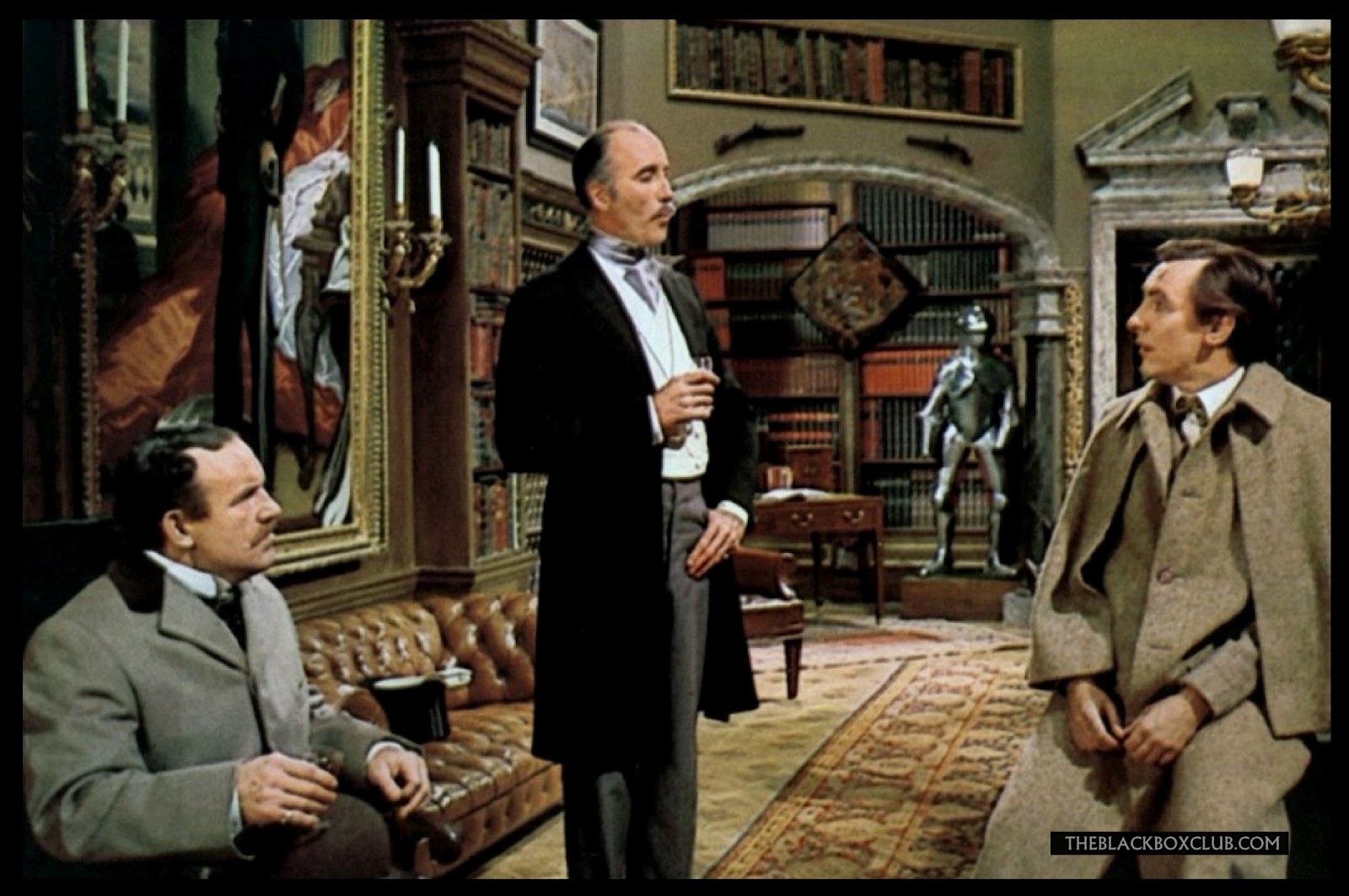

There are certainly several of Wilder’s fingerprints in the picture, it’s just that the use of such a well-known character and the Scottish locations, among other things, feels like fresh dust. It’s a perfect marriage of classic Hollywood filmmaking with the newfound freedoms that resulted from an especially creative period in American movies. For some people, the problem may be that it’s not entirely either one of those. The pacing is deliberate and relaxed, yet the first half hour has little to do with the remainder of the film. Holmes and the trusty Dr. Watson may be familiar names ingrained in most of our memories, but the portrayals are hardly consistent with interpretations up to that point. Holmes, in particular, is much more ambiguous and complex, with noncommittal sexual preference, questionable decision making, and an unapologetic dependency on cocaine.


These are attributes parsed from the original stories, to be sure, but they still vary significantly from the consensus of Holmes as an infallible master of deduction. Robert Stephens, whose cocktail of whiskey and sleeping pills during the shoot delayed production for weeks, plays Holmes as prim, proper and arrogant, all attempts to mask the character’s sadness. Colin Blakely’s Watson is just the opposite, convivial and slightly bumbling. Both performances are perfectly used by Wilder, regardless of how they fit in with Conan Doyle’s mythology. As we see in the film, Holmes scolds Watson repeatedly about his extreme glamorization of the detective’s work. Considering these are two of the most famous fictional characters in literary history, it’s undeniable that Wilder and Diamond had a difficult task in bringing their skewed version of Holmes and Watson to the screen. The interesting thing is that the film seems destined to disappoint both those looking for a Sherlock Holmes movie and the ones interested in a typical Billy Wilder effort. And yet The Private Life of Sherlock Holmes is an exceptional film. No wonder it was a commercial disappointment! Who’s supposed to embrace this thing again?


People who enjoy quality filmmaking, for starters. That initial half hour, when Holmes and Watson are mysteriously summoned to a Russian performance of Swan Lake so that the star can request the detective’s paternal seed, is so good that you wonder why other films don’t frequently employ episodic structures. Of course, that was Wilder’s intention, to present a series of four episodes, all of which were filmed and ready to go. A story about a Belgian woman dropped on the doorstep of Holmes and Watson, leading the trio to Scotland and an apparent encounter with the Loch Ness Monster, comprises the remaining hour and a half while the other two portions were cut. In terms of holy grails of lost footage, as much as I’d like to see Orson Welles’ more complete version of The Magnificent Ambersons, I think I’d be equally anxious to see the full version of Wilder’s film. It’s a huge credit to Wilder’s ability as a director that even with the severe edits he was able to produce something as brilliant as the existing cut is here.


After Gabrielle Valladon (played by the lovely Genevieve Page) is deposited at Holmes’ Baker Street address, Wilder does well to produce a subversion of the famous character’s well-documented skills, veiled in a pretty good mystery. At some point, it seems natural to try and understand why Wilder and Diamond would bother in making a fairly difficult film with Holmes as the center. The best explanation I can come up with would be the desire to portray Holmes as a man wrongly described, whose actual attributes are far more humanlike than what’s shown in the stories. It’s the burden of brilliance, but also the inconvenience of not being as intelligent as your superhuman reputation. There are several chuckles, but the film certainly isn’t a comedy so I don’t think that was ever the aim, to place Holmes in a simple and slightly comic series of situations. It would seem more that the idea was for a repositioning of the Holmes character as a man unable to deal with his basic loneliness and alienation, soothed only by pompous one-upping of his sidekick Watson and frequent drug use.


The Holmes here is ultimately a failure at the hands of technology, bested by his brother Mycroft, who, in turn, suffers a major miscalculation of his own. So is it the dissolving of myths that Wilder is interested in? Is this his Liberty Valance? Yeah, I sort of think so. Though he was only 64 at the film’s release, and would churn out four more pictures afterwards, Wilder created his definitive “old man” movie here. The call-backs to a more classic style even than in his previous few efforts and the patience of experience he displays are both important elements to bridging the old with the new. Even when Wilder was younger, he didn’t normally employ the classical and calculated sense of purpose seen here. The structure is considered and nearly perfect. This is part of why it’s so incredible to think that the film was initially envisioned as much longer. The existing version feels appropriate as it is, only marred, in my opinion, a little by the first part of the Loch Ness Monster bit.


When Sherlock Holmes fails to really do much of anything right, despite his predictably shortsighted detective work, it’s at the expense of volumes of lionizing literature. The film thus works as a warning against the perils of smug overconfidence. For Holmes, the sticky truth isn’t that he’s a failure (something he seems to be fighting against throughout), but that a promising opportunity for romance has been squandered. It’s a slow realization, but by the end it’s obvious that he’s in movie love with the not-really Belgian Gabrielle/Ilse. The sexuality aspect here is interesting because Wilder and Diamond put it at the forefront for the viewer. Holmes’ reluctance to declare his heterosexuality to Watson early on seems to be due to one of three reasons: 1.) He’s being coy; 2.) He’s unsure himself as to his current feelings; or 3.) He’s so desexualized as to make it seemingly irrelevant. I think any of these three explanations work perfectly fine. With any of them, Holmes makes it obvious that he’s not actively searching for female companionship, making the presence of Gabrielle/Ilse a difficult situation.


The forced push at the end, when Holmes seems to realize his feelings for her just when she’s no longer attainable, serves as another reminder of how empty his life is. Watson and his silly stories are just about all the character has going for him. Then when it looks like the audience will be treated to the usual ending wrapped in sentimentality, Wilder continues the film and, in so doing, removes any trace of happiness. Watson is little more than a hyper-intelligent canine with a medical bag and Holmes the junkie can only shoot up and pass out (off-screen, of course). In essence, this is Wilder’s most daring film since Ace in the Hole, and it appeals to generally no one outside the director’s most devoted followers. He was able to completely demystify a legendary character with a huge following, using a fully sincere approach, while also putting together a deceptive genre story that proves quite entertaining. The Private Life of Sherlock Holmes is destined to remain largely unappreciated because it has few of the attributes Wilder is most known for, but it’s nevertheless an atypical slice of brilliance from the director.


Wilder himself apparently disagreed. In Cameron Crowe’s book Conversations with Wilder, The Private Life of Sherlock Holmes is characterized by its creator as basically a great film ruined by later editing after the director went off to another country (shades of Ambersons). Wilder retained final cut in his contract, but a terrible test screening and a supposedly misplaced negative resulted in the trimmed version, topping out at 125 minutes, being what hit theaters. Other reports seem to indicate Wilder was agreeable with the existing edit. Regardless, upon release it promptly sank, just like Ace in the Hole. Wilder had gone four years since the release of his last film, The Fortune Cookie, and it’s not surprising that audiences mostly stayed away from this one. The financially successful films of 1970 were either epic spectacles like Aiport and Patton or then-daring expressions of a new generation like M*A*S*H and Bob & Carol & Ted & Alice. Ironically, despite the freedom afforded Wilder that probably would have been unimaginable a decade or two earlier, his audience was no longer interested.

The saga of the film’s different incarnations is well documented on the R1 DVD, which ported over several of the laserdisc extras. A new 15-minute interview (from 2003) with Christopher Lee, who plays Mycroft Holmes, doesn’t shed a lot of light on the various cuts, but it does give Lee the chance to single out Wilder as the best director he’s ever worked with, and it also lets the actor reminisce on his own turns playing Sherlock Holmes. The film’s editor Ernest Walter, the man referred to by Wilder in Crowe’s book, goes into great detail about what was cut and so forth in a half-hour interview from the mid-nineties that was originally on the laserdisc. Then, you can see for yourself much of what was removed. A prologue with Colin Blakely as Watson’s modern-day grandson would have further set up the idea that these four episodes derived from material deemed too private to be published in Holmes’ lifetime. This particular portion is told on the DVD from still photos and script excerpts, but the viewer definitely gets a good feeling of how it might have turned out.


The crude reconstruction continues with one of the excised sequences, a lengthy story involving an upside down room. It has audio, but only photographs instead of video. I think this would have been an exceptionally strong portion of the film had it remained because it reinforces the idea that Watson cares deeply for Holmes and that the detective is sort of miserably entwined in his own intelligence. The next scene removed was a brief flashback where Holmes and Gabrielle/Ilsa are just about to go to sleep on the train. The scene was intended as a means for explaining some of Holmes’ reluctance to become romantically involved, stemming from an incident with a schoolboy crush who turned out to be a prostitute. This too would have fit perfectly within the film and improved the existing scene without bogging it down.


The final episode not in the finished film exists on the DVD in letterboxed video, but is missing the audio. The dialogue from the script has been inserted as subtitles. The scene is very funny and concerns Watson putting on Holmes’ hat (literally) and trying to solve a murder. In relation to the rest of the film, it seems to fit the least of the cut portions. If the movie had been made today, this little bit could have worked perfectly as a DVD-only extra or even a short intended to run before the film. All total, there’s over an hour of extra material here, all of which was shot and excluded from the final cut. The inclusion of this footage on the DVD is really something to be thankful for, but the hope that somehow Wilder’s full version could be restored still nags.

Feature: link
Images: Marcus Brooks 

Friday, 15 June 2012

JANETTE SCOTT: THE OLD DARK HOUSE: REVIEW AND LOBBY CARD GALLERY

I wish I knew what James Carreras and Anthony Hinds were thinking in 1962, when they decided to bring William Castle over from America to produce and direct their remake of James Whale’s The Old Dark House. Everything I’ve read about the studio’s history devotes as little attention as possible to The Old Dark House, and I can totally understand that. It’s a dreadful, shameful movie, a humiliating blot on two otherwise remarkably consistent records. But you know there has to be a story here, and I’d love to hear it. Hammer, after all, was not in the habit of handing creative control of their products over to people from outside their usual stable of producers, directors, and writers. They’d imported plenty of American talent over the years, but only for jobs in front of the camera. 


The Hammer regulars had very carefullly developed an instantly recognizable house style since the studio’s rise to international prominence in 1957, and if it’s true what they say about imitation, then that style was among the most sincerely flattered all over the horror-film-producing world. Castle, too, had an unmistakable style, and it could not possibly have been any further at variance from Hammer’s. Although luridness was surely a core Hammer characteristic, filmmakers like Terence Fisher, Freddie Francis, Val Guest, and Jimmy Sangster almost always managed to make it look classy and well-mannered. 


Castle’s luridness was of an unapologetically boorish and thoroughly American stripe. Having him over to make a Hammer film was like hiring a carnival barker to sell Jaguars. All I can think of to explain it is the fact that The Old Dark House was a co-production with Hammer’s latest transatlantic partners, Columbia Pictures; Castle was arguably Columbia’s star horror director in the early 60’s, and I can imagine that studio’s leadership snowballing Hinds and Carreras with some bunch of bullshit about creative synergy or whatever. What this most unlikely of alliances produced, however, was something close to the exact opposite of synergy. Castle and Hammer turn out to be the two great tastes that induce gagging and nausea together.


Tom Penderel (Tom Poston, of Zotz!) is an American car salesman living in London. Specifically, he seems to work at a Lincoln dealership, which I didn’t know they had over there. His living arrangements are rather peculiar, for although he shares his flat with another man, Penderel and Casper Femm (Peter Bull, from The 3 Worlds of Gulliver and Footsteps in the Fog) have never actually met. This is possible because Casper occupies the flat only during the day while Tom is at work, vacating it each evening to go… well, somewhere. The two sort-of roommates are about to make each other’s acquaintance at last, however, for Casper has lately gotten it into his head to buy one of Tom’s extravagantly huge and powerful vehicles. To that end, Tom leaves the lot at quitting time in a powder-blue Continental convertible, and drives it to the private club where Casper does his gambling. Penderel has a hard time talking his way past the concierge (whose whole job, after all, is to keep the club free of rabble like Tom), but eventually gets in with a stern warning not to take part in any of the games. The meeting does not go quite as Tom expects. Casper is enchanted with the car, alright, but he wants Penderel to drive it home for him. And by “home,” Casper means not the apartment that he and Tom share, but rather the ancestral manse of the Femm family, far away in Dartmoor. That, apparently, is where he disappears to every night. Tom will have to make the drive alone, too, because pressing time constraints about which Casper feels himself not at liberty to speak here demand that he himself return by airplane. Penderel understandably balks at this onerous stipulation, but Casper wins him over partly by appealing to a wildly exaggerated conception of their friendship and partly by mentioning his lovely cousin, Cecily.


The drive to Dartmoor is uneventful until Tom comes to the end of it. An intense, persistent thunderstorm breaks out during the home stretch of the journey, Femm Manor turns out to be accessible only via a winding dirt track through the center of an immense marsh, and the front gate is stuck shut when Penderel finally arrives before it. His efforts to unstick the gate have the collateral effect of dislodging the enormous granite gargoyle atop one of the masonry columns anchoring it, and while Tom dodges the falling statue handily enough, Casper’s Lincoln isn’t so fortunate. Also, the knocker on Femm Manor’s front door was booby-trapped by Casper’s Uncle Potiphar (Mervyn Johns, from Dead of Night and The Confessional) so as to dump anyone who tries to use it through a trapdoor into the cellar, where he can safely interrogate them about their business at the house. Oh— and Casper’s dead, too.


Wait— what?! Yes, Casper is dead, and although none of his relatives profess to know how, they are virtually unanimous in suspecting foul play. Tom gets the latter information (or at least some hints in its direction) from Cecily (Janette Scott, from Paranoiac and The Day of the Triffids)— who, incidentally, pretty well lives up to her billing and marks herself out thereby as Penderel’s natural love-interest. The prime suspect appears to be Cecily’s father, Roderick (Robert Morley, of A Study in Terror and Theater of Blood), de facto head of the Femm clan, and she makes every effort to hustle Tom out the door before her old man returns home. No such luck there. Roderick’s arrival is not without its upside, however, for it means that at last there’s someone able and willing to answer a few of the 11,000 questions that Tom has formulated since being dragooned into delivering Casper’s car to the chateau.


To begin at the beginning, the Femm family is obviously very rich, but that wealth was not gained legitimately. The founder of the line was a notorious pirate called Morgan— whom we are indeed apparently supposed to identify with that Captain Morgan, even though the timeline and biography for the Femms’ Morgan don’t remotely line up with his. Building this house in the middle of a swamp was Morgan’s way of going belatedly straight, and the terms of the trust in which he put his plundered riches were intended to keep all of his descendants out of the buccaneering business, too. In order to maintain any claim to a share of the family fortune, a Femm must meet at least a minimal standard of permanent residence within the old manse; they must be present beneath its roof each midnight, which is obviously incompatible with a life of piracy on the high seas. That it would also be incompatible with many other totally legitimate lifestyles was apparently of no concern to Morgan. The trust is inalterable so long as the house remains within the family, which is the next best thing to saying it’s inalterable forever, since there’s also a clause forbidding its sale. Not even arson would get the clan out from under their ancestor’s thumb, since the only fire that could harm the fortress-like walls of Femm Manor is the volcanic variety from which the basalt blocks originally sprang. Meanwhile, the funds disbursed from the trust as an allowance to the heirs are equally divided among all of them who play by its rules, so that they each have an obvious incentive to engineer each other’s disinheritance.


That last is why Casper’s death has everyone so worried. It’s hard to think of a more efficient means of engineering someone’s disinheritance than murdering them, and sanity is unmistakably in short supply among the Femms. To all outward appearances, the younger generation— Casper and his twin brother, Jasper (also Peter Bull); Cecily; the predatorily amorous Morgana (Carry On Screaming’s Fenella Fielding)— are merely eccentric, but their elders to a one are loonier than Harley Quinn. Potiphar is expecting the end of the world any day now, and has an ark built and stocked to Biblical specifications in the backyard, all ready for the rains to float it. (The funniest scene in the movie— funny for all the wrong reasons— concerns a meeting between Penderel and one of Potiphar’s hyenas. It’s right up there with the taxidermy attack in Jesus Franco’s Count Dracula.) The twins’ mother, Agatha (Joyce Grenfell), looks harmless enough, channeling her craziness into literally hundreds of miles per annum of useless knitting, but the way she talks about her perpetual project puts me strongly in mind of the three Fates— and you remember what was supposed to happen when Atropos snipped off her sisters’ threads. Morgana’s father, Morgan (Danny Green, from Murder at the Baskervilles and The 7th Voyage of Sinbad), is the most visibly dangerous of the lot, harboring a psychotic jealousy of his daughter, and being generally assumed to have killed all of her previous suitors. As for Roderick, his gun collection could outfit a respectable Third World military, and of all the Femms, he’s the most openly conscious of the family legacy as a zero-sum game. Now ordinarily it might seem that Tom personally has nothing to worry about except for steering clear of Morgan after Morgana sets her sights on him, even once Casper’s killer begins working on the rest of the clan. However, there happens to be a legend about a little-known American side of the family, and Roderick thinks he detects a resemblance between Penderel and the portrait of old Morgan the Pirate that hangs in the chateau’s drawing room.


Before we go any further, I want to remind you all of my utter loathing for James Whale’s interpretation of The Old Dark House. I consider it easily the worst major-studio horror movie of an era in which major-studio horror movies more often than not were clumsy, anemic affairs, of more academic interest than actual artistry or entertainment value. So when I tell you that William Castle’s The Old Dark House reeks in the nostrils of the Muses, you will know that it is not just loyalty to the original talking. Whatever imagined benefit of a Castle-Hammer alliance might draw you to this movie, I assure you, you won’t find it here. The only trace of normative Hammer-ness is a genuinely terrific set— and it was used to much better effect a bit later in The Kiss of the Vampire, anyway. The Castle touch, meanwhile, is represented only by a very modest gimmick indeed, an animated main title sequence by Charles Addams, which is far and away the best thing about the film. Otherwise, The Old Dark House is the kind of mess that any two-bit hack could have made. Danny Green, to begin with, is no Boris Karloff, and Tom Poston is no anybody— although he seems, horrifyingly enough, to be aiming vaguely in the direction of Kay Kyser! Story logic is thin nearly to the point of nonexistence. Most notably, there’s no apparent reason at all for the Femms to pick this night in particular to begin exterminating each other. 


If you fail to unravel the mystery of the killer’s identity, it will be only because you stopped giving a shit well before anything in the way of a clue was presented. The remake manages to be just as boring and pointless as the original, even despite having both five times the body count (including a double knitting-needle throat-stabbing!) and something faintly resembling a plot. And as with the old version, it’s a tough call which is the bigger affront, that soul-sapping dreariness and inanity, or all the noxious anti-comedy. Whale at least was trying for something sort of sophisticated by the standards of his day, alternating poisonously unfunny comedy of manners with poisonously unfunny camp. Castle and screenwriter Robert Dillon, on the other hand, mostly just substitute random zaniness on the Crane Wilbur model, shameless reusing not a few gags that had been polluting the atmosphere of horror comedies at least as far back as The Monster in 1925. To be fair, there are also a few thoroughly botched attempts at the sort of gallows humor that AIP’s writers were proving so adept with around the same time, but not enough to have rescued The Old Dark House from itself even if they had worked. Frankly, I’m not a bit surprised that the Hammer leadership’s reaction to the finished product was to send it straight to the vault, not releasing it domestically until 1966. Columbia— perhaps also not surprisingly— showed no such discernment.
REVIEW: Scott Ashlin
Scott's Excellent Website: Click Here
IMAGES: Marcus Brooks

Thursday, 14 June 2012

VINCENT PRICE KARLOFF LORRE RATHBONE: 'THE COMEDY OF TERRORS' REVIEW AND LOBBY PHOTOGRAPHS


CAST:
Vincent Price (Waldo Trumbull), Peter Lorre (Felix Gillie), Basil Rathbone (John F. Black), Boris Karloff (Amos Hinchley), Joyce Jameson (Amaryllis Trumbull)


PRODUCTION:
Director – Jacques Tourneur, Screenplay – Richard Matheson, Producer – Anthony Carras, Photography – Floyd Crosby, Music – Les Baxter, Special Effects – Pat Dinga, Art Direction – Daniel Haller. Production Company – AIP. USA 1963


SYNOPSIS:
Alcoholic wife-beater Waldo Trumbull has run the funeral business he inherited from his father-in-law into the ground. His landlord John F. Black threatens to foreclose unless Trumbull comes up with a year’s unpaid rent. And so Trumbull and his assistant Felix Gillie decide to resort to murder in order to drum up some business. When the wife of their first victim leaves town without paying their bill, they decide they can kill two birds with one stone by making Black into their next victim.


COMMENTARY:
The Comedy of Terrors was not one of Roger Corman’s Edgar Allan Poe films but has enough in common that it could easily have been. It has more or less the same credits as Corman’s comedic Poe effort The Raven (1963), including stars Boris Karloff, Peter Lorre and Vincent Price – who is playing essentially the same part that Lorre did in the similarly comedic The Black Cat episode of Corman’s Tales of Terror (1962), screenwriter Richard Matheson, production designer Daniel Haller, musician Les Baxter and photographer Floyd Crosby.


The Comedy of Terrors was directed by Jacques Tourneur, who a couple of decades earlier had made distinction with two of Val Lewton’s finest psychological horror films Cat People (1942) and I Walked with a Zombie (1943). Here Tourneur is in broad burlesque mode and the film is aimed at a frequently buffoonish level of knockabout comedy. What saves The Comedy of Terrors from total silliness is a witty and adept script from Richard Matheson who wrote most of Roger Corman’s Edgar Allan Poe films. 


All the cast are on fine form – Vincent Price is in full fruity flight with some hilarious scenes threatening to poison Boris Karloff off, while Peter Lorre does his craven cringing thing with equally hilarious regard. There are some mercilessly funny scenes with Vincent Price and Peter Lorre trying to force Basil Rathbone to stay in his coffin. The film reaches an especially hilarious ending with Basil Rathbone maniacally quoting Shakespeare, everybody being killed off (sometimes multiply so) and an especially droll final scene where Boris Karloff feeds Vincent Price some ‘medicine’.


Jacques Tourneur made several excellent psychological horror films – namely Cat People (1942), I Walked with a Zombie (1943), The Leopard Man (1943) and Curse of the Demon/Night of the Demon (1957), as well as the lost city sf film The City Under the Sea/War Gods from the Deep (1965). 

REVIEW: Richard Scheib 
IMAGES: Marcus Brooks

VINCENT PRICE: THE FALL OF THE HOUSE OF USHER (1960) REVIEW AND GALLERY


CAST:
Vincent Price (Roderick Usher), Mark Damon (Philip Winthrop), Myrna Fahey (Madeleine Usher), Harry Ellerbe (Bristol)

PRODUCTION:
Director/Producer – Roger Corman, Screenplay – Richard Matheson, Based on the Short Story by Edgar Allan Poe, Cinematography – Floyd Crosby, Music – Les Baxter, Photographic Effects – Ray Mercer, Process Photography – Larry Butler, Special Effects – Pat Dinga, Makeup – Fred Phillips, Production Design – Daniel Haller. Production Company – Alta Vista/AIP. USA 1960

SYNOPSIS:
Philip Winthrop travels from Boston to New England to see his fiancée Madeleine at the forbidding Usher family mansion. He is greeted by her brother Roderick who tells him that Madeleine is sick and that he must leave. Winthrop is insistent on seeing her. He learns that both Roderick and Madeleine are infected with the family’s hereditary sickness, which causes a hyper-acuteness of the senses – Winthrop must wear slippers because the sound of footfalls are an agony to their ears; the light must be kept shaded and the rooms curtained; and all but the most bland of gruel is pain to their taste buds. Madeleine then falls dead and is buried in the family crypt. Just as Winthrop is about to depart, he discovers that Madeleine suffers from catalepsy and has been buried alive.


COMMENTARY:
There is a cult that surrounds Roger Corman. There is one part of the cult, a large part fostered by Corman himself, that celebrates Roger Corman the legendary B movie director/producer – Corman who could make a movie in two days (including the time taken to write the script); who could take footage from Russian science-fiction films and write not one but three entire films around it; who could come in under shooting schedule on one film and decide on the spot to shoot material for another film using the same sets and stars; and who had the unerring eye to pick up and coming talent, including giving early career breaks to names like Jack Nicholson, Ron Howard, Joe Dante, Francis Ford Coppola, Peter Bogdanovich, Peter Fonda, Jonathan Demme and James Cameron among many others. Corman began producing with the detective film Highway Dragnet (1954) and then started directing with the Western Five Guns West (1955), but it was at AIP (American International Pictures) that he made a name for himself churning out cheap but entertaining B-monster movies. (See the bottom of the page for a list of Roger Corman’s other genre films).


There is another half to the Roger Corman legend and that is Roger Corman the serious filmmaker. This is something that began here with The House of Usher. Corman was clearly inspired by the success that England’s Hammer Films had had in the previous few years with their new colour adaptations of the Universal classics, The Curse of Frankenstein (1957) and Dracula/The Horror of Dracula (1958). The success of these and the host of other remakes, sequels and original subjects that Hammer would conduct over the next decade inspired a huge international interest in Gothic horror. The same year as this, Mario Bava created a Gothic horror boom in Italy beginning with Black Sunday (1960). And so, Corman turned to American writer Edgar Allan Poe for his subject matter. Of course, Corman had a problem in persuading AIP producers Samuel Z. Arkoff and James H. Nicholson to allow him to make a film in colour and with a substantially greater budget than the rest of his films. It was a period when AIP often used to make their monster movies by first coming up with a novelty poster and then creating a film to go with it and so Corman had difficulty getting them to understand The House of Usher – he tells an amusing story about how he persuaded them during a pitch session that it would be a film where the house was the monster. Even so, Arkoff and Nicholson insisted on paring down Edgar Allan Poe’s story title The Fall of the House of Usher so it could fit on a billboard.


The House of Usher was the film that proved that Roger Corman was a serious filmmaker and one that had his work suddenly re-evaluated by critics in the 1960s. After the success he had with The House of Usher, Corman spun out a series of other Poe based films – Pit and the Pendulum (1961), Premature Burial (1962), Tales of Terror (1962), The Raven (1963), the Poe-titled but H.P. Lovecraft adapted The Haunted Palace (1963), The Masque of the Red Death (1964) and The Tomb of Ligeia (1964). And when Corman tired of making Edgar Allan Poe films, AIP carried on their own series of loosely Poe based or related films – The City Under the Sea/War-Gods of the Deep (1965), The Oblong Box (1969), Cry of the Banshee (1970), Murders in the Rue Morgue (1971), even renaming the US release of the historical witch persecution film Matthew Hopkins – Witchfinder General (1968) as The Conqueror Worm, and so on.


Roger Corman never made any other of his Edgar Allan Poe films (except The Masque of the Red Death) with the same successful balance of mood and design that he achieved here. What Corman did was to undercut the floridness of Hammer Gothic with the moody intellectual angst of Ingmar Bergman – Corman was a great admirer of Bergman and you can see Bergman’s influence on his work, particularly The Masque of the Red Death. It resulted in a form that achieved a level of moodily gloom-laden and thunderously overwrought melodrama. Corman accomplishes some nicely subtle effects at times but mostly The House of Usher succeeds on its own level of torturous angst – the climax with Vincent Price and the crazed Myrna Fahey fighting as the house burns around them and the house’s final descent to be swallowed up in the tarn is superlative. Vincent Price is persuaded to turn the usual hamminess of his acting towards a painfully anguished performance. In fact, it was this line in tortured, weak-livered aristocracy that made Vincent Price’s career for the next two decades. He is aided immensely by Richard Matheson’s nicely formal 19th Century dialogue, which is perfect in describing almost unspeakable agonies. (Matheson conducts a fine adaptation in which, unlike almost all his other Poe screen adaptations, he manages to pad the 1839 short story out to feature length without any obvious signs).

The other form of aid that Corman gets is from production designer Daniel Haller – the opening scenes as Mark Damon makes his way by horseback across a burned-out landscape of blackened, skeletal trees, scorched turf and billowing mist to the striking charcoal grey facade of the house is an unforgettable piece of mood setting. (Here Corman was entrepreneurially able to grab a camera and go out to the scene of a brush fire in the Hollywood Hills and shoot the blasted heath). Equally good are Bert Schoenberg’s briefly glimpsed, amazingly tortured paintings that stand in for portraits of the Usher family – in fact, they, like the entire film, give the impression of being the dramatic equivalent of an Edvard Munch painting.


The House of Usher was later directly spoofed in Elvira’s Haunted Hills (2002). Other adaptations of the Edgar Allan Poe story are:– Jean Epstein’s French silent version The Fall of the House of Usher (1928); a dreary and not very faithful British version The Fall of the House of Usher (1948); the inept tv variation The Fall of the House of Usher (1979) with Martin Landau; Jesus Franco’s cheap The Fall of the House of Usher (1983) with Howard Vernon; Harry Alan Towers’ equally cheap House of Usher (1989) with Oliver Reed; Ken Russell’s demented variation The Fall of the Louse of Usher (2002); the low-budget modernised The House of Usher (2006); and David DeCoteau’s softcore gay House of Usher (2008).


Aside from the abovementioned Poe films, Roger Corman’s other genre films as director are:– Day the World Ended (1955), It Conquered the World (1956), Not Of This Earth (1956), War of the Satellites (1956), Attack of the Crab Monsters (1957), The Saga of the Viking Women and Their Journey to the Waters of the Great Sea Serpent (1957), The Undead (1957), Teenage Caveman (1958), A Bucket of Blood (1959), The Wasp Woman (1959), Last Woman on Earth (1960), The Little Shop of Horrors (1960), Creature from the Haunted Sea (1961), Tower of London (1962), The Terror (1963), X – The Man with X-Ray Eyes (1963), The Trip (1967), Gas; or It Became Necessary to Destroy the World in Order to Save It (1970) and Frankenstein Unbound (1990). Corman has made over 300 film as producer, which are too numerous to list here.


Richard Matheson has been a prolific genre screenwriter and novelist. His other genre works include The Incredible Shrinking Man (1957) based on his own novel, the Jules Verne adaptation Master of the World (1961), the occult film Night of the Eagle/Burn, Witch, Burn (1961), the Corman-produced mortician’s comedy The Comedy of Terrors (1963), The Last Man on Earth (1964) based on his novel I Am Legend (1954), the Hammer psycho-thriller The Fanatic/Die, Die, My Darling (1965), the classic Hammer occult film The Devil Rides Out/The Devil’s Bride (1968), the historical biopic De Sade (1969), Steven Spielberg’s first film Duel (1971), The Night Stalker (1972) and The Night Strangler (1973) tv movies, the haunted house film The Legend of Hell House (1973) from his novel, the tv adaptation of Dracula (1974), the tv movies Scream of the Wolf (1974), The Stranger Within (1974), Trilogy of Terror (1975), Dead of Night (1977) and The Strange Possession of Mrs Oliver (1977), the tv mini-series adaptation of Ray Bradbury’s The Martian Chronicles (1980), the time travel romance Somewhere in Time (1980) from his own novel, Jaws 3-D (1983), Twilight Zone – The Movie (1983), and numerous classic episodes of The Twilight Zone, Thriller and Star Trek. Works based on his novels and stories are The Omega Man (1971) from his I Am Legend, What Dreams May Come (1998), Stir of Echoes (1999), I Am Legend (2007), The Box (2009) and Real Steel (2011).

Star Mark Damon made a career as a leading man in Italy following The House of Usher and then in the 1980s returned to Hollywood where he became a producer with the likes of 9½ Weeks (1986), Short Circuit (1986), The Lost Boys (1987) and The Jungle Book (1994), among many others. Production designer Daniel Haller later went onto become a director himself, making in particular two efforts Die, Monster, Die/Monster of Terror (1965) and The Dunwich Horror (1969) that adapt H.P. Lovecraft but draw upon the brooding, redolent style of Roger Corman’s Poe films. 


REVIEW: Richard Scheib
IMAGES: Marcus Brooks

Wednesday, 13 June 2012

DIANE CLARE ANDRE MORELL: 'PLAGUE OF THE ZOMBIES' BLU RAY DVD DUAL PLAY RELEASE: IT'S COMING!


So, the COUNTDOWN is on! We are now just days away from JUNE 18th which will bring us the STUDIO CANAL DVD BLU RAY dual release of HAMMER FILMS 1966 'PLAGUE OF THE ZOMBIES'. We will be celebrating with full review and gallery. Subscribe and don't miss out!

Tuesday, 12 June 2012

HAMMER FILMS: OLIVER REED: SWASH AND BUCKLE: 'THE SCARLET BLADE' REVIEW AND LOBBY STILLS


Quick question, are you a diehard fan of the studio Hammer? If you’ve answered yes then congratulations, you’re on the right review. If however you answered no, and you don’t like old films (I know there are some of you out there) then you’ll probably want to sit this one out and go watch Sherlock at the cinema or something. For now though we return to our diehard Hammer fans (or HammerHeads as I like to imagine they call themselves) who will no doubt be dancing in the street with delight at the release of the previously rare Scarlet Blade which has previously never had a video or DVD release in the UK.


Released alongside another rare ‘classic’ The Brigand of Kandahar, The Scarlet Blade is easily the better of the two, and the one worth seeking out if you feel like some classic swashbuckling action. A case could be made that there have been all too few (although I’m not sure anyone who would put this forward) films released about the English Civil War. If you were to take a quick trip to Google, you’d discover that beyond the 1970 epic Cromwell, there isn’t much else on offer than the 1963 film, The Scarlet Blade.


So if you’re a fan of the English Civil war, prepare for fun and excitement as Cromwellian soldiers, Colonel Judd (Lionel Jeffries) and Captain Sylvester (Oliver Reed) capture King Charles of England (Robert Rietty). We join the story in 1648 as Colonel Judd (Lionel Jeffries) has just commandeered Beverly Manor. This is obviously naughty so we have the Scarlet Blade and his merry men (this film has more than a hint of Robin Hood about it) as they rage a guerrilla campaign against the baddies. Things then take a turn for the romantic as Judd’s impressionable daughter Claire (June Thorburn) becomes a co-conspirator with the Scarlet Blade. This co-conspiracy quickly leads to love with the man who her father is after and soon Captain Sylvester (Reed) joins her cause as well. If it all sounds like a perfect opportunity for swooning then you’d be right. It is, there is, and it’s all rather pompously lovely.


The Scarlet Blade has more than enough story for it to fill its 80 minute running time, although you’ll never shake the feeling that the director Gilling fails to input enough decent action or realistic romance to make this worthwhile discovering. There are enough character shifts to shame an entire season of 24, while the script seems a bit confused about what is going on as well. Things aren’t helped either by the fact that the heroes and much less charismatic and interesting than the villains.


I did however like that the film ends on a surprisingly depressing note. Despite all the wooden acting and 60‘s cheese the downbeat, tragic ending is rather shocking and a delightful twist. So although it’s been a rare film over the years, I’m afraid to say that The Scarlet Blade is just simply ‘ok.’ It’s not a rediscovered classic, nor is it a historical waste of time. Instead it raises the worst sort of response – indifference.

You can see this and many other reviews on this website:
Images: Marcus Brooks 

Monday, 11 June 2012

DONALD PLEASENCE JULIE EGE TOM BAKER : THE MUTATIONS REVIEW AND STILLS GALLERY


CAST:
Donald Pleasence (Dr Nolte), Tom Baker (Lynch), Brad Harris (Brian Redford), Scott Anthony (Tony), Michael Dunn (Burns), Julie Ege (Heidi), Jill Haworth (Lauren)

PRODUCTION:
Director – Jack Cardiff, Screenplay – Edward Mann; Robert D. Weindack, Producer – Weindack, Photography – Paul Beeson, Music – Basil Kirchin; Jack Nathan, Photographic Effects – Ken Middleham, Special Effects – Mike Hope, Makeup – Charles Packer, Art Direction – Herbert Smith. Production Company – Getty Pictures Corp.UK. 1974.


SYNOPSIS:
University lecturer Dr Nolte is kidnapping his students to use as subjects in an experiment in merging human and plant-life. Some of the students then discover their mutated and hideously disfigured classmates, the unsuccessful results of Nolte’s experiments, discarded as exhibits in a nearby circus freakshow.


COMMENTARY:
The Mutations is somewhat of a mutation itself. It is a genetic throwback that could easily have been one of the poverty row mad scientist films of the 1930s and 40s. Back then in any PRC or Monogram production it would have been absolutely mandatory that Bela Lugosi have filled Donald Pleasance’s lab-coat. The plot is constructed out of mad scientist genre cliches, albeit with a few modern touches like gratuitous shower scenes from Julie Ege.


Perhaps the oddest thing about The Mutations is that it is directed by the former Oscar-winning cinematographer Jack Cardiff. Cardiff had a highly respectable curriculum vitae, having lensed like Michael Powell classics A Matter of Life and Death/Stairway to Heaven (1946), Black Narcissus (1947) and The Red Shoes (1948) and other works such as Pandora and the Flying Dutchman (1951) and The African Queen (1952) where he became famed for his epic work with Technicolor. Cardiff had also directed a handful of titles with the acclaimed D.H. Lawrence adaptation Sons and Lovers (1960) and the first Smellovision film Scent of Mystery (1960).


The Mutations is a strange recapturing of Freaks (1932), casting real human deformities as the mutated creatures at the circus. Although the tastelessness with which characters crack puns about the various human deformities certainly puts the film into dubious regard. Certainly, Jack Cardiff fails to imbue the deformities with any of the pathos that Tod Browning did in Freaks.


The Mutations is a bad film – Jack Cardiff directs at a tedious pace and the plot is so uninvolving that nobody could care less what happens. Even the usually reliable Donald Pleasance fails to enliven his part, which seems to mostly consist of reciting dialogue from scientific textbooks. Ken Middleham, best known for his insect photography on The Hellstrom Chronicle (1971) and Phase IV (1974), contributes some modest time-lapse photography. The film also features Tom Baker as the circus master, just prior to Baker being cast as the fourth incarnation of Doctor Who (1963-89, 2005– ). 

Review: Richard Scheib 
Images: Marcus Brooks
Related Posts Plugin for WordPress, Blogger...