RECENT POST FROM THE BLACK BOX CLUB

Thursday, 24 May 2012

HAMMER FILMS: THE VERONICA CARLSON GALLERY: STARTS HERE THIS SUNDAY MAY 27TH!


THE BLACKBOXCLUB.COM VERONICA CARLSON GALLERY STARTS HERE ON SUNDAY 27TH MAY 2012. QUITE A COLLECTION OF COLOUR AND BLACK AND WHITE PORTRAITS OF VERONICA FROM SOME OF HAMMER FILM PRODUCTIONS FINEST!

Tuesday, 22 May 2012

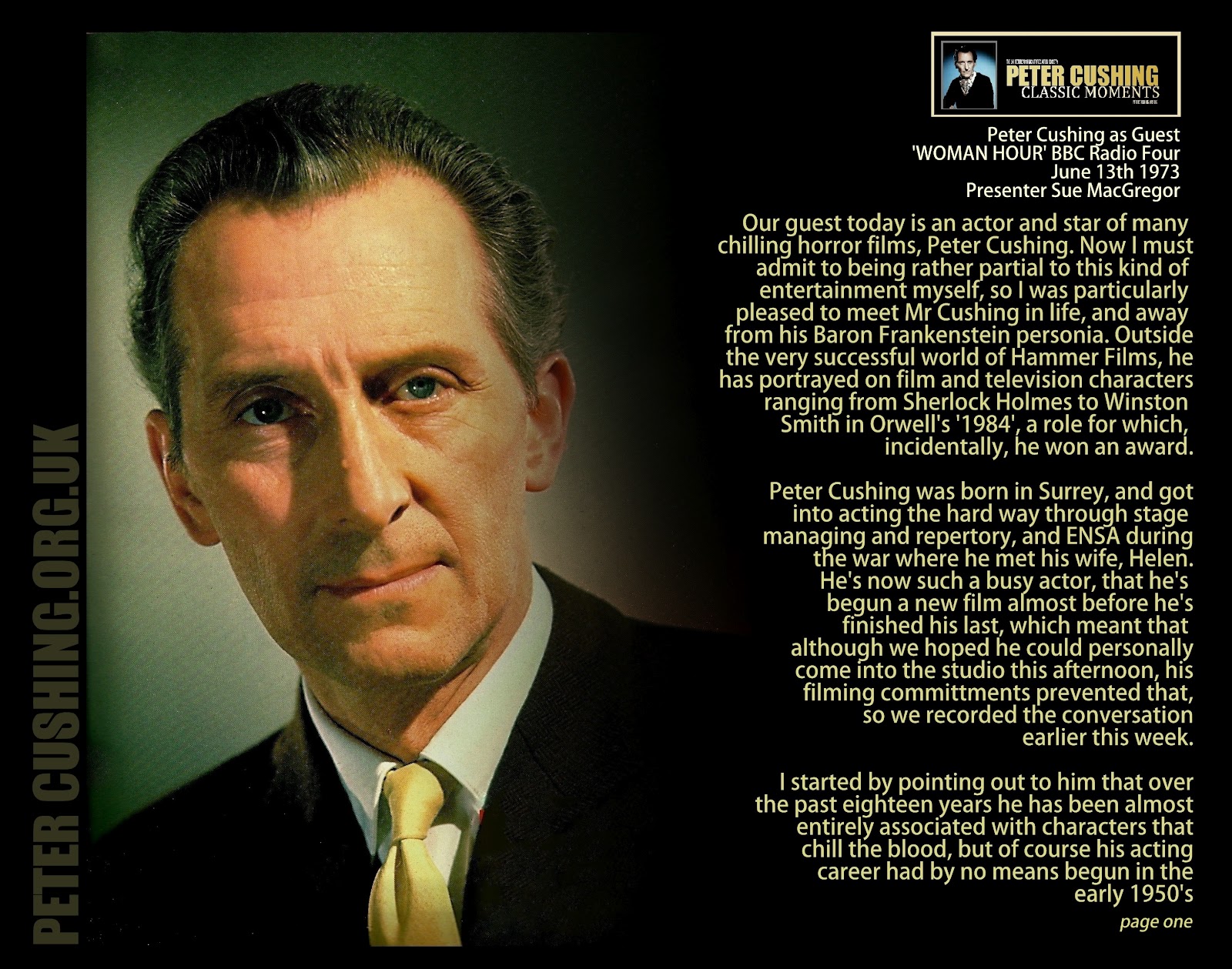
PETER CUSHING BBC RADIO FOUR INTERVIEW FROM 1973 COMING TO PETERCUSHING.ORG.UK

A HEADS UP from the UK PETER CUSHING APPRECIATION SOCIETY: PETERCUSHING.ORG.UK: Posting SATURDAY 26th MAY: Peter Cushing Interview from June 13th 1973: BBC RADIO FOUR WOMAN'S HOUR PROGRAMME: Long though lost!

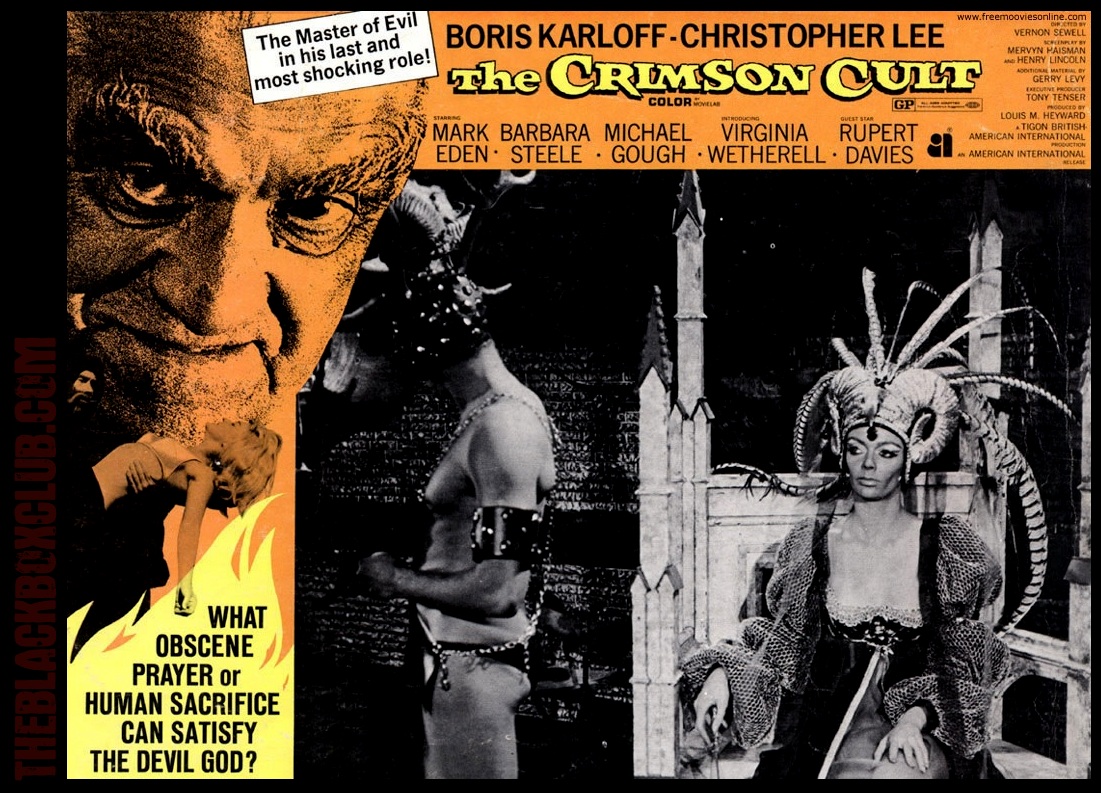
CURSE OF THE CRIMSON ALTAR: KARLOFF LEE STEELE GOUGH: REVIEW AND GALLERY


CAST:
Mark Eden (Robert Manning), Virginia Wetherell (Eve Morley), Christopher Lee (J.D. Morley), Boris Karloff (Professor John Marsh), Michael Gough (Elder), Barbara Steele (Lavinia Morley)

CREW:
Director – Vernon Sewell, Screenplay – Mervyn Haisman & Henry Lincoln, Story – Jerry Sohl, Producer – Louis M. ‘Deke’ Hayward, Photography – Johnny Coquillon, Music – Peter Knight, Art Direction – Derek Barrington. Production Company – Tigon/AIP. UK. 1969.

SYNOPSIS:
Antique dealer Bob Manning heads to Craxton Lodge in Graymarsh, the last known locale of his missing brother Peter. J.D. Morley, the owner of Craxton Lodge, claims to have never heard of Peter but invites Manning to stay. Manning soon begins to discover evidence that Peter was there and that he has met foul circumstances. Meanwhile, he is plagued by dreams of occult rituals concerning the witch Lavinia Morley who was burnt at the stake centuries ago and has promised revenge on the ancestors of her persecutors.
COMMENTARY:
Curse of the Crimson Altar makes some claim to being based on the H.P. Lovecraft story, The Dreams in the Witch House (1933), although neither Lovecraft’s name nor the story are mentioned in the credits. As has been pointed out by H.P. Lovecraft fans, the connection is tenuous, with the story’s arcane esotericism – like the oddly-angled attic room – having been pared down until the film is no more than a routine variation on the revived-witch-taking-revenge-on-present-day-ancestors story that has been in circulation ever since City of the Dead (1959) and Black Sunday (1960). The Dreams in the Witch House was later filmed by Stuart Gordon as an episode of Masters of Horror (2005-6).
Director Vernon Sewell never generates anything but the most routine of suspense. Any atmosphere during the drug hallucination sequences, for instance, is considerably undone by such laughable sights as a body-builder in tights wearing what is clearly a motorcycle helmet with studs and a pair of antlers glued on it. The plot is weak, with the action consisting of much skulking around the house and a series of clumsily unveiled clues. The title is of little relevance – to be strictly fastidious, the story is not about the curse of the crimson altar but the curse of the green-skinned witch.
Like many (particularly British) films of the late 1960s, Curse of the Crimson Altar is quick to draw a connection between then youth culture, drugs and Satanism – the opening quotation boldly connects drug taking with Satanism. However, apart from a brief orgy sequence as Mark Eden turns up at the manor, this is a promise that is never fulfilled (and the youth orgy angle raised by the credits is a sensationalistic cheat as it the lord of the manor, not his wayward niece, who is involved in the occult).
The film also manages to criminally waste a fine genre line-up. Cult Italian-horror queen Barbara Steele appears only painted in green and without any lines, while Michael Gough makes an appearance as a mad butler uttering cryptic portents then later turns up dead in a coffin without any explanation. Christopher Lee has been through it all before and at least holds the dreary proceedings together by maintaining a consummate professionalism. Unfortunately, the mere fact that it is Christopher Lee tends to mitigate against the mystery that has been built up – Lee being perfectly polite and denying any knowledge of the missing person, at the same time as evidence to the person’s having been there continues to mount, only acts like a giant neon arrow that points in his direction.
The person that does best out of the affair is 82-year-old Boris Karloff who, despite being wheelchair-ridden and badly showing his age, manages to convey some sinister threat. The moment he invites Mark Eden to come and see his collection to which Eden innocently asks “What sort of collection?” and Karloff, with a sweet smile, answers “Instruments of torture,” is great (even if the mere tableful of instruments later presented heavily belies the moment). The greatest distinction Curse of the Crimson Altar had is in being Boris Karloff’s last film (apart from four films made in Mexico films that never received distribution until on video in the 1980s). Karloff died of pneumonia, which is reputedly something that he caught during the film’s location shooting in the draughty manor.
Curse of the Crimson Altar was one of the films made by Vernon Sewell, a minor director in the heyday of English horror cinema. Vernon Sewell also made:- The Medium (1934), Latin Quarter (1945), The Ghosts of Berkeley Square (1947), Ghost Ship (1952), House of Mystery (1960) and The Blood Beast Terror (1968). 

Review:Richard Scheib
Images: Marcus Brooks
Source:HERE

Monday, 21 May 2012

VICTORIA VETRI: WHEN DINOSAURS RULED THE EARTH: VAL AND VETRI DO THE DINOSAUR REVIEW AND GALLERY

CAST:
Victoria Vetri (Sanna), Robin Hawdron (Tara), Patrick Allen (Kingsor), Drewe Henley (Khaku), Sean Caffrey (Kane), Magda Konopka (Ulido), Imogen Hassall (Ayak), Patrick Holt (Ammon)

PRODUCTION:
Director/Screenplay – Val Guest, Story – J.G. Ballard, Producer – Aida Young, Photography – Dick Bush, Music – Mario Nascimbene, Music Supervisor – Phillip Martell, Visual Effects – Jim Danforth, Special Effects – Allan Bryce, Roger Dicken & Brian Johncock [Johnson], Art Direction – John Blezard. Production Company – Hammer. UK 1970
SYNOPSIS:
A tribe of sun-worshippers are about to sacrifice a beautiful blonde virgin Sanna. She is saved when powerful winds sweep her over a cliff and away to sea. She is then found by Tara, a man from a fishing tribe. He welcomes her into his tribe and they fall in love. This makes Ayak, who desires Tara, jealous. When a moon appears in the sky for the first time and the tribe panics, Ayak accuses Sanna of witchcraft. Sanna flees into the jungle where she is forced to survive on her own amid the dinosaurs.
COMMENTARY:
Hammer Films gained considerable fame in the late 1950s and 60s with their various horror films. Amidst this, they combined with American stop-motion animator Ray Harryhausen to create One Million Years B.C. (1966), which revived the creaky old cavemen vs dinosaurs genre. After the success of One Million Years B.C., Hammer instituted an antediluvian exotica cycle, making the likes of Slave Girls/Prehistoric Women (1967), When Dinosaurs Ruled the Earth and finally Creatures the World Forgot (1971).
Some regard When Dinosaurs Ruled the Earth as the best of the entries in Hammer’s exotica cycle. The film had a screen treatment commissioned from cult science-fiction writer J.G. Ballard, although this was substantially rewritten by director Val Guest. J.G. Ballard was responsible for some of the most experimental and out-there works of the 1960s New Wave movement in literary science-fiction, including the novel that became David Cronenberg’s Crash (1996), while his semi-autobiography was adapted to the screen by Steven Spielberg as Empire of the Sun (1987).
How much of the finished film is Ballard’s could be anybody’s guess. Certainly, it is difficult to believe that a respectable writer like J.G. Ballard could involve himself with a film like this that manages gets its geological epochs mixed up by between 64 million and 4.6 billion years (respectively how long before mankind the dinosaurs and the origin of the Moon were). Although, when a film is so anthropoloigically mixed-up that it has dinosaurs and cavemen co-existing in the same era this hardly seems to matter.
The plot rambles in a pedestrian way. There is a love story going on but most of the time that takes backseat to the dinosaurs. (It must be hard to write multi-level stories in films like this where the actors are delivering their lines in grunts). Hammer clearly made When Dinosaurs Ruled the Earth much more cheaply than One Million Years B.C. and went to Jim Danforth, then known for work on films like Jack the Giant Killer (1962), The Wonderful World of the Brothers Grimm (1962) and 7 Faces of Dr Lao (1964), to deliver the dinosaur effects at cut-price rates. Despite suffering variable perspective, the animated dinosaurs are good. There is an exciting scene with the villagers fighting off a rampaging dinosaur with flames, some cute scenes with Victoria Vetri befriending the baby dinosaur, and other fine set-pieces with a pterodactyl and giant crabs. That said, Jim Danforth never invests them with the same kind of detail and character that Ray Harryhausen did in One Million Years B.C..
The film goes on location in the Canary Islands, which provides a considerable expansive beauty. Special effects supervisor Brian Johncock understandably changed his surname to Johnson and later supervised effects for Space: 1999 (1975-7), Alien (1979) and even headed Industrial Light and Magic for The Empire Strikes Back (1980) and Dragonslayer (1981).
Val Guest’s other genre films include:- the comedy Mr Drake’s Duck (1951) about a duck that lays radioactive eggs; Hammer’s Nigel Kneale adaptations The Quatermass Xperiment/The Creeping Unknown (1955), Quatermass 2/The Enemy from Space (1957) and The Abominable Snowman (1957); the end of the world film The Day the Earth Caught Fire (1961); some scenes of Casino Royale (1967); and the sf pop music film Tomorrow (1970).

Review:Richard Scheib
Images: Marcus Brooks
Source Review:HERE

Sunday, 20 May 2012

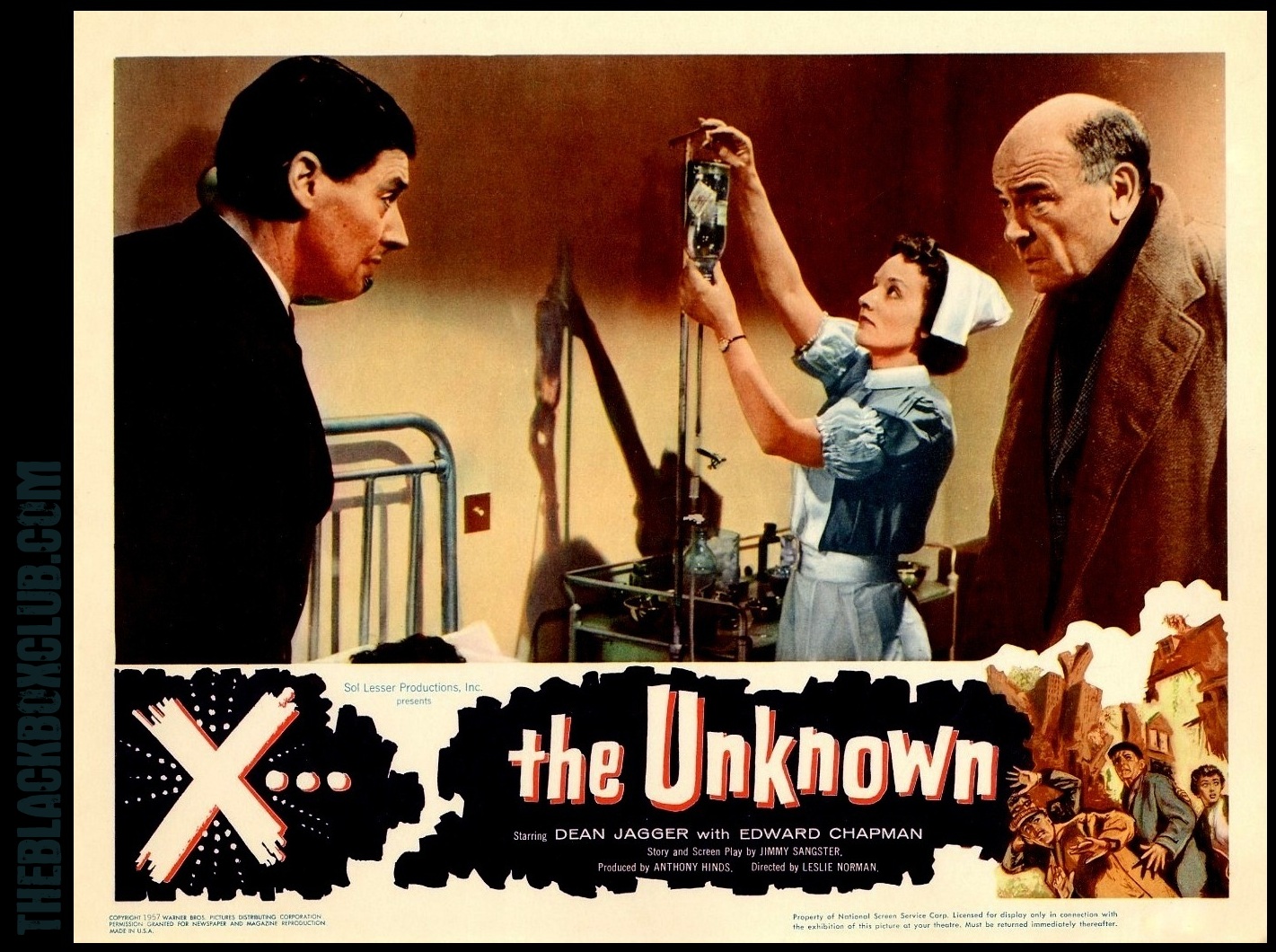
X THE UNKNOWN: HAMMER FILMS: 'CAN ANYTHING ESCAPE IT'S TERROR?' LOBBY CARDS GALLERY AND REVIEW

Soldiers in the Scottish Highlands are conducting manoeuvres in the countryside, the superiors teaching the troops to find radioactivity buried in a muddy field with a Geiger counter. When it looks as if they have all had their shot, it turns out not to be the case because one soldier complains he had not had a go, so amid much grumbling the canister is buried once again and off he goes. However, he has some trouble, due to the sudden increase in radioactivity in the area: that canister has attracted something from beneath the earth... something deadly.
In Britain during the nineteen-fifties the most influential fictional name in science fiction, and horror for that matter, was Professor Bernard Quatermass, the scientist dreamt up by writer Nigel Kneale for a wildly popular television serial. The low budget production company Hammer seized their chance to get the rights for the movie version, which turned their fortunes around and made them the byword for British horror movies across the world, but Kneale was maybe not quite as prolific for them as they had hoped, so when they wanted a new Quatermass film he was not able to deliver one quite yet.
Therefore Hammer turned to one of their staff, budding screenwriter Jimmy Sangster, to pen a script for a sequel, but Kneale was protective of his character and refused to allow permission. Their solution? Change the name of the lead scientist, here played by American import (for more international appeal) Dean Jagger, and go ahead with the production anyway, and the results were another hit for the studio, not to mention a new career for Sangster who became one of the most respected chiller screenwriters around. But X the Unknown was never truly going to rival Quatermass, and now is regarded as a footnote.
Which is kind of a shame, because if it was not up to Kneale standards it was nevertheless efficiently assembled and offered some fair suspense, along with some envelope-pushing gore, nothing that looks too ghastly by today's standards, but it's still surprising to see characters getting their flesh melted off in a movie of this vintage. For the first half of a pretty short effort, we have little idea of what has emerged from the ground to terrorise the locals, and the implication is that it may well be invisible, but those victims are reacting to something off-camera, so you'll be wondering what it could possibly be. It had to be said that the film was ruthless in bumping off those who crossed the monster's path.
So not only do the comic relief soldiers get melted - one of them played by a pre-fame Anthony Newley - but a little kid gets offed as well, which is particularly grim but illustrates the take no prisoners attitude of the menace. As to what that menace is, if you thought the first killer blob movie was, well, The Blob in 1958, then here was its predecessor, getting in there first with an extremely simple but undeniably effective movie monster, for it's a great big mass of radioactive mud which is bubbling up from the earth to devour the humans. Along with that effective item of nastiness on a budget, you got some Scottish colour to add personality to what might have been rather undistinguished otherwise, including one of the scuzziest drunks in fifties cinema, and as a bonus Leo McKern showed up as an inspector assisting Jagger's no-nonsense boffin for a serviceable middle-aged blob-fighting duo. If it remained in the shadow of Kneale, and still does, X the Unknown did entertain. Music by James Bernard, himself starting a great career with Hammer.


Review: Graeme Clark
Images: Marcus Brooks
Source:HERE
Related Posts Plugin for WordPress, Blogger...