RECENT POST FROM THE BLACK BOX CLUB

Friday, 25 January 2013

KARLOFF AND BAVA: BLACK SABBATH : I TRE VOLTI DELLA PAURA : GALLERY AND REVIEW

CAST:
Boris Karloff (Narrator). A Drop of Water:- Jacqueline Perreiex (Helen Corey), Milly (The Maid). The Telephone:- Michele Mercier (Rosy), Lidia Alfonisi (Mary). The Wurdulak:- Boris Karloff (Gorka), Mark Damon (Count Vladimir d’Urfe), Susy Andersen (Sdenka), Glauco Onorato (Gregor), Rika Dailina (Maria), Massimo Righi (Peter)

PRODUCTION:
Director – Mario Bava, Screenplay – Mario Bava, Alberto Bevilacqua & Marcello Fondato, Based on the Short Stories A Drop of Water by Anton Chekov, The Telephone by F.G. Snyder and The Wurdulak by Ivan Tolstoy, Producer – Paolo Mercuri, Photography – Ubaldo Terzano, Music – Roberto Nicolosi, Music (US Version) – Les Baxter, Art Direction – Giorgio Giovannini. Production Company – Emmipi Cinematografica/Lyre Cinematografica/Galatea S.P
SYNOPSIS:
A Drop of Water – A woman is asked to dress the corpse of a neighbour who has died but steals a ring from its finger. Upon returning to her apartment, the dead body rises to haunt her. The Telephone – A woman living alone in her apartment receives phone calls from her dead boyfriend whom she turned over to the authorities. He is now able to see everything she does and taunts her that he will kill her by dawn. The Wurdulak – A nobleman travelling across the Russian steppes seeks refuge with a family. They are concerned about their father who went hunting a vampire known as the wurdulak, leaving them with the warning that if he returned after five days he must be killed. The father returns just after the five days expire and the family is uncertain what to do, even as he starts to drink their blood 
COMMENTARY:
Black Sabbath was the seventh film of the great Mario Bava. Bava had single-handedly created the entire continental Gothic horror genre with his Black Sunday/The Mask of the Demon/The Revenge of the Vampire Woman (1960). Black Sunday was the greatest of Mario Bava’s several forays into the Gothic horror but Black Sabbath is commonly regarded as at least his second best. Here Bava seems to be trying to revisit what he did in Black Sunday – two of the three episodes are adapted, like Black Sunday, from stories by Russian authors, and the third story returns to the same 19th century Russian milieu of Black Sunday. The principle difference is that here Mario Bava shoots in colour as opposed to black-and-white.
Black Sabbath is an anthology of three stories. Boris Karloff is brought as linking narrator, fulfilling much the same function he did on tv’s Thriller (1960-62). The principal frisson in all three stories is the theme of an individual’s home being alienated from them – the first two stories almost entirely take place inside a single apartment with a woman being haunted and driven insane by an eruption of the supernatural. The first story A Drop of Water is occasionally heavy-handed but Mario Bava builds an effectively eerie accumulation of atmosphere through the likes of amplified drops of water and blinking lights from the street, eventually arriving at the ghostly appearance of the dead body in the apartment

Even better is the second story The Telephone, which has a number of intensely unsettling moments like where the mysterious caller starts taunting the girl about things she has just done; where writing mysteriously appears on a blank piece of paper as she is reading it; and the caller taunts her “You’ll be dead by dawn” – a shock effect taken from The Cabinet of Dr Caligari (1919).
  
The third and best story The Wurdulak most resembles Black Sunday in tone (although in colour it comes out looking more like a Hammer film). It too plays on a sense of alienation of the familiar – in this case, a vampire that specifically preys upon members of his own family by turning their affections against them. There are some fine scenes with Boris Karloff returning and settling back into normal family life in blithe disregard of his family’s uncertainty about what he has become. Mario Bava builds some intense atmosphere with faces seen outside windows, Boris Karloff skulking around in a white perm and subtly underlit makeup, and a superb moment where a now vampirized child returns, knocking on the door and his mother is unable to resist her maternal affections to go to him
 
Mario Bava’s other films are:- the Gothic classic Black Sunday/The Mask of the Demon/The Revenge of the Vampire Woman (1960); the Greek muscleman fantasy Hercules in the Center of the Earth/Hercules vs the Vampires (1961); the giallo The Evil Eye (1962); the Gothic horror Night is the Phantom/The Whip and the Body/What? (1963); the giallo psycho-sexual thriller Blood and Black Lace (1964); the Gothic Kill Baby ... Kill/Curse of the Dead/Curse of the Living Dead/Operation Fear (1965); the sf/horror film Planet of the Vampires (1965); the spy comedy Dr Goldfoot and the Girls Bombs (1966), Bava’s worst film; the masked super-thief film Danger Diabolik (1967); the giallo Five Dolls for an August Moon (1970); the giallo Hatchet for a Honeymoon/Blood Brides (1971); the giallo Twitch of the Death Nerve/Bloodbath/A Bay of Blood/Carnage/Ecology for a Crime (1971); the Gothic Baron Blood (1972); the giallo/haunted house film Lisa and the Devil/House of Exorcism (1972); and the possession film Shock/Beyond the Door II (1977).

Review: Richard Schieb
Images: Marcus Brooks

IN THE MAKE UP CHAIR: CHRISTOPHER LEE MR BLAKE : I , MONSTER : AMICUS FLMS (1971)

MAKE UP ARTIST HARRY FRAMPTON WORKS ON CHRISTOPHER LEE DURING THE MAKING AMICUS FILMS 'I MONSTER IN 1971. THE FILM ALSO STARS PETER CUSHING AND MIKE RAVEN.

Thursday, 24 January 2013

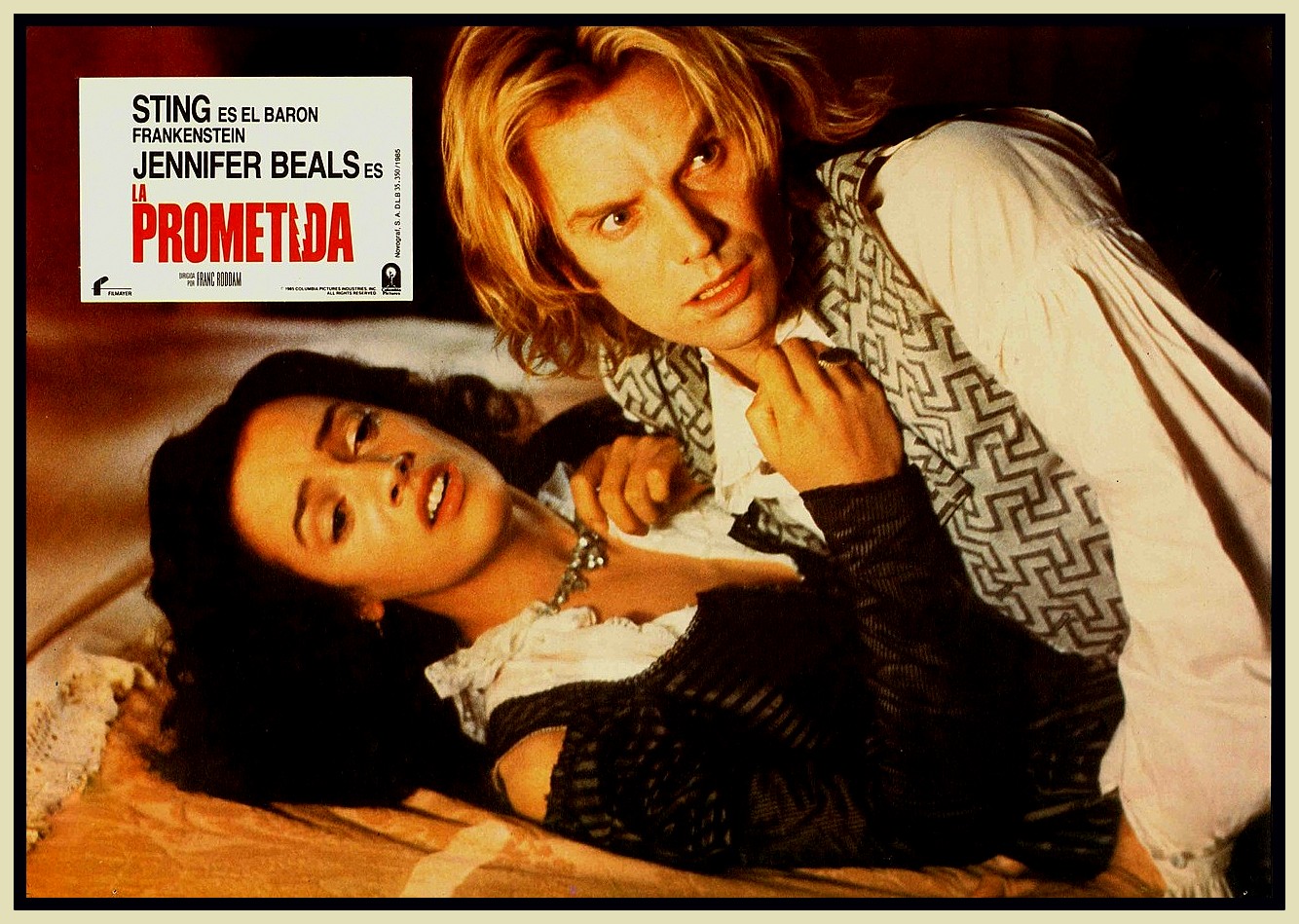
BEAL AND STING IN THE BRIDE: FRANKENSTEIN FOR DREAMERS: LOBBY CARD GALLERY AND REVIEW

CAST:
Sting (Baron Charles Frankenstein), Jennifer Beals (Eva), Clancy Brown (Viktor), David Rappaport (Rinaldo), Alexei Sayle (Magar), Phil Daniels (Bela), Geraldine Page (Mrs Baumann), Carey Elwes (Joseph), Veruschka (Countess), Quentin Crisp (Dr Zahlus) 
PRODUCTION:
Director – Franc Roddam, Screenplay – Lloyd Fonvielle, Based on the Novel Frankenstein by Mary W. Shelley, Producer – Victor Drai, Photography – Stephen H. Burum, Music – Maurice Jarre, Special Effects Supervisor – James Whiting, Makeup – Sarah Monzani & Aaron Sherman, Production Design – Michael Seymour. Production Company – Columbia. USA. 1985.  
SYNOPSIS:
Using harnessed lightning, Baron Charles Frankenstein brings to life his second creation, a beautiful female. He names her Eva. His first creation, a male, Viktor, is angry when Frankenstein betrays his promise to give her to him as a mate. Viktor is then consumed in a laboratory explosion but survives. Presumed dead by Frankenstein, he meets Rinaldo, a friendly dwarf who invites Viktor to join him on a trip across Europe to join a circus in Bulgaria. Meanwhile, as Frankenstein introduces her to society, Eva becomes the attention of many male paramours. A battle of wills ensues as she comes to desire her independence from Frankenstein.

COMMENTARY:

Director Franc Roddam promoted The Bride as being a feminist reworking of Bride of Frankenstein (1935). It was a lavish big-budget version that was clearly a revisionist attempt. This meant goodbye to Dr Pretorious, Queen Nefertiti hairdos and Boris Karloff with his tombstone intonation: “We belong dead” and all resemblances to the 1935 version. There is no longer any of the dark, arch humour that James Whale invested the original with. Instead, this is a film drenched in period atmosphere – at times, The Bride looks for all the world closer in tone to a straight version of My Fair Lady (1964) than anything resembling James Whale’s droll classic.
Certainly, The Bride is a film that is beautiful to look at. The photography is stunning – the Countess’s reception is like a perfectly poised Classical canvas. The production design is superb – the multi-tiered laboratory in the opening scene with ornate inscriptions in German and giant buckets of water waiting to douse the lightning rods evinces a great shiver of excitement. However, the film is no more than a series of posed tableaux. Franc Roddam has no idea how to dramatically enervate it. 

The laboratory opening is indeed spectacular, but thereafter the film splits off into its two separate storylines – one following Viktor’s trek across Europe (and the bonding scenes with he and the dwarf do get terribly twee) and the other about Frankenstein and Eva’s battle for supremacy – but it merely becomes one tableaux following another without dramatic cohesion. There is no Dr Pretorious character in this film – the film could have done with something that to get it worked up. 
As Frankenstein, Sting does what he does best – acting ruthless and evil (he is the perfect person to play The Vampire Lestat (1985) if they ever get around to filming it) – but the character has no depth beyond that. Jennifer Beals came to attention after her sizzling debut in Flashdance (1983) and this was her second film. Subsequent to Flashdance, she almost entirely vanished without a trace. With her dark saucer-eyes, she is all provocative innocence but the moment she opens her mouth, her American accent crashingly destroys all pretence. Much better is the pairing of David Rappaport and Clancy Brown – Rappaport’s crafty swagger has charm and Clancy Brown’s slow genteel brings a touch of pathos to the monster altogether missing since the days that Boris Karloff stopped playing the part. 
In the end, The Bride will probably only be remembered for Franc Roddam’s ability to bring together a most unusual cast list – one of the world’s biggest rock stars Sting; England’s ‘stately homo’ Quentin Crisp of The Naked Civil Servant (1975) fame as the lab assistant, no less); absurdist comedian Alexei Sayle; Polish model Veruschka; the eccentric grand dame and previous year’s Best Actress Oscar winner Geraldine Page; diminutive 3’11” David Rappaport; and, apparently, Mariel Hemingway, who was cast as Elizabeth but had her scenes cut out. 
British director Franc Roddam had come to fame with Quadrophenia (1979), based on The Who album and featuring Sting in his first acting role, and The Lords of Discipline (1983) about brutality in a military academy. Roddam’s subsequent films have been the little-seen War Party (1988) about an historical war reenactment gone wrong and the mountaineering drama K2 (1992), as well as the tv mini-series Moby Dick (1998) and Cleopatra (1999). He is also the creator of the classic 1980s British tv series Auf Weidersehen, Pet (1983-6) and creator of the reality tv series Masterchef (1990-2001) and its various spinoffs. Screenwriter Lloyd Fonvielle also wrote the stories for Cherry 2000 (1987) and The Mummy (1999), as well as wrote and directed the unusual film noir ghost story Gotham/The Dead Can’t Lie (1988).      

 Richard Scheib

Wednesday, 23 January 2013

CHRISTOPHER LEE RETURNS : BARBARA SHELLEY : SUZAN FARMER : DRACULA PRINCE OF DARKNESS : KEY STILLS GALLERY AND REVIEW


CAST:
Andrew Keir (Father Shandor), Christopher Lee (Count Dracula), Francis Matthews (Charles Kent), Barbara Shelley (Helen Kent), Suzan Farmer (Diana Kent), Charles Tingwell (Alan Kent), Philip Latham (Klove), Thorley Walters (Ludwig)


PRODUCTION:
Director – Terence Fisher, Screenplay – John Sansom, Story – John Elder [Anthony Hinds], Producer – Anthony Nelson-Keys, Photography – Michael Reed, Music – James Bernard, Music Supervisor – Philip Martell, Special Effects – Bowie Films Ltd, Makeup – Roy Ashton, Production Design – Bernard Robinson. Production Company – Hammer/Seven Arts. UK. 1966.  


SYNOPSYS:
Two English couples holidaying in Transylvania are abandoned on the roadside after their coach breaks down. They are picked up by a driverless black coach and taken to Castle Dracula where they are granted hospitality by Dracula’s manservant. During the night, one of the men is attacked and gutted by Dracula’s manservant and his blood used to revive Dracula. Two of the group manage to flee the castle. In the village below, they join a local priest in standing up to destroy Dracula.


COMMENTARY:
Dracula - Prince of Darkness was the third of Hammer’s Dracula films. Unlike the first sequel The Brides of Dracula (1960), Prince of Darkness brings back Christopher Lee who had refused to return to the series until he had established himself as a serious actor first.


The Brides of Dracula worked well despite the absence of Christopher Lee but Prince of Darkness achieves somewhat less successfully despite Lee’s return. It is a film that never coheres or gets fired up despite a great deal of potential to do so. A large part of the problem is Christopher Lee who, while he returns, gets no dialogue (although Lee claims this was his own choice because the dialogue he was given was so awful). Reduced to merely hissing and dilating his red contact lenses, this has the effect of making Lee much more animalistic – something that Lee conveys most effectively – but the net result is that the central threat in the film is like a tiger in a cage, prowling and roaring, but never getting to pounce.


Certainly, many of the other elements come together well. The opening of the film – warnings to avoid the castle; villagers refusing to acknowledge its existence even though it sits in front of their eyes; travellers abandoned in the middle of nowhere and then the appearance of a mysterious black coaches harnessed to horses that have wills of their own; and the castle, which is conversely shown to be welcoming with dinner laid out and a fire stoked up, even luggage placed in their respective rooms – builds an increasing sense of unease. 


This erupts in a shock sequence where Charles Tingwell is stabbed and his body is hoisted upside down over the catafalque containing Dracula’s ashes and the throat slit to spill his blood, which brings the ashes to life. It is a conceptually remarkable sequence – one that created considerable controversy at the time, blasphemous inversions of The Crucifixion being seen in it and all – although today seems tame. 


Thereafter, Dracula - Prince of Darkness becomes more a series of set-pieces, loosely connected by the overall plot of Dracula trying to seduce Suzan Farmer while husband Francis Matthews sets out to rescue her. There are a number of good sequences interspersed throughout – notably the climax where Dracula runs out onto the ice and Andrew Keir shoots into it around him, causing it to crack and Christopher Lee to be swallowed up by the running water (although the sequence is betrayed by cramped sets – the ice-pack being only several yards square. It is a problem shared in other parts of the film too – the castle corridor where most of the skulking takes part is about 20 feet in length and contains only two doors). The film is also happy to swipe the Renfield character out of Bram Stoker – calling him Ludwig – with Thorley Walters giving an amusingly doddery performance in the role.


The most remarkable sequence in the film is the scene where Barbara Shelley is held down on a table, hissing and writhing, as a stake is hammered into her heart by the dispassionate priesthood. It is perhaps the most potent image of sexual repression in all of British horror cinema. Indeed, Dracula - Prince of Darkness, more than any of the Hammer Draculas, embodies the recurrent image of sexual repression threatening to emerge to tear Victorian society apart and its dispassionate elimination by men of reason. 


The travellers are deliberately set up as representatives of English genteel in order to be torn apart – the strongest image of this polarity is the turning of the prim, uptight and anxious Barbara Shelley into a voluptuous vampire, begging Francis Matthews “Give us a kiss.” The sexual overtones in the scene where Christopher Lee causes Suzan Farmer to kneel and drink from the cut he opens with his fingernail in his chest are incredibly vivid.


Hammer’s other Dracula films are:– Dracula/The Horror of Dracula (1958), The Brides of Dracula (1960), Dracula Has Risen from the Grave (1968), Taste the Blood of Dracula (1970), Scars of Dracula (1971), Dracula A.D. 1972 (1972), The Satanic Rites of Dracula/Count Dracula and His Vampire Bride (1973) and The Legend of the 7 Golden Vampires/The Seven Brothers Meet Dracula (1974). 


Terence Fisher’s other genre films are:– the sf films The Four-Sided Triangle (1953) and Spaceways (1953), The Curse of Frankenstein (1957), Dracula/The Horror of Dracula (1958), The Revenge of Frankenstein (1958), The Hound of the Baskervilles (1959), The Man Who Could Cheat Death (1959), The Mummy (1959), The Stranglers of Bombay (1959), The Brides of Dracula (1960), The Two Faces of Dr Jekyll (1960), The Curse of the Werewolf (1961), The Phantom of the Opera (1962), The Gorgon (1964), Frankenstein Created Woman (1967), The Devil Rides Out/The Devil’s Bride (1968), Frankenstein Must be Destroyed (1969) and Frankenstein and the Monster from Hell (1973), all for Hammer. Outside of Hammer, Fisher has made the Old Dark House comedy The Horror of It All (1964) and the alien invasion films The Earth Dies Screaming (1964), Island of Terror (1966) and Night of the Big Heat (1967).
 

Review: Richard Schieb
Images: Marcus Brooks  

Tuesday, 22 January 2013

JANE SEYMOUR PIN UP 41: SINBAD AND THE EYE OF THE TIGER. MORE SEYMOUR PHOTOS TO COME!

BLACKBOXCLUB PIN UP NUMBER 41: JANE SEYMOUR IN 'SINBAD AND THE EYE OF THE TIGER' CLICK ON LINK FOR MORE STILLS OF JANE AND GALLERY. http://theblackboxclub.blogspot.co.uk/2012/07/jane-seymour-taryn-power-patrick-wayne.html

KB ZORKA ON THE LIFE AND CAREER OF PRUDENCE HYMAN: DEAR PRUDENCE : THE GORGON HAMMER FILMS 1964

"No living thing survived and the spectre of death hovered in waiting for her next victim."
  -'The Gorgon,' (1964)

It's only natural that when we think of the ladies of the classic Hammer Horror films, we think of the countless, beautiful women that will forever be as associated with the studio's name as that of Christopher Lee or Peter Cushing. We think of names such as Ingrid Pitt or, First Lady of Hammer: Hazel Court. However, the first woman to become anything but beautiful for the studio, was the unknown, Prudence Hyman. Subsequently, it was after the release of The Gorgon,  that Hammer would begin a long legacy of these dangerous females. And all of it began with an ex-ballerina and ENSA performer named, Prudence Hyman.


Long before she would become Hammer's Gorgon, 'Megaera,' Prudence Hythe was born in London, England on February 2, 1914. She was a classically trained ballerina who studied in England and  Paris and made her dancing debut at the age of seventeen in 'Twelfth Night.'  Between 1934-1935, she toured with various ballet companies, and during the second World War, she was a member of  ENSA; a traveling group of artists whose purpose was to entertain the troops. It was while she was a member of the ENSA group, that Prudence and her fellow members were once flown to safety during a harrowing adventure through a horrible storm. The group's hero was a young, Royal Air Force Lieutenant that, interestingly, she would manage to meet-up with many years later: None other than Christopher Lee.


In 1960, Prudence played a small, uncredited role alongside the once brave pilot in Hammer's, The Two Faces of Dr Jekyll. She played the part of a tavern woman, while Paul Massie took on the dual role of the mad scientist. However, it would be four years later that Prudence Hyman would make horror history: She would be the first female monster in Hammer's long, Gothic-style film legacy.


The Gorgon was one of the last films to have been produced by Hammer during their six-year distribution deal with Columbia Pictures. Seeing as their last two films had been shelved by the distributor, the studio needed something new and exciting that would bring audiences back to the theater. To do so, they went straight to the public itself. An advertisement was placed in 'The Daily Cinema' magazine, in which the film company was soliciting stories from anyone with a good idea.The last line of the advertisement read as follows: "Because good, compulsive selling ideas with the right titles are what Hammer are looking for right now." Of the many submissions, a story by J. Llewellyn Divine was selected. It was a rather involved and lengthy story. But, after a bit of re-writing and initially naming the script, "Supernatural", the script was rewritten a second time and given the name, The Gorgon.


Shooting began in December of 1963 at Bray Studios,where The Evil of Frankenstein had just wrapped production. Due to budget and time constraints,as well as to give the set the look and feel of 1910, many of the same interior sets from The Evil of Frankenstein were redressed and used for The Gorgon. The film starred Christopher Lee, Peter Cushing and Hammer's most famous female star of the time.The "First Leading Lady of British Horror," Barbara Shelley. On board as director was, in my humble opinion, the man who made Hammer Horror what it is: The legendary Terence Fisher (February 23, 1904-June 18, 1980). 


In the role of 'Carla Hoffman', Barbara Shelley had wanted to simultaneously play the role of the title character. As the film's possessed, amnesiac heroine, she felt that the dual role would make the storyline more sensible and fluid; that it should be she who "gorgonized" the film's victims. She also had a few ideas for producer Anthony Nelson Keys on how to make Megaera more frightening and realistic as well. Her idea consisted of using real garden snakes, and to find a way to humanely weave them into a special wig. However, due to the film's budget and short production schedule, Nelson rejected her idea, and chose instead to use another actress to play the part: Prudence Hyman. Nelson also felt that with a different actress playing the part, it would help to conceal the Gorgon's alternate, "human" identity. Although, after seeing The Gorgon herself on screen, the producer had regretted his decision about Shelley's wig idea. It's difficult to say if it was Hyman herself, or the costume which disappointed Nelson. Nonetheless, Christopher Lee's opinion of Megaera was also less-than-flattering: "The only thing wrong with The Gorgon, is The Gorgon!" Fortunately, fans today are less forgiving.  


To create the look of The Gorgon and her snakes, makeup man Roy Ashton applied the hideous skin and makeup to Hyman, while special effects engineer, Syd Pearson, had a bit more of a challenge by creating the snakes themselves. Pearson had twelve plaster moulds made, and from each mould he cast latex rubber snakes. Cables were then placed through each of the snakes' bodies for movement, and were then woven through the actress' wig. Each snake was then individually attached to cables which ran down Hyman's back. The cables trailed approximately twenty-five feet behind her where they were controlled by a large contraption which contained pegs. As the pegs were turned, the tension gave the effect of each snake moving individually.


The Gorgon finished production in January, 1964, and was double-billed with Curse Of The Mummy's Tomb. Although we only see The Gorgon herself for less than twenty minutes throughout the entire film, each shot of Prudence Hyman's 'Megaera' is a treat, to say the least. The cinematography of Michael Reed is simply superb and, in true Hammer form, the sets are gorgeous. Hyman herself moves with a grace and elegance that one would expect from a former ballerina. Incredibly, she went back to playing uncredited roles for the studio. She was given small parts in Rasputin: The Mad Monk, and The Witches, which were both were released in 1966. 


It is truly interesting to know that an unknown actress with no starring roles, or major parts, made horror film history as one of it's first female monsters; and the first for Hammer. Sadly, the name Prudence Hyman remains rather unknown, and The Gorgon has only recently become appreciated as one of Hammer's lesser known and hidden gems. Very little has been written about Prudence Hyman, or her incredible contribution to the horror genre. As is normally the case with so many important people throughout history, it is not in their lifetimes that they are appreciated, or even understand what they have accomplished while they're alive: such was the case with Prudence Hyman. She died at the age of 81 on June 1, 1995 and was put to rest in her birthplace of London, England. 

FEATURE: KB ZORKA @http://theoblongbox10.blogspot.co.uk/ 
IMAGES: MARCUS BROOKS

Related Posts Plugin for WordPress, Blogger...