RECENT POST FROM THE BLACK BOX CLUB

Showing posts with label anthony hopkins. Show all posts

Friday, 5 April 2013

DO YOU BELIEVE IN REINCARNATION? AUDREY ROSE: ANTHONY HOPKINS SUSAN SWIFT: GALLERY AND REVIEW


CAST:
Marsha Mason (Janice Templeton), Anthony Hopkins (Elliot Hoover), John Beck (Bill Templeton), Susan Swift (Ivy Templeton), Norman Lloyd (Dr Steven Lipscomb), Philip Sterling (Judge Harmon Langley), Robert Walden (Brice Mack), John Hillerman (Scott Velie) 

PRODUCTION:
Director – Robert Wise, Screenplay/Based on the Novel by Frank De Felitta, Producers – Frank De Felitta & Joe Wizan, Photography – Victor J. Kemper, Music – Michael Small, Special Effects – Henry Millar Jr, Production Design – Harry Horner. Production Company – United Artists. 


SYNOPSIS:
Bill and Janice Templeton become concerned about a stranger who keeps following and calling them and sends presents to their 11 year-old daughter Ivy. The stranger introduces himself as Elliot Hoover and tells them how he has come to believe following a trip to India that Ivy is the reincarnation of his daughter Audrey Rose who was killed in a car crash the same day that Ivy was born. He is able to calm Ivy’s recurrent nightmares down by calling her Audrey Rose. Hoover then abducts Ivy but is arrested. His subsequent attempts to argue a case for reincarnation at his trial become a cause celebre.


COMMENTARY:
Rosemary’s Baby (1968) gave birth to an enormous cinematic occult horror boom in the 1970s. The boom spawned such successes as The Exorcist (1973), Carrie (1976) and The Omen (1976), each of which propagated their own subgenres of imitators. Audrey Rose came near at the end of that cycle when the genre had successfully established itself among A-budget films and where the theme of evil and/or possessed children was its overriding subject.


Both the film of Audrey Rose and the 1975 Frank De Felitta book it is based on give the feeling of a story that wanted to be something more serious that instead ended up pigeonholed in the horror genre. Screenwriter/original novelist De Felitta’s other works show him as a writer who wants to deal with the supernatural as real (or at least the sort of supernatural that becomes the stuff of tabloid magazines – reincarnation, hauntings, ghost rapes). His novel was set up toward the purpose of placing an argument for reincarnation on a courtroom stand, which must surely stand as the ultimate arbiter of Western rationalism. (In reality though, the case presented here probably would be thrown by any court – whether or not Ivy is the reincarnation of Hoover’s daughter is surely irrelevant, the only thing a court is interested in is the issue at hand – whether or not Hoover abducted Ivy). The film does change the balance of the book somewhat. In the book, the court case took up nearly three-quarters of the story but in the film the court case is reduced to only two or three showcase arguments and presented with considerable bias – no contrary arguments doubting or questioning reincarnation are ever highlighted from the prosecution’s side, for instance.


The film cannot escape the basic fact that it is burdened by a wordy and static script. This however does lead to a unique approach from director Robert Wise who uses the dialogue itself as suspense. Wise hypnotically engages us in Anthony Hopkins’s monologues, where one becomes so enrapt that even small movements like the spilling of a teacup or the relatively uninteresting shot of a door opening behind someone eavesdropping on a conversation is made to hold suspenseful power. There are some effective scenes – particularly the one with burns suddenly appearing on Susan Swift’s hands when she places them on a cold window. However, try as Robert Wise might to turn Audrey Rose into an interesting dramatic film, the material remains solidly unmoving.


The first half of the film, set around Hoover’s bizarre intrusion into the family digs into the 1970s Stranger Danger peril. Hoover’s actions are designed with the intent of making the family anxious – their being followed, anonymous phone-calls, mysterious presents left, the child being abducted from school and from the apartment – without any thought placed into why the otherwise relatively rational Hoover is behaving so creepily. When we come to understand where the character is coming from later in the film, such furtive actions fail to make sense. The film’s generation of Stranger Danger paranoia is ironically so effective that it becomes almost impossible to view Hoover’s motivations normally and it is only through turning of him into a passive wimp for the rest of the film and Anthony Hopkins’s performance that the character succeeds in retaining any sympathy. Far better at engendering sympathy is Marsha Mason who gives an enormously convincing performance in what is essentially a passively handwringing role. Young Susan Swift also manages to comes across as mature and intelligent.


Robert Wise directed a number of classic films including Run Silent, Run Deep (1958), West Side Story (1961) and The Sound of Music (1965). Wise’s other genre films are:– The Curse of the Cat People (1944) and The Body Snatcher (1945), two classic psychological horror films made for Val Lewton; the human hunting film A Game of Death (1945); the alien visitor classic The Day the Earth Stood Still (1951); the haunted house classic The Haunting (1963); the Michael Crichton adaptation The Andromeda Strain (1971) and Star Trek – The Motion Picture (1979).


Screenwriter Frank De Felitta has a number of other genre credits. He wrote and produced the overpopulated future film Z.P.G. (Zero Population Growth) (1971); directed/wrote the tv movie Trapped (1973) about a man hunted through a department store by dogs; directed/wrote the supernatural time travel tv movie The Two Worlds of Jennie Logan (1979); directed the American Gothic tv movie The Dark Night of the Scarecrow (1981); wrote the interesting ghost story The Entity (1982); and directed/wrote the worthwhile psycho-thriller Scissors (1991).  

Review:HERE
Images: Marcus Brooks 

Tuesday, 25 December 2012

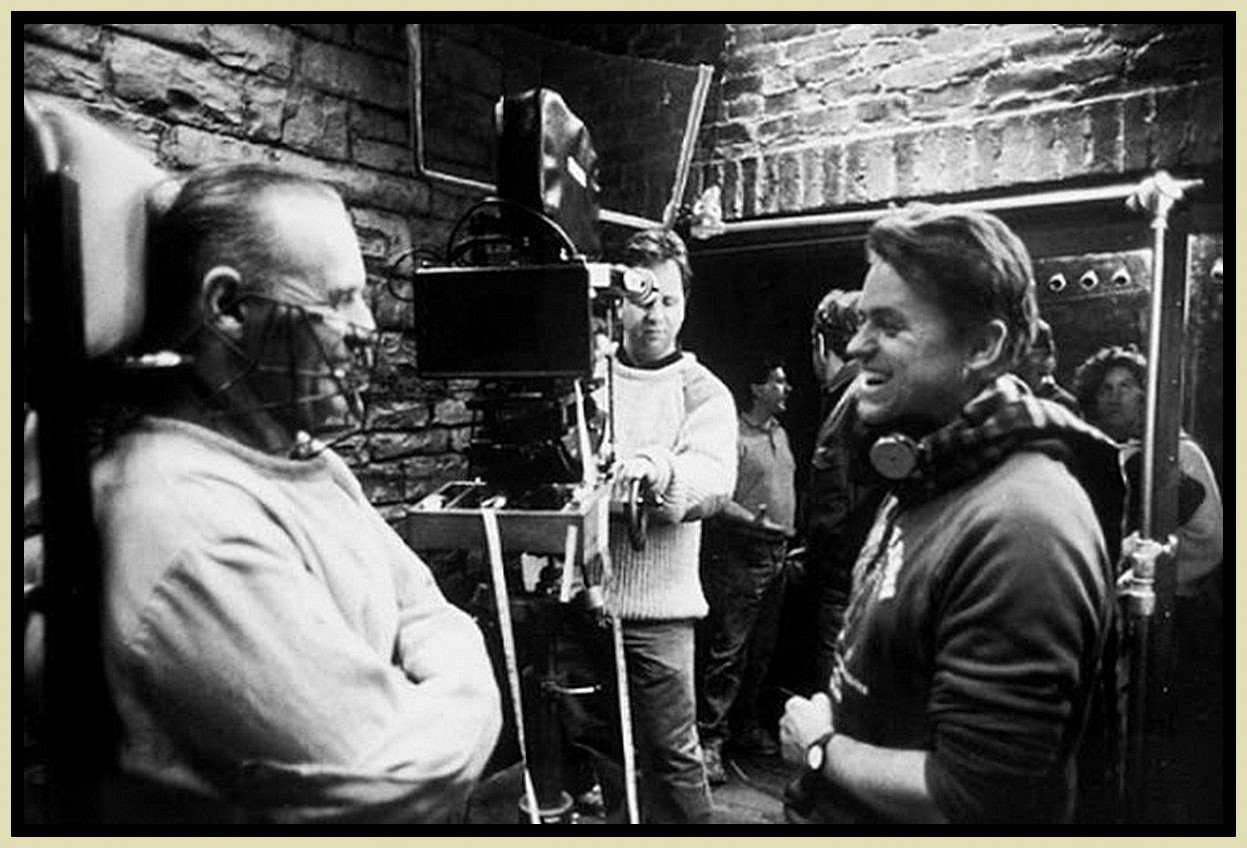
JODIE FOSTER : ANTHONY HOPKINS : THE SILENCE OF THE LAMBS : GALLERY AND REVIEW

CAST:
Jodie Foster (Clarice Starling), Anthony Hopkins (Dr Hannibal Lecter), Scott Glenn (Jack Crawford), Ted Levine (Jame Gumb), Anthony Heald (Dr Frederick Chilton), Brooke Smith (Catherine Martin), Kasi Lemmons (Ardelia Mapp), Diane Baker (Senator Ruth Martin)
PRODUCTION:
Director – Jonathan Demme, Screenplay – Ted Tally, Based on the Novel by Thomas Harris, Producers – Ron Bozman, Edward Saxon & Kenneth Utt, Photography – Tak Fujimoto, Music – Howard Shore, Makeup – Carl Fullerton, Production Design – Kristi Zea. Production Company – Strong Heart/Demme. 
SYNOPSIS:
Trainee FBI agent Clarice Starling is assigned by the FBI’s Behavioural Science Director to interview Hannibal Lecter, a former psychiatrist of genius intelligence with a predilection for cannibalism where he is locked away in a maximum security cell. It is hoped that Clarice can bring Lecter’s understanding of the psychopathic mind to bear on the serial killer nicknamed Buffalo Bill who is skinning the bodies of women across the country. As time draws near for another victim who has just been abducted by Buffalo Bill, the fascinating, urbane Lecter draws Clarice into his web, taunting her with clues in return for personal information about her past.
Thomas Harris is to thrillers what Stanley Kubrick was to cinema. Both were recluses; both were exacting perfectionists who only produced one work a decade it seemed – there is an average of seven years between Thomas Harris’s novels; and when each work did appear it was a masterpiece of its form. Thomas Harris has only produced five books so far – Black Sunday (1975), Red Dragon (1981), The Silence of the Lambs (1988), Hannibal (1999) and Hannibal Rising (2006). All of these have been filmed – as Black Sunday (1977) and the Hannibal Lecter tetraology, which is listed at the bottom of the page.
The Silence of the Lambs is generally regarded as a landmark and a modern masterpiece. It won that year’s Academy Awards for Best Film, Best Director, Best Adapted Screenplay, Best Actor (Anthony Hopkins) and Best Actress (Jodie Foster). Without a doubt, The Silence of the Lambs was influential – it made the career of Anthony Hopkins who had a substantial body of work mostly as a supporting actor before this but rarely as a lead. (Ironically, despite coming to fame as a genius cannibal here, Anthony Hopkins then found himself cast as a latter-day Laurence Olivier in various costume dramas).
The Silence of the Lambs was perhaps the single most influential genre film of the 1990s, producing hordes of imitators about people going to visit psychopathic geniuses locked in cells – Beyond Bedlam/Nightscare (1994), Angel Dust (1994), Just Cause (1995), The Ugly (1997), Instinct (1999), Oxygen (1999), The Cell (2000), Antibodies (2005) and Cold Blood (2005-6). Moreover, its model, wherein Thomas Harris had drawn upon the FBI methods of psychologically profiling serial killers, developed a fascination with the public, with the term ‘serial killer’ entering popular parlance, even becoming an object of cultish veneration. A number of films rushed to copy The Silence of the Lambs’s model of detectives tracing criminals using forensic psychology – the likes of Slaughter of the Innocents (1993), When the Bough Breaks (1994), Se7en (1995), Copycat (1995), Kiss the Girls (1997), Postmortem (1997), The Bone Collector (1999), Resurrection (1999), The Watcher (2000), Murder By Numbers (2002), Mindhunters (2004), Taking Lives (2004), Twisted (2004) and tv series such as Prime Suspect (1991– ), Cracker (1993-6), Millennium (1996-9), Profiler (1996-9) and CSI: Crime Scene Investigators (2000– ) and its spinoffs.  
Although, for all their use of the forensic psychology model, The Silence of the Lambs and its successors seemed to oddly repudiate it. Certainly, there is an intense fascination to this new genre – what one might call the forensic psychology psycho-thriller – as one watches a detective story being built up out of patterns and tiny behavioural clues. Prior to The Silence of the Lambs, the psycho movie genre’s view of psychology and behaviour had been rooted in absurdly outmoded and melodramatic forms of Freudian trauma – Psycho (1960) and successors – or where killers were stripped of human motivation and seen as incarnate faces of evil – Halloween (1978) and Friday the 13th (1980) and various sequels. The forensic psychology psycho-thriller gave the psycho film psychological motivation – it took a glimpse inside the heads of psychopaths at what made them tick behaviourally.
Oddly and with recurrent regard, these films, upon introducing the image of the forensic psychological profiler, then repudiated what it stood for. Almost all of the post-The Silence of the Lambs films have created uber-killers – geniuses that are beyond normal psychopathological motivation and who sit and toy with their pursuers – Hannibal Lecter here, Ed Harris in Just Cause, the killer in Copycat, Jack of All Trades in Profiler, Brian Wicklow in Cold Blood – or who laugh at any attempt to analyse their motivation – Brad Pitt in Kalifornia (1993) and Machine in 8MM (1999). In contrast, real forensic psychology brought serial killer motivation into the open and explained what they did in terms of psychological motivation where concepts of good and evil were moral judgements that served little purpose. The forensic psychology film on the other hand contrarily emphasises less the mundanity of their crimes as it did moral horrors with the likes of Se7en, 8MM and Millennium even going so far as to tie killers to impending social collapse.
The true debate in forensic psychology thrillers is a libertarian vs determinist one – are killers responsible for their behaviour? Real world forensic psychology tends to see most killers as helpless pawns caught in behavioural patterns caused by extreme childhood abuse, whereas forensic psychology films to a person glimpse inside the madness and conclude that not only they but by implication all social disease is down to choice. It is a conservative viewpoint. To place this in perspective – these are the same arguments used to justify the death penalty – that every person is responsible for their actions, that all crime is something that is morally chosen. 
The Silence of the Lambs may be one of those occasions where one feels out of step with general critical opinion. Thomas Harris’s book is a genuine steel trap of a thriller – a book that this author has read all in one sitting. The film is a competent psycho-thriller but left one wondering what all the fuss was about. There are times that the film is amazingly faithful to small details of the book – the chess game timed by the beetle crossing the board, Miggs’s ejaculating into Clarice’s hair, Gumb using a couch to fool Catherine Martin to helping him, even some of the dialogue word for word. Other time it cuts and drops wholesale and what screenwriter Ted Tally substitutes is amazingly clumsy and ham-fisted – like Lecter’s trail of clues leading Clarice to Raspail’s car, which gets concertinaed down to a laughable clue about “Help Yourself”. Gone is Lecter’s teasing game with Senator Martin about ‘Billy Rubin’. Most of all gone is the book’s unfolding profile of Buffalo Bill. We have a few glimpses given throughout of Bill skinning large-bodied women, Lecter’s hints that he covets something and that he is not a real transsexual, some clues about sewing – but gone are any of the book’s explanation as to how Gumb built a coat of breasts. In its place, we see Ted Levine looking like a gender-bender refugee from a Guns‘n’Roses concert.
Part of the problem with The Silence of the Lambs is also Jonathan Demme. Jonathan Demme is a competent commercial director, no more. Demme had made various weak comedies such as Something Wild (1987) and Married to the Mob (1988). Subsequent films such as Philadelphia (1994) exist more as sentimentality-heavy sermons aimed at the Academy Awards crowd, while his remake of The Manchurian Candidate (2004) failed to take off. (The exception being the superb Beloved (1998), which should have won the accolades that The Silence of the Lambs did). Jonathan Demme’s fundamental crime here is failure to have faith in the ability of Thomas Harris’s story to tell itself. To express points that do not need it, he resorts to caricature – the pompous Chilton becomes a puffed-up cardboard character; there is no reason why Gumb needed to be an over-the-top crossdresser when a single scene of him dressing in a dead woman’s breasts or even describing such would have had unforgettable impact.
The character of Hannibal Lecter and Anthony Hopkins’s fine performance have an undeniable effectiveness (and went onto to become a cultural icon) but again Jonathan Demme overstates the part and has to deck Lecter out in pasty face and have him calmly conducting music in the air while covered in blood and surrounded by dead bodies. The scenes between Anthony Hopkins and Jodie Foster have their own creepy fascination but again Jonathan Demme lacks it as a storyteller. The dramatic emphasis of the film is on the obvious set-pieces – Lecter’s escape from prison, or Clarice’s surprise turning up at Gumb’s house while the FBI trap closes in another direction, her being hunted with a nightscope in the cellar. While Jonathan Demme hypes the story in these places, there is none of the sense you get in Thomas Harris’s novel of Hannibal Lecter sitting in his cell controlling the entire game and having both the FBI and Senator Martin’s running about and of the way that Thomas Harris would, with breathtaking skill, pull the carpet out from underneath the reader. The best one can say for The Silence of the Lambs is that it is a competent thriller for those who have not read Thomas Harris.  
Hannibal (2001) was a direct sequel, featuring a return performance from Anthony Hopkins but not Jodie Foster. The less well-known Manhunter (1986), based on Thomas Harris’s Red Dragon (1981), features Hannibal Lecter’s first screen appearance. Subsequent to the success of The Silence of the Lambs and Hannibal, Manhunter was remade as a prequel and a Hannibal Lecter origin story with Red Dragon (2002) also featuring Anthony Hopkins. Hannibal Rising (2007) was a further prequel, telling the story of Lecter’s childhood. The Silence of the Hams (1994) was a parody. Parodies can also be found in Fatal Instinct (1993), National Lampoon's Loaded Weapon 1 (1993), Austin Powers in Goldmember (2002), Cats & Dogs: The Revenge of Kitty Galore (2010) and Hoodwinked Too! Hood vs. Evil (2011).

Review: Richard Scheib
Images: Marcus Brooks
  
Related Posts Plugin for WordPress, Blogger...