RECENT POST FROM THE BLACK BOX CLUB

Showing posts with label john wyndham. Show all posts

Friday, 11 May 2012

'VILLAGE OF THE DAMNED': WYNDHAM'S CUCKOO'S' REVIEW AND LOBBY CARD GALLERY


CAST:
George Sanders (Professor Gordon Zellaby), Michael Gwynn (Major Alan Bernard), Martin Stephens (David Zellaby), Barbara Shelley (Anthea Zellaby), Laurence Naismith (Dr Willers)


CREW:
Director – Wolf Rilla, Screenplay – Wolf Rilla, George Barclay & Stirling Silliphant, Based on the Novel The Midwich Cuckoos by John Wyndham, Producer – Ronald Kinnoch, Photography (b&w) – Geoffrey Faithfull, Music – Ron Goodwin, Photographic Effects – Tom Howard, Art Direction – Ivan King. Production Company – MGM.


PLOT:
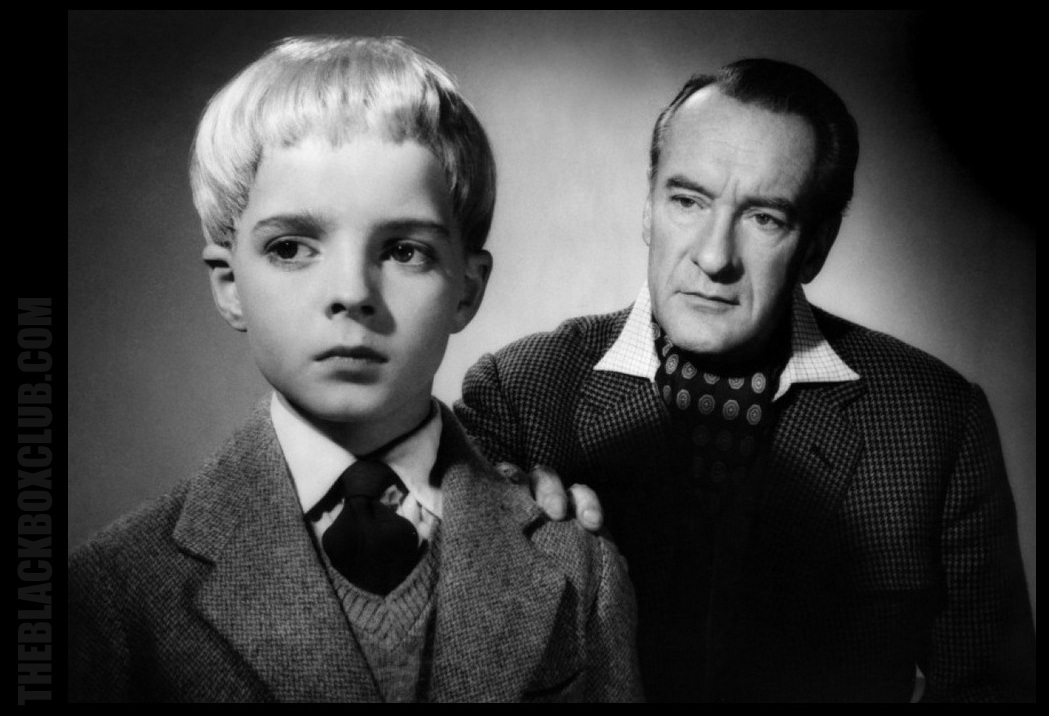
A mysterious forcefield affects the English village of Midwich, causing everybody within its radius to fall asleep. Afterwards, every women of child-bearing age is found to be pregnant, including teenage girls and women whose husbands were absent. All give birth to blonde-haired children who have remarkable intelligence and a complete lack of emotion. As the villagers band together in fear, the children group together to defend against all that threatens them and demonstrate powerful mind control abilities.


COMMENTARY:
This fine adaptation of John Wyndham’s novel The Midwich Cuckoos (1957) is one of the few successful attempts at translating across the Atlantic the paranoia of 1950s American science-fiction films like It Came from Outer Space (1953), Invaders from Mars (1953) and Invasion of the Body Snatchers (1956). Village of the Damned adapts the fear of takeover that plays out in American science-fiction of the 1950s in uniquely British ways – the film makes considerable play between the sedate normality of the English countryside and the creepy arrival of the unexplained. 


The very effectiveness of the 1950s alien takeover films was that the aliens were not BEMs but wore the very same skin that humans do but had no emotions. And Village of the Damned is one of the most effective examples of this – the children are all human but their humanity is subtly exaggerated in a way that makes them seem infinitely more alien – slightly raised foreheads, a preponderance of blonde hair. (In an effect that director Wolf Rilla tried to argue against, the children have also been given glowing eyes when their powers are in operation, something that crudely and unnecessarily overstates their chill presence). In some respects, Village of the Damned could almost be read as a film about the fear of Nazism – it is, after all, about taking on a group of Teutonic people who seem intent on becoming the Master Race.


Like Invasion of the Body Snatchers et al, the invasion digs deeply into the social status quo. The infiltration notably comes inside the very placid unit of the home, but in a very British take on things it cuts right across the class board – from the unwed working class mother to upper-middle class Barbara Shelley. One can only guess at the impact that the taboo lines the film crosses would have had in its time – unwed pregnancies, allusions to the Immaculate Conception, patricide, infanticide. In fact, the reason that Village of the Damned was made in England was because the Catholic Legion of Decency had protested against MGM’s plan to make the film in the US three years earlier.


The full scope of John Wyndham’s novel is retained, resulting in a film that is intelligent and thematically audacious. Wolf Rilla creates a number of scenes that build with remarkably chilling effect – the opening is a masterpiece of the inexplicable in watching the scientists trying to determine the extent of the invisible barrier with bobbies collapsing the moment they cross the line. The ending with George Sanders trying to maintain the image of the brick wall in his head as the children try to break it down is also a visually striking and tensely sustained sequence.

Children of the Damned (1963) was billed as a sequel but is more a reworking of the same theme and a lesser film. The film was disappointingly remade by John Carpenter as Village of the Damned (1995).


Other John Wyndham screen adaptations were The Day of the Triffids (1962); the alternate world film Quest for Love (1971); the BBC tv mini-series The Day of the Triffids (1981); the children’s tv series Chocky (1984) about an alien visitor; and the BBC tv mini-series The Day of the Triffids (2009). 


Review: Richard Scheib
Images: Marcus Brooks

Monday, 30 April 2012

'THE DAY OF THE TRIFFIDS' : HOWARD KEEL JANETTE SCOTT: REVIEW AND GALLERY OF THE 60'S CLASSIC


CAST:
Howard Keel (Bill Masen), Nicole Maurey (Christine Durant), Janina Faye (Susan), Kieron Moore (Tom Goodwin), Janette Scott (Karen Goodwin), Carole Ann Ford (Bettina), Mervyn Johns (Professor Coker), Geoffrey Matthews (Luis de la Vega), Gilgi Hauser (Teresa de la Vega)


PRODUCTION:
Director – Steve Sekely, [Uncredited Additional Scenes – Freddie Francis], Screenplay – Phillip Yordan, Based on the Novel by John Wyndham, Producer – George Pitcher, Photography – Ted Moore, Music – Ron Goodwin, Special Effects – Wally Veevers, Makeup – Paul Rabiger, Production Design – Cedric Dawe. Production Company – Security Pictures.
SYNOPSIS:
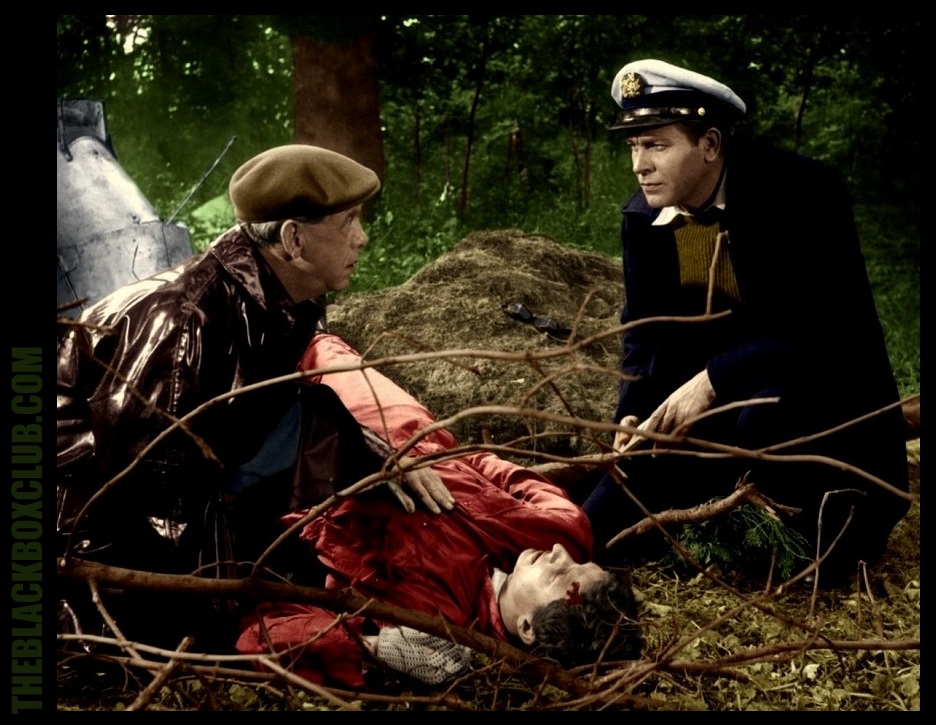
Sailor Bill Masen is in hospital for an eye operation. With his eyes bandaged, he is unable to witness a freak meteorite shower that occurs that night. When he wakes up in the morning, Masen finds London in chaos with the entire populace having been blinded by radiation from the meteorite shower. The shower has also brought with it triffids, a form of ambulatory, carnivorous plant that now emerge to prey upon the helpless populace. Gathering a small group of seeing survivors, Masen makes his way across Europe fighting off the triffids and searching for survivors to reorganise civilisation.
COMMENTARY
In the 1950s, British author John Wyndham was for a time regarded as a successor to H.G. Wells. Wyndham had considerable success with novels such as The Day of the Triffids (1951), The Kraken Wakes (1953), The Chrysalids (1955) and The Midwich Cuckoos (1957). In effect, Wyndham took the apocalyptic science-fiction of Wells and reworked it into disaster parables for middle-class England of the 1950s. John Wyndham’s books proved very popular in the time, as much with crossover audiences as they were with science-fiction readers.
This film of the John Wyndham novel is mostly – and rightly so – lambasted for the complete demolition job it does of the book. The script was from Phillip Yordan a prolific Hollywood screenwriter who wrote a number of Cinemascope religious/historical epics – El Cid (1961), King of Kings (1961) and The Fall of the Roman Empire (1964), and had revealed an equally clod-handed hand for science-fiction with Conquest of Space (1955). The director was Hungarian émigré Steve Sekely, who had made a number of crime thrillers in the 1940s and previously visited genre material with the cheap Revenge of the Zombies (1943).
Most insulting of the changes that the film rings up is its need for a happy ending where humanity overcomes the triffid menace. This is hilariously tipped by a prominently featured sign: “Seawater: Warning – Highly Dangerous” sitting in the lighthouse – and it is no cheesier than when Dorothy employed it against the Wicked Witch of the West in The Wizard of Oz (1939). The ending with the masses trouping in a long line up to a church to, what the narrator ominously informs, “give thanks” for their delivery, unhappily looks back to the pious ending of the equally pillaged film adaptation of H.G. Wells’ The War of the Worlds (1953). It is an ending that seems all the more false for the abject cheer in the face of the situation ie. 99% of the world having been blinded.
On the plus side, it should be said that The Day of the Triffids has its occasional moments. After a dull opening, the film impresses for a time, even if all that impresses has been taken direct from John Wyndham. The blindness is neatly introduced in a scene where a doctor gets Howard Keel to examine his eyes, confirming the diagnosis of blindness, then sends him to find a non-existent satchel while behind a screen one can see the doctor running up to the window and then the smash of glass as he jumps through. Steve Sekely is even good enough to improvise a series of apocalyptic vignettes of his own invention, most impressively the cutaway to the panic of the passengers aboard a plane about to crash because it has no more fuel. However, by the time the film has reached the continent, any semblance to John Wyndham has been abandoned and the plot peters out into a series of lacklustre incidents.
The effects work is of a decidedly variable quality. The opticals work with a meteorite shower flashing down behind and lighting up the interior of the conservatory is fine, as are the patchwork opticals of a burning London. However, when it comes to actually having to build models it seems the budget has run out, failing at all to show the crashing of the train into the station or the plane into the docks. The triffids move exactly as though they are being pulled along on a low trolley from below camera-height. At least Steve Sekely whips them up into some occasionally effective scares – one scene with a triffid closing in on a skidding car was clearly mimicked seventeen years later by John Carpenter in The Fog (1980). The lighthouse scenes with Kieron Moore and Janette Scott were in fact shot afterwards by Freddie Francis, later to become a genre director for Hammer and Amicus, when the film that Sekely delivered was not up to running length.
The film was remade as a tv mini-series The Day of the Triffids (1981) by the BBC, which is an excellent adaptation that is much more faithful to the novel and has far more convincing Triffid effects. The Day of the Triffids (2009) was a further tv mini-series remake from the BBC with Dougary Scott as Bill Masen and Joely Richardson as Josella, although this widely departed from the John Wyndham novel.
Other John Wyndham screen adaptations are Village of the Damned (1960), from Wyndham’s The Midwich Cuckoos (1957), which was remade as Village of the Damned (1995); the alternate world film Quest for Love (1971); and the children’s tv series Chocky (1984) about an alien visitor. 


REVIEW: Richard Schheib
IMAGES: Marcus Brooks
REVIEW: HERE

Related Posts Plugin for WordPress, Blogger...