RECENT POST FROM THE BLACK BOX CLUB

Showing posts with label lobby cards. Show all posts

Wednesday, 30 April 2014

SHANE BRIANT WINNING Q AND A COMPETITION ENTRIES AND ANSWERS: EXCLUSIVE LOBBY CARDS


The WINNING entries and questions...and the best of, from our 'Frankenstein and the Monster from Hell: Shane Briant Q and A! can be seen at The UK Peter Cushing Appreciation Society Blog. Congratulations to the lucky winners and many thinks to everyone who entered, to Shane for taking part, Hammer films, and everyone at Fetch!

Part two of our Shane Briant 'Frankenstein and the Monster from Hell' Q and A will be a THE HORROR CHANNEL facebook page shortly

You can now order your copy of the UNCUT, three disc blu ray / dvd of 'Frankenstein and the monster from Hell' starring Peter Cushing, Shane Briant, Madeline Smith and Dave Prowse... just by clicking this link! (http://amzn.to/1i51bHI) We will be posting a review of this UK release at The UK Peter Cushing Appreciation Society Blog later today!
The WINNING entries and questions...and the best of, from our 'Frankenstein and the Monster from Hell: Shane Briant Q and A! Congratulations to our lucky winners and many thinks to everyone who entered, to Shane for taking part, Hammer films, and everyone at Fetch!

Part two of our Shane Briant 'Frankenstein and the Monster from Hell' Q and A will be a THE HORROR CHANNEL facebook page shortly :)

You can now order your copy of the UNCUT, three disc blu ray / dvd of 'Frankenstein and the monster from Hell' starring Peter Cushing, Shane Briant, Madeline Smith and Dave Prowse... just by clicking this link! (http://amzn.to/1i51bHI) We will be posting a review of this UK release at this blog later today at the blog! - See more at: http://petercushingblog.blogspot.co.uk/#sthash.CS61ceaP.dpuf
The WINNING entries and questions...and the best of, from our 'Frankenstein and the Monster from Hell: Shane Briant Q and A! Congratulations to our lucky winners and many thinks to everyone who entered, to Shane for taking part, Hammer films, and everyone at Fetch!

Part two of our Shane Briant 'Frankenstein and the Monster from Hell' Q and A will be a THE HORROR CHANNEL facebook page shortly :)

You can now order your copy of the UNCUT, three disc blu ray / dvd of 'Frankenstein and the monster from Hell' starring Peter Cushing, Shane Briant, Madeline Smith and Dave Prowse... just by clicking this link! (http://amzn.to/1i51bHI) We will be posting a review of this UK release at this blog later today at the blog! - See more at: http://petercushingblog.blogspot.co.uk/#sthash.CS61ceaP.dpuf
The WINNING entries and questions...and the best of, from our 'Frankenstein and the Monster from Hell: Shane Briant Q and A! Congratulations to our lucky winners and many thinks to everyone who entered, to Shane for taking part, Hammer films, and everyone at Fetch!

Part two of our Shane Briant 'Frankenstein and the Monster from Hell' Q and A will be a THE HORROR CHANNEL facebook page shortly :)

You can now order your copy of the UNCUT, three disc blu ray / dvd of 'Frankenstein and the monster from Hell' starring Peter Cushing, Shane Briant, Madeline Smith and Dave Prowse... just by clicking this link! (http://amzn.to/1i51bHI) We will be posting a review of this UK release at this blog later today at the blog! - See more at: http://petercushingblog.blogspot.co.uk/#sthash.CS61ceaP.dpuf

Sunday, 27 April 2014

HAMMER FILMS: 'FRANKENSTEIN AND THE MONSTER FROM HELL' BLU RAY AND LOBBY CARDS WINNERS ANNOUNCED!


The WINNERS NAMES have just been released on our  Peter Cushing UK Appreciation Society Website and UK Peter Cushing Appreciation Society Facebook Fan Page of the Shane Briant Q and A Competition! Have won a Frankenstein and the Monster from Hell Blu Ray UNCUT? Have you won a set of exclusive Frankenstein and the Monster from Hell lobby cards? ARE YOU A WINNER? Click on the links above and find out!


Order YOUR copy HERE


Friday, 5 April 2013

DO YOU BELIEVE IN REINCARNATION? AUDREY ROSE: ANTHONY HOPKINS SUSAN SWIFT: GALLERY AND REVIEW


CAST:
Marsha Mason (Janice Templeton), Anthony Hopkins (Elliot Hoover), John Beck (Bill Templeton), Susan Swift (Ivy Templeton), Norman Lloyd (Dr Steven Lipscomb), Philip Sterling (Judge Harmon Langley), Robert Walden (Brice Mack), John Hillerman (Scott Velie) 

PRODUCTION:
Director – Robert Wise, Screenplay/Based on the Novel by Frank De Felitta, Producers – Frank De Felitta & Joe Wizan, Photography – Victor J. Kemper, Music – Michael Small, Special Effects – Henry Millar Jr, Production Design – Harry Horner. Production Company – United Artists. 


SYNOPSIS:
Bill and Janice Templeton become concerned about a stranger who keeps following and calling them and sends presents to their 11 year-old daughter Ivy. The stranger introduces himself as Elliot Hoover and tells them how he has come to believe following a trip to India that Ivy is the reincarnation of his daughter Audrey Rose who was killed in a car crash the same day that Ivy was born. He is able to calm Ivy’s recurrent nightmares down by calling her Audrey Rose. Hoover then abducts Ivy but is arrested. His subsequent attempts to argue a case for reincarnation at his trial become a cause celebre.


COMMENTARY:
Rosemary’s Baby (1968) gave birth to an enormous cinematic occult horror boom in the 1970s. The boom spawned such successes as The Exorcist (1973), Carrie (1976) and The Omen (1976), each of which propagated their own subgenres of imitators. Audrey Rose came near at the end of that cycle when the genre had successfully established itself among A-budget films and where the theme of evil and/or possessed children was its overriding subject.


Both the film of Audrey Rose and the 1975 Frank De Felitta book it is based on give the feeling of a story that wanted to be something more serious that instead ended up pigeonholed in the horror genre. Screenwriter/original novelist De Felitta’s other works show him as a writer who wants to deal with the supernatural as real (or at least the sort of supernatural that becomes the stuff of tabloid magazines – reincarnation, hauntings, ghost rapes). His novel was set up toward the purpose of placing an argument for reincarnation on a courtroom stand, which must surely stand as the ultimate arbiter of Western rationalism. (In reality though, the case presented here probably would be thrown by any court – whether or not Ivy is the reincarnation of Hoover’s daughter is surely irrelevant, the only thing a court is interested in is the issue at hand – whether or not Hoover abducted Ivy). The film does change the balance of the book somewhat. In the book, the court case took up nearly three-quarters of the story but in the film the court case is reduced to only two or three showcase arguments and presented with considerable bias – no contrary arguments doubting or questioning reincarnation are ever highlighted from the prosecution’s side, for instance.


The film cannot escape the basic fact that it is burdened by a wordy and static script. This however does lead to a unique approach from director Robert Wise who uses the dialogue itself as suspense. Wise hypnotically engages us in Anthony Hopkins’s monologues, where one becomes so enrapt that even small movements like the spilling of a teacup or the relatively uninteresting shot of a door opening behind someone eavesdropping on a conversation is made to hold suspenseful power. There are some effective scenes – particularly the one with burns suddenly appearing on Susan Swift’s hands when she places them on a cold window. However, try as Robert Wise might to turn Audrey Rose into an interesting dramatic film, the material remains solidly unmoving.


The first half of the film, set around Hoover’s bizarre intrusion into the family digs into the 1970s Stranger Danger peril. Hoover’s actions are designed with the intent of making the family anxious – their being followed, anonymous phone-calls, mysterious presents left, the child being abducted from school and from the apartment – without any thought placed into why the otherwise relatively rational Hoover is behaving so creepily. When we come to understand where the character is coming from later in the film, such furtive actions fail to make sense. The film’s generation of Stranger Danger paranoia is ironically so effective that it becomes almost impossible to view Hoover’s motivations normally and it is only through turning of him into a passive wimp for the rest of the film and Anthony Hopkins’s performance that the character succeeds in retaining any sympathy. Far better at engendering sympathy is Marsha Mason who gives an enormously convincing performance in what is essentially a passively handwringing role. Young Susan Swift also manages to comes across as mature and intelligent.


Robert Wise directed a number of classic films including Run Silent, Run Deep (1958), West Side Story (1961) and The Sound of Music (1965). Wise’s other genre films are:– The Curse of the Cat People (1944) and The Body Snatcher (1945), two classic psychological horror films made for Val Lewton; the human hunting film A Game of Death (1945); the alien visitor classic The Day the Earth Stood Still (1951); the haunted house classic The Haunting (1963); the Michael Crichton adaptation The Andromeda Strain (1971) and Star Trek – The Motion Picture (1979).


Screenwriter Frank De Felitta has a number of other genre credits. He wrote and produced the overpopulated future film Z.P.G. (Zero Population Growth) (1971); directed/wrote the tv movie Trapped (1973) about a man hunted through a department store by dogs; directed/wrote the supernatural time travel tv movie The Two Worlds of Jennie Logan (1979); directed the American Gothic tv movie The Dark Night of the Scarecrow (1981); wrote the interesting ghost story The Entity (1982); and directed/wrote the worthwhile psycho-thriller Scissors (1991).  

Review:HERE
Images: Marcus Brooks 

Sunday, 31 March 2013

THE REPTILE: HAMMER FILMS : LOBBY CARD SET

CAST:
Ray Barrett (Harry Spalding), Noel Willman (Dr Franklyn), Jennifer Daniel (Valerie Spalding), Jacqueline Pearce (Anna Franklyn), Michael Ripper (Tom Bailey), John Laurie (Mad Peter Crockett), Marne Maitland (Malay)
PRODUCTION:
Director – John Gilling, Screenplay – John Elder [Anthony Hinds], Producer – Anthony Nelson Keys, Photography – Arthur Grant, Music – Don Banks, Music Supervisor – Philip Martell, Special Effects – Bowie Films, Makeup – Roy Ashton, Production Design – Bernard Robinson. Production Company – Hammer/Seven-Arts.
SYNOPSIS:
Harry Spalding, a captain in the Royal Grenadiers, inherits a cottage in a small Cornish village after his brother Charles dies in mysterious circumstances. He moves into the cottage with his wife Valerie. Harry discovers that several locals have been killed by mysterious snake bites. This is also found to have been the cause of Charles’s death. The origin of the snake killings appears to rest with Dr Franklyn who lives in the village mansion. As Harry investigates, he discovers that these are being caused by Franklyn’s daughter Anna who was abducted by a snake cult that Franklyn was researching in Borneo and that she now periodically transforms into a snake creature.


Tuesday, 12 March 2013

'HE WHO ROBS THE GRAVES OF EGYPT DIES!' THE MUMMY HAMMER FILMS (1959)


Hammer Films 'The Mummy' Starring Peter Cushing as John Banning, Christopher Lee as Kharis and Yvonne Furneaux as Isobel. Directed by Terence Fisher and produced at Bray Studios. Shooting Production: February 25th until April 16th 1959.


Hammer Films 'The Mummy' Starring Peter Cushing as John Banning, Christopher Lee as Kharis and Yvonne Furneaux as Isobel. Directed by Terence Fisher and produced at Bray Studios. Shooting Production: February 25th until April 16th 1959.


Hammer Films 'The Mummy' Starring Peter Cushing as John Banning, Christopher Lee as Kharis and Yvonne Furneaux as Isobel. Directed by Terence Fisher and produced at Bray Studios. Shooting Production: February 25th until April 16th 1959.

Thursday, 7 March 2013

QUICK GLANCE REVIEW: FRANCIS MATTHEWS AND ANDREW KEIR: DRACULA PRINCE OF DARKNESS:


QUICK GLANCE: DRACULA PRINCE OF DARKNESS: HAMMER FILMS 1966

CAST:
Andrew Keir (Father Shandor), Christopher Lee (Count Dracula), Francis Matthews (Charles Kent), Barbara Shelley (Helen Kent), Suzan Farmer (Diana Kent), Charles Tingwell (Alan Kent), Philip Latham (Klove), Thorley Walters (Ludwig)

PRODUCTION:
Director – Terence Fisher, Screenplay – John Sansom, Story – John Elder [Anthony Hinds], Producer – Anthony Nelson-Keys, Photography – Michael Reed, Music – James Bernard, Music Supervisor – Philip Martell, Special Effects – Bowie Films Ltd, Makeup – Roy Ashton, Production Design – Bernard Robinson. Production Company – Hammer/Seven Arts. 

SYNOPSIS:
Two English couples holidaying in Transylvania are abandoned on the roadside after their coach breaks down. They are picked up by a driverless black coach and taken to Castle Dracula where they are granted hospitality by Dracula’s manservant. During the night, one of the men is attacked and gutted by Dracula’s manservant and his blood used to revive Dracula. Two of the group manage to flee the castle. In the village below, they join a local priest in standing up to destroy Dracula.

OUR STILLS GALLERY AND FULL REVIEW: HERE 

Wednesday, 6 March 2013

'DON'T MOVE SIR HENRY, IF YOU VALUE YOUR LIFE!' PETER CUSHING CHRISTOPHER LEE: 'THE HOUND OF THE BASKERVILLES (1959)'

CAST:
Peter Cushing (Sherlock Holmes), Andre Morell (Dr John Watson), Christopher Lee (Sir Henry Baskerville), Francis De Wolff (Dr Richard Mortimer), Marla Landi (Cecile Stapleton), Ewen Solon (Stapleton), Miles Malleson (Bishop Frankland), John Le Mesurier (Barrymore), David Oxley (Sir Hugo Baskerville), Helen Goss (Mrs Barrymore), Judi Moyens (Servant Girl)

PRODUCTION
Director – Terence Fisher, Screenplay – Peter Bryan, Based on the Novel by Sir Arthur Conan Doyle, Producer – Anthony Hinds, Photography – Jack Asher, Music – James Bernard, Music Conductor – John Hollingsworth, Special Effects – Sid Pearson, Makeup – Roy Ashton, Production Design – Bernard Robinson. Production Company – Hammer.

SYNOPSIS:
Sherlock Holmes and Dr Watson receive a visit from the physician Richard Mortimer. Mortimer tells them the story of the curse that haunts the Baskerville family. This apparently resulted after the ancestor Sir Hugo Baskerville pursued and murdered a servant girl with his dogs, only to then be killed himself by a supernatural hound. The same ghostly hound is believed to have killed all the heirs to the Baskerville title, including most recently Sir Charles Baskerville. Holmes and Watson meet the new heir Sir Henry and accompany him to the Baskerville estate in Devon. There they determine mysterious happenings and great evil are afoot. Holmes tries to get to the bottom of the mystery and find whether the hound heard baying on the moors is a supernatural agency or a more mundane plot to murder Sir Henry.

Sunday, 3 February 2013

THE HOUSE THAT DRIPPED BLOOD: PETER CUSHING FACE TO FACE PUBLICITY SHOT (1971)


FACE TO FACE: PETER CUSHING AND FRIEND IN A PUBLICITY STILL FROM AMICUS PRODUCTIONS THE HOUSE THAT DRIPPED BLOOD' (1971)

Tuesday, 29 January 2013

DARIO ARGENTO: PHENOMENA: LOBBY CARDS AND REVIEW

CAST:
Jennifer Connelly (Jennifer Corvino), Donald Pleasence (John MacGregor), Daria Nicolodi (Frau Bruckner), Dalila DiLazzaro (Headmistress), Federica Mastroianni (Sophie), Patrick Bauchau (Inspector Rudolf Geiger)
PRODUCTION:
Director/Producer – Dario Argento, Screenplay – Dario Argento & Franco Ferrini, Photography – Romano Albani, Insect Photography – Ferdinando Armati, Underwater Photography – Gianlorenzo Battaglia, Special Stage Effects – Tonino Corridori, Insect Effects – Maurizio Garrone, Makeup – Sergio Stivaletti, Production Design – Maurizio Garrone, Nello Giorgetti, Luciano Spadoni & Umberto Turco. Production Company – Dacfilm. Italy. 1985.
SYNOPSYS:
Jennifer Corvino, daughter of an American film star, arrives in Switzerland in the area known as ‘The Swiss Transylvania’ to attend the Richard Wagner School for Girls. She arrives at the same time as a killer starts stalking the girls at the school. She is befriended by the wheelchair-ridden Scottish entomologist John MacGregor who discovers that Jennifer has an ability to telepathically communicate with insects. As she explores her newfound ability, Jennifer realises that this also offers a means of discovering the killer’s identity. 
COMMENTARY:
The films of Dario Argento have an extraordinary wildness to them. They cannot be viewed as rational psycho-thrillers or traditional tales of the occult – they are works that exist almost entirely for the sake of displaying scenes of gratuitous sadism, all presented with a wild artistic flair. Argento’s artistic fascination with psychopathology and sadism can take one aback. It is as if Argento treats the human body and its entrails as though it were an artist’s clay that he might pull apart and rearrange as though fascinated to see what sorts of objects might be placed up against or into it 
Many Italo-horrorphiles call Phenomena a slipshod piece of Argento. However, there is much to enjoy – Argento holds one’s attention throughout and the plot is neither any more nor any less coherent than any other Dario Argento film. The setting is admittedly a steal from Suspiria (1977) but Argento only uses it as a springboard and turns the film into a unique detective story. The scenes where Jennifer Connelly realises her psychic powers and starts using the insects to locate the killer are the most fascinating in the film and, although Argento never takes the insect telepathy angle anywhere after introducing it, this slant on a detective story has a uniqueness unlike anything that has ever been done before.
When it comes to his trademark suspense and dismemberment, Argento creates some startling scenes – like where Jennifer Connelly realises that she has been poisoned and starts making herself try to throw up before it affects her. The extended climax is also excellent with wild and weird sequences like where Jennifer Connelly follows a telephone cord down a tunnel into a cellar filled with pools of maggot-ridden dead bodies; or Patrick Bauchau having to break his own hand so that he can get out of a manacle; and Jennifer Connelly’s climactic fight with the killer’s son, being dragged underwater by him as she tries to flee the burning gasoline in the water.
Jennifer Connelly, then only fifteen years old, turns in a reasonably sophisticated performance and Donald Pleasence lends his kindly if aging presence as the wheelchair-ridden scientist.
Dario Argento’s other films are:– The Bird with the Crystal Plumage (1970), The Cat O’Nine Tails (1971), Four Flies on Grey Velvet (1971), Deep Red (1976), Suspiria (1977), Inferno (1980), Tenebrae/Unsane (1982), Opera/Terror at the Opera (1987), Two Evil Eyes (1990), Trauma (1993), The Stendhal Syndrome (1996), The Phantom of the Opera (1999), Sleepless (2001), The Card Player (2004), Mother of Tears: The Third Mother (2007), Giallo (2009) and Dracula 3D (2012). 

Sunday, 27 January 2013

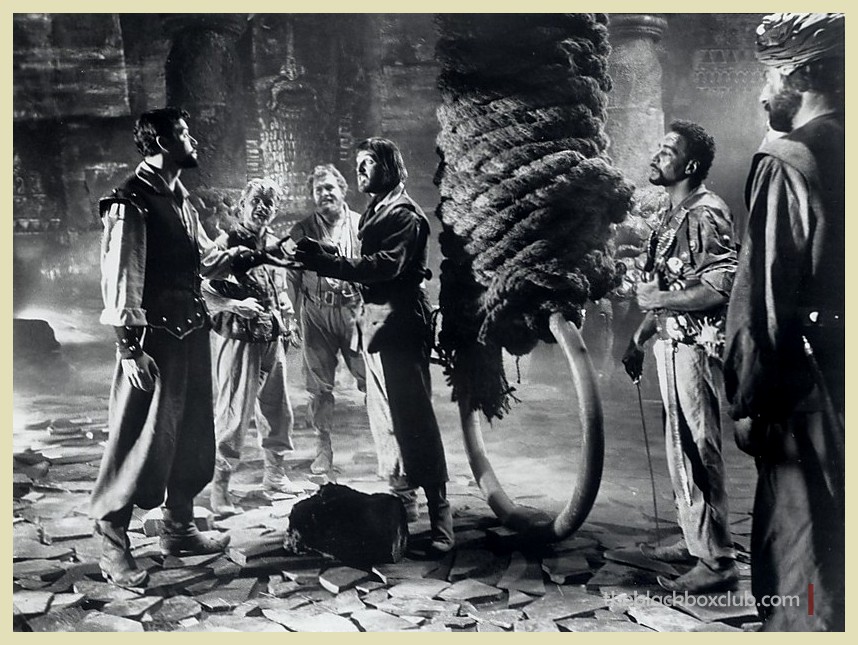
326 MAGIC TRICKS LIGHT THE SCREEN: CAPTAIN SINBAD (1963) GALLERY AND REVIEW

CAST:
Guy Williams (Sindbad), Heidi Bruhl (Princess Jana), Pedro Armendariz (El Kerim), Abraham Sofaer (Galgo)
PRODUCTION:
Director – Byron Haskin, Screenplay – Harry Relis & Samuel B. West, Producers – Frank & Herman King, Photography – Gunter Sentfleben, Music – Michel Michelet, Music Conductor – Kurt Graunke, Photographic Effects – Tom Howard, Special Effects – Augie Lohman & Lee Zavitz, Art Direction – Isabelle & Werner Schlichting. Production Company – King Brothers.
SYNOPSIS:
The sorcerer El Kerim usurps the city of Baristan from its weak king. The princess Jana tries to warn her beloved, Sindbad. Her intentions are discovered by El Kerim who turns men into rocs to bomb Sindbad’s ship with boulders. Sindbad survives and comes to Baristan disguised as a thief to stop El Kerim. However, El Kerim has removed his heart and cannot be killed. And so Sindbad must undertake a perilous journey to the tower where El Kerim’s heart is guarded by a hydra.
COMMENTARY:
Captain Sindbad was one of several productions inspired by the success of Ray Harryhausen’s The 7th Voyage of Sinbad (1958). Captain Sindbad was a West German production, although the producers imported for the occasion American director Byron Haskin, who had made a number of genre entries such as The War of the Worlds (1953), The Naked Jungle (1954), Conquest of Space (1955) and From the Earth to the Moon (1958), as well as Guy Williams, star of tv’s Zorro (1957-9) and later Lost in Space (1965-8) and several of the supporting cast.
Captain Sindbad is an innocuous juvenile fantasy. It quickly follows the cliches of the Arabian Nights cycle as set down by 7th Voyage and the various cinematic versions of The Thief of Bagdad – the honest sailor who raises rebellion while disguised as a thief, the blackguard vizier usurper who has designs on the princess (who also happens to be the hero’s beloved). It is colourful in a pedestrian, undemanding way that proves mildly entertaining. The scenes with Abraham Sofaer’s magician tend toward the buffoonish
When it comes to the fantasy on display, the conception of the effects work – flying rocs, miniature storms, the hydra, a hand that extends several metres and a pre-Exorcist (1973) head-spinning effect – tends to belie the delivery, although the film tries hard. The film’s great moment of creative corner cutting in the special effects department is having Guy Williams face an invisible dragon. The climactic confrontation with the hydra is a little shabby.

Review: Richard Scheib
Images Marcus Brooks

Saturday, 19 January 2013

BARBARA STEELE: BLACK SUNDAY : LA MASCHERA EL DAIMO REVIEW AND PHOTOGRAPH GALLERY

CAST:
Barbara Steele (Katya/Princess Asa), John Richardson (Dr Andrej Gorobec), Andrea Checchi (Professor Choma Kruvajan), Arturo Dominici (Prince Ivo Javutich), Enrico Olivieri (Prince Constantine), Antonio Pierfederici (The Priest), Ivo Garrani (Prince Vajda), Tino Bianchi (Ivan)

PRODUCTION:
Director/Photography (b&w) – Mario Bava, Screenplay – Ennio De Concini & Mario Serandrei, English Language Dialogue – George Higgins III, Based on the Short Story The Vij by Nikolai Gogol, Producer – Massimo De Rita, Music – (Italian Version) Robert Nicolosi & (English Language Version) Les Baxter, Art Direction – Giorgio Giovannini. Production Company – Lina Productions/Galatea/Jolly Films.  Italy. 1960. 


SYNOPSIS:
In 17th Century Russia, Princess Asa is tried and convicted for vampirism and witchcraft. A mask with spikes on its inside is hammered over her face and she is burned at the stake. Two centuries later, the coach of Professor Choma Kruvajan and his companion Dr Andrej Gorobec crashes in the forest. They come upon the chapel that holds Asa’s coffin where she is kept imprisoned by the shadow of the cross coming through a window. Kruvajan accidentally revives Asa. They must then try to stop Asa as she attempts to possess her modern-day descendant Princess Katya

COMMENTARY:
Black Sunday is a genre classic. It was a success that produced a deluge of continental (primarily Italian) horror. Hammer had already fired up a massive Gothic revival with The Curse of Frankenstein (1957) and Dracula/The Horror of Dracula (1958) in the previous three years and in the USA Roger Corman had had similar success with a series of Edgar Allan Poe adaptations. With Black Sunday, director Mario Bava defined a set the tropes that would become the continental Gothic formula. As opposed to Hammer’s product, the Italian horror film placed an emphasis on sadism, particularly facial mutilation; and as, opposed to the Anglo-horror film, which is very much rooted in the battle between reason and suppression, the continental Gothic became a genre that was based in the past (most Italo-horror films are set in the early 19th Century or earlier) and firmly on the side of superstition – science and reason never enter into these films, there is rarely ever a Man of Reason like Peter Cushing’s Van Helsing. There were many imitators through the 1960s – directors such as Riccardo Freda and Antonio Margheriti – making similar films set in large gloomy castles and featuring necrophiliac minglings of death and love. 


Most importantly, Black Sunday made Mario Bava a cult name with audiences. Bava had worked as a cinematographer and had purportedly (uncreditedly) directed several forgettable spaghetti Gothics – I Vampiri/The Devil’s Commandment (1957) and Caltiki, the Immortal Monster (1959) – before debuting with Black Sunday. Bava would then go onto a number of other Gothic horrors – Black Sabbath (1963), Night is the Phantom/What! (1963), Kill, Baby ... Kill!/Curse of the Living Dead (1966), Baron Blood (1972) – as well as giallo psycho-thrillers like Blood and Black Lace (1964), Blood Brides/Hatchet for a Honeymoon (1969) and Twitch of the Death Nerve/Bloodbath (1971). While many of these are excellent, Black Sunday would be a film that Bava never managed to subsequently surpass. 


It is almost impossible to gain an appreciation of Black Sunday’s atmosphere when seeing it on video – it needs a cinematic airing to give true voice to the extraordinary beauty of Mario Bava’s atmosphere and camerawork. For a period like 1960 when camera set-ups where still largely static, Bava’s camerawork is incredibly sinuous and fluid, always on the move. The shock opening with Barbara Steele being tied up, her back bared and the letter ‘S’ branded into her flesh, then the spiked Mask of Satan placed onto her face and hammered on with a crunch and a spurt of blood still holds some effect thirty years later. (It was this scene that had Black Sunday banned in the UK until 1968). What is most striking is Mario Bava’s instinctive feel for Gothic mood – the scene where the prince appears out of the shadows and approaches the bed of Ivo Garrani is almost pure Castle of Otranto (1764). The most extraordinary sequence in the film is the luring of the professor to the castle, which is filled with images like the black coach appearing out of the mist and racing through the forest in slow-motion with Arturo Dominici on top maniacally whipping the horses along; and the luring of the professor into the castle where Dominici and his lantern move further and further ahead, while giant embossed doors boom shut unaided by human hand, slowly trapping the professor deeper and deeper into a claustrophobic maze of underground passages. 


Although the film makes some claim to be based on the Nikolai Gogol short story The Vij (1835), there is virtually nothing of this in the finished script. The Vij was set around a night in a crypt as the hero waits for the witch to arise from her tomb while she marshals occult forces against him, a scene that is puzzlingly missing from the film. The main sequence of The Vij would have been perfect for the film’s extended climax, but is not used – in fact, the climax that Black Sunday has is oddly anti-climactic. In subsequent films, Mario Bava showed himself to be a director less concerned with plot than with visual set-pieces and this is probably the problem. The script here seems oddly unbalanced – it, for instance, makes mistakes like having the vampires engage in ordinary fistfights with the heroes, which rob them of their supernatural menace; it also jumbles vampires in with what should be a straight-forward reincarnated witch story. Nevertheless, Black Sunday is a classic. 


The film was purportedly remade as Black Sunday/The Mask of the Demon/Demons 5: The Devil’s Veil (1989) by Mario Bava’s son Lamberto, although this had almost nothing to do with the original here. The Nikolai Gogol story was more faithfully adapted as the Russian-made The Viy (1967) and the Yugoslav-made A Holy Place (1990). 


Mario Bava’s other genre films are:- the Greek muscleman fantasy Hercules in the Center of the Earth/Hercules vs the Vampires (1961); the giallo The Evil Eye (1962); the Gothic horror anthology Black Sabbath (1963); the Gothic horror Night is the Phantom/The Whip and the Body/What? (1963); the psycho-sexual thriller Blood and Black Lace (1964); the Gothic Kill Baby ... Kill/Curse of the Dead/Curse of the Living Dead/Operation Fear (1965); the sf/horror film Planet of the Vampires (1965); the spy comedy Dr Goldfoot and the Girls Bombs (1966), Bava’s worst film; the masked super-thief film Danger Diabolik (1967); the giallo Five Dolls for an August Moon (1970); the giallo Hatchet for a Honeymoon/Blood Brides (1971); the giallo Twitch of the Death Nerve/Bloodbath/A Bay of Blood/Carnage/Ecology for a Crime (1971); the Gothic Baron Blood (1972); the giallo/haunted house film Lisa and the Devil/House of Exorcism (1972); and the possession film Shock/Beyond the Door II (1977).      

Review: Richard Scheib
Images: Marcus Brooks
Related Posts Plugin for WordPress, Blogger...