Showing posts with label vintage stills. Show all posts
Tuesday, 1 January 2013
VAMPIRE CIRCUS: HAMMER FILMS MINI STILLS GALLERY
A CIRCUS OF DELIGHTS! HAMMER FILM PRODUCTIONS 'VAMPIRE CIRCUS' FOR A FULL REVIEW AND BEHIND THE SCENES GALLERY PLEASE CLICK ON HERE: VAMPIRE CIRCUS
Labels:
adrienne corri,
anthiny higgins,
hammer film productions,
lawrence payne,
lynne fredreick,
vampire circus,
vampirism,
vintage lobby cards.,
vintage stills
Thursday, 22 March 2012
HAMMER FILM PRODUCTIONS: FRENCH NEWSPAPER PROMO AD: 'DRACULA PRINCE OF DARKNESS'
Labels:
barbara shelley,
christopher lee,
dracula prince of darkness,
hammer film,
peter cushing,
terence fisher,
vampires,
vintage stills
Monday, 5 March 2012
HAMMER FILM PRODUCTIONS: THE REPTILE: COME SLITHER!
THE CREW:
Director: John Gilling. Screenplay: John Elder. [Anthony Hinds]. Producer: Anthony Nelson Keys. Photography: Arthur Grant. Music: Don Banks. Music Supervisor: Philip Martell. Special Effects: Bowie Films. Makeup: Roy Ashton. Production Design: Bernard Robinson. Production Company: Hammer Film Productions/Seven-Arts.
CAST:
Ray Barrett: Harry Spalding. Noel Willman: Dr Franklyn. Jennifer Daniel: Valerie Spalding. Jacqueline Pearce: Anna Franklyn. Michael Ripper: Tom Bailey. John Laurie: Mad Peter Crockett. Marne Maitland: Malay
THE PLOT:
Harry Spalding, a captain in the Royal Grenadiers, inherits a cottage in a small Cornish village after his brother Charles dies in mysterious circumstances. He moves into the cottage with his wife Valerie. Harry discovers that several locals have been killed by mysterious snake bites. This is also found to have been the cause of Charles’s death. The origin of the snake killings appears to rest with Dr Franklyn who lives in the village mansion. As Harry investigates, he discovers that these are being caused by Franklyn’s daughter Anna who was abducted by a snake cult that Franklyn was researching in Borneo and that she now periodically transforms into a snake creature.
This Hammer film has obtained a reputation as a minor classic. It is almost invariably discussed in tandem with director John Gilling’s The Plague of the Zombies (1966), which he shot back-to-back with this on the same sets and using several members of the same cast. Both films are strong examples of the colonial revenge theme that rings through a number of Anglo-Horror films – others include The Stranglers of Bombay (1959) and The Ghoul (1975). In these films colonial evils – thuggee cults, dark foreign rituals – represent the same symbolic threat to British society as vampirism does in Hammer’s Dracula films – that is, it festers beneath the repressions of polite society and unleashes dangerous sensual energies.
The Reptile was made at a time when Hammer had conducted most of their variations on classic monsters and were trying to come up with new ideas. In reality, all that they did was coin new variations on the vampire – such as The Gorgon (1964) and the Reptile here. The Reptile is only Dracula with snakes. The reptile attack pattern is even identical to the vampire’s – two teeth marks at the neck – and the reptile’s end dispatch is not dissimilar to the one in Dracula/The Horror of Dracula (1958). However, this tends to reveal the film’s conceptual limitations. The reptile’s behaviour is not logically thought out – in actuality, a snake kills its victims either when it is threatened or to have food, whereas the reptile here appears to be doing neither. In effect, it is a series of random killings that have been designed to be modeled on vampirism but that come without much in the way of supporting rationale.
Director John Gilling’s effectiveness is in building atmosphere. He gets good mileage out of the hoary old tropes – the villagers who refuse to talk to strangers, the town drunk who may or may not be crazy and is the only one able to give an insight into the menace. Even better is the subtlety with which Gilling uses the genre’s expectations where Jacqueline Pearce, later to attain cult status as the intergalactic dictator on tv’s Blake’s 7 (1978-81), is painted as a threatened innocence where in fact everything that is happening to her is completely the opposite – father Noel Willman is made to seem autocratic and controlling when in fact he is trying to restrain her from attacking others; when a cat is brought to her by Marne Maitland, it is made to seem that he is threatening the cat when in fact he is offering it to her; a skin briefly-seen in her bed gives the impression that she is another victim of the reptile where in fact it is the skin she has shed.
John Gilling’s other genre films include Old Mother Riley Meets the Vampire/My Son, The Vampire (1952), The Gamma People (1956), The Flesh and the Fiends/Mania (1960), The Shadow of the Cat (1961), Panic (1963), The Night Caller (1965), The Plague of the Zombies (1966), The Mummy’s Shroud (1967) and The Devil’s Cross (1975). Gilling also wrote the scripts for House of Darkness (1947), The Gorgon (1964) and Trog (1970). Review: Richard Scheib
Images: Marcus Brooks
Labels:
christopher lee,
hammer film,
hammer glamour,
jacqueline pearce,
michael ripper,
peter cushing,
retro horror,
roy ashton,
the reptile,
vintage stills
Sunday, 4 March 2012
HAMMER FILM PRODUCTIONS: PLAGUE OF THE ZOMBIES: THE DEAD ARE AWAKE AND WALKING! REVIEW AND GALLERY!
CREW:
Director: John Gilling. Screenplay: Peter Bryan. Producer: Anthony Nelson Keys. Photography: Arthur Grant. Music: James Bernard. Music Supervisor: Philip Martell. Special Effects: Bowie Films Ltd. Makeup: Roy Ashton. Production Design: Bernard Robinson. Production Company: Hammer Film Productions /Seven Arts.
CAST:
Andre Morell: Sir James Forbes, Diane Clare: Sylvia Forbes, John Carson: Squire Clive Hamilton, Brook Williams: Dr Peter Tompson, Jacqueline Pearce: Alice Tompson, Michael Ripper: Sergeant Jack Swift, Marcus Hammond: Martinus, Alex Davion: Denver, Roy Royston: Vicar.
PLOT: Professor of medicine Sir James Forbes receives a letter from his former pupil Peter Tompson, now a GP in a small town in Cornwall. Tompson mentions how he is baffled by a strange plague that is killing the locals. Sir James and his daughter Sylvia travel to Cornwall to investigate. Not long after they arrive, Tompson’s wife Alice succumbs to the plague and dies. The local squire Clive Hamilton forbids them to conduct autopsies on the bodies so Sir James decides to conduct an illegal exhumation, only to find that the coffins in the graves of the plague victims are all empty. Sir James realizes that Hamilton is using voodoo to raise the dead as zombies and is then employing them as slave labour in his tin mines. As he makes this discovery, Hamilton conducts a voodoo spell to bring Sylvia under his control.
The Plague of the Zombies is a Hammer film that has gained a modest cult reputation in Anglo-horror circles. This is something that was boosted by its relative obscurity on video/dvd up until recent years. It was directed by John Gilling who had made a number of other Anglo-horror films. (See below for listing of John Gilling’s other films).
The Plague of the Zombies is frequently discussed in tandem with John Gilling’s The Reptile (1966), both of which were shot back-to-back. Both films use many of the same sets – the village streets and the inn – and have similar plots with outsiders arriving in a small village in Cornwall where they discover that something is killing off the locals. In both cases, the menace is seen to be foreign in nature (voodoo here, a woman transformed into a snake creature after being abducted by a snake cult in Borneo in The Reptile). Both films also star Jacqueline Pearce as one of the central characters who is transformed by the menace, as well as contain a minor appearance from Michael Ripper as one of the locals.
John Gilling directs with florid effect. There is a striking opening sequence involving rituals being conducted by figures in white hoods smeared with bloody symbols. The film gains some impact in the long scene where Andre Morell and Brook Williams dig up Jacqueline Pearce’s grave and we wait in closeup on her face before her eyes suddenly open and then she crawls out of the grave with a lascivious smile, before being decapitated by Morell. This is followed by the much remembered (and copied) scene where Brook Williams has a dream of the zombies clawing their way up out of the grave and coming after him. There are many other notable pieces – the eerieness of the scene where John Carson draws Diane Clare to him, and a reasonably intense climax as the house and mine go up in flames. Regular Hammer makeup man Roy Ashton creates some excellent zombie makeups – with their pallid faces and glowing eyes, these look startlingly gruesome, even after two decades of exposure to George Romero copies.
The Plague of the Zombies also has a striking political subtext – that of an uncaring aristocracy and their exploitation of the working classes. John Gilling sets up a series of potent images that illustrate this – the fox hunt with the hunters riding through the village at full tilt, heedlessly charging through a funeral procession, knocking the coffin over the side of a bridge; or where Diane Clare is abducted by the local Hellfire Club who circle and taunt her and then gamble over her fate. (Gilling loves the image of the aristocrats resplendent in their spiffing scarlet red jackets). The idea of the peasantry being turned into zombies to work in the mines is rich in symbolism and the images that we see of the zombies being whipped and made to work are striking.
On the minus side, some of the plotting is vague – it is not made clear why John Carson is also zombiefying and placing the women of the show under his spell – it is a little far-fetched to believe that he is doing this because he wants to turn them into slaves in the mines as well. Rather though, his motives seem to be the all-embracing Hammer standby of the courtly nobleman placing women under his hypnotic spell with sinister intent.
Andre Morell fulfils the role of the savant that in any other Hammer film would mandatorily be played by Peter Cushing. Morell plays the part with an aristocratic grace – it is almost like a Peter Cushing role that has been cast with a country gentleman. John Carson is in what normally be the Christopher Lee role – that of the sinister lord of the manor up to no good. However, John Carson eschews any sense of the sinister threat that Christopher Lee would have given the role and plays the part with a mannered politeness that contrarily serves to only give the character even more sinister effect.
John Gilling’s other genre films include Old Mother Riley Meets the Vampire/My Son, The Vampire (1952), The Gamma People (1956), The Flesh and the Fiends/Mania (1960), The Shadow of the Cat (1961), Panic (1963), The Night Caller (1965), The Reptile (1966), The Mummy’s Shroud (1967) and The Devil’s Cross (1975). Gilling also wrote the scripts for House of Darkness (1947), The Gorgon (1964) and Trog (1970).
Review: Richar Scheib
Here
Images: Marcus Brooks
HAMMER FILM PRODUCTIONS: 'THE PLAGUE OF THE ZOMBIES'
IS RELEASED ON BLU RAY MAY 7TH 2012
You can order here!
On the minus side, some of the plotting is vague – it is not made clear why John Carson is also zombiefying and placing the women of the show under his spell – it is a little far-fetched to believe that he is doing this because he wants to turn them into slaves in the mines as well. Rather though, his motives seem to be the all-embracing Hammer standby of the courtly nobleman placing women under his hypnotic spell with sinister intent.
John Gilling’s other genre films include Old Mother Riley Meets the Vampire/My Son, The Vampire (1952), The Gamma People (1956), The Flesh and the Fiends/Mania (1960), The Shadow of the Cat (1961), Panic (1963), The Night Caller (1965), The Reptile (1966), The Mummy’s Shroud (1967) and The Devil’s Cross (1975). Gilling also wrote the scripts for House of Darkness (1947), The Gorgon (1964) and Trog (1970).
Review: Richar Scheib
Here
Images: Marcus Brooks
HAMMER FILM PRODUCTIONS: 'THE PLAGUE OF THE ZOMBIES'
IS RELEASED ON BLU RAY MAY 7TH 2012
You can order here!
Labels:
andre morell,
blu ray,
diane clare,
hammer film productions,
jacqueline pearce,
michael ripper,
peter cushing,
plague of the zombies,
retro horror films,
vintage stills
Wednesday, 4 January 2012
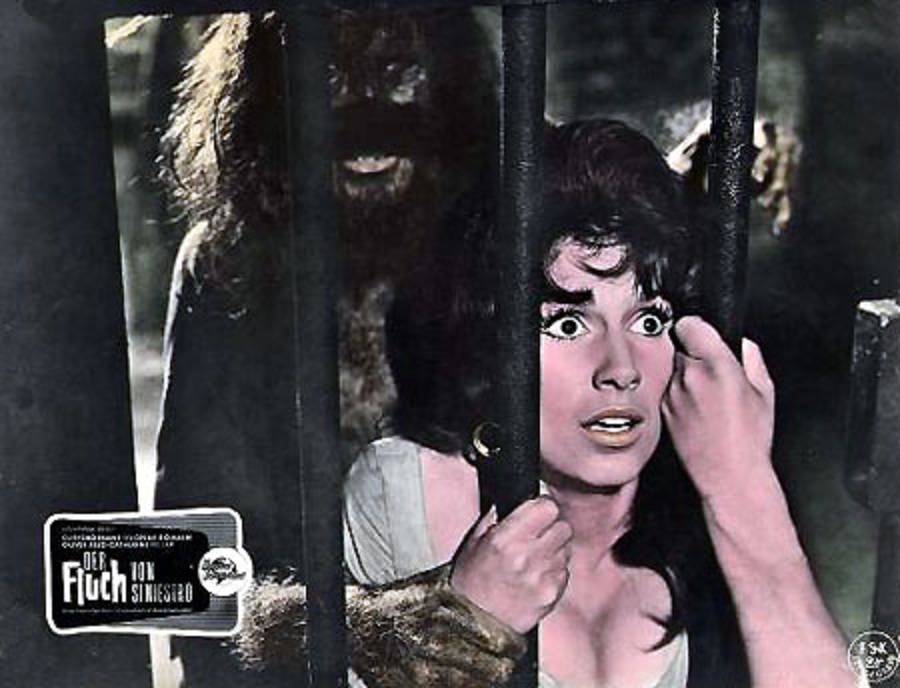
YVONNE ROMAIN : OLIVER REED: HAMMER FILMS: THE CURSE OF THE WEREWOLF 1961 LOBBY STILLS AND REVIEW!
CAST:
Oliver Reed (Leon), Clifford Evans (Don
Alfredo Carrido), Catherine Feller (Christina), Richard Wordsworth
(Beggar), Yvonne Romain (Jailer’s daughter), Antony Dawson (Marquis
Siniestro), Hira Talfrey (Teresa), Warren Mitchell (Pepe Valiente),
Josephine Llewellyn (The Marquesa), Justin Walters (Young Leon)
PRODUCTION:
Director – Terence Fisher, Screenplay – John Elder [Anthony Hinds], Based on the Novel The Werewolf of Paris
by Guy Endore, Producer – Anthony Hinds, Photography – Arthur Grant,
Music – Benjamin Frankel, Special Effects – Les Bowie, Makeup – Roy
Ashton, Production Design – Bernard Robinson. Production Company –
Hammer/Hotspur.
SYNOPSIS:
A beggar goes to the wedding banquet of
the Marquis Siniestro. The cruel Marquis treats the beggar as an object
of amusement and then has him thrown in a dungeon. Forgotten for many
years, the beggar is treated with kindness by the jailer’s daughter.
However, the beggar is overcome by loneliness and rapes the daughter.
She runs away and is taken in by the kindly Don Alfredo Carrido where
she gives birth to a son on Christmas Day and dies shortly afterwards.
The Don adopts the child, calling him Leon. As he grows up, Leon
demonstrates a strange liking for the blood of animals. When a shepherd
shoots an attacking wolf, Leon is later found with bullets in his body.
Growing into manhood, Leon takes a job with wealthy landowner Don
Fernando and soon becomes attracted to Don Fernando’s daughter
Christina. But when his instincts are aroused by a whore, Leon turns
into a werewolf. Terrified, he tries to persuade Christina to marry him
in the hope that her pure love might overcome his animal nature.
COMMENTARY:
England’s Hammer Films found considerable recognition with the twin successes of The Curse of Frankenstein (1957) and Dracula/The Horror of Dracula
(1958), both remakes of Universal genre classics of the 1930s. This
success spurred them onto conduct remakes of other classics including The Mummy (1959), The Two Faces of Dr Jekyll (1960) and The Phantom of the Opera
(1962). But when Hammer turned their attention to updating the werewolf
legend they ran into a problem – the wolf man character that became a
staple among Universal’s Famous Monsters lineup in the 1940s following The Wolf Man
(1941) was one of the few characters that Universal had created
specifically for the screen, rather than adapting from a novel as they
had with most of the other classics. So instead of purchasing the rights
to remake the screenplay of The Wolf Man, Hammer turned to a novel The Werewolf of Paris (1934) by Guy Endore. [Guy Endore himself had some fame during the 1930s as a screenwriter with films like Mad Love (1935), Mark of the Vampire (1935) and The Devil-Doll (1936)].
As with Hammer’s reworking of the abovementioned classics, The Curse of the Werewolf
is a thoughtful and substantial reworking of the werewolf myth. In his
screenplay (which varies substantially from the Guy Endore novel),
Hammer producer Anthony Hinds roots werewolf mythology firmly in Spanish
Catholicism. Indeed, The Curse of the Werewolf
is perhaps the only werewolf story to treat lycanthropy as something
that is not passed by a bite, but as a divinely cursed state. In order
to set this up, Anthony Hinds creates a lengthy preamble to Leon’s story
– it is over 50 minutes before we get to see Oliver Reed and over an
hour before Reed becomes the werewolf. It comes filled with crashingly
heavy symbolism at times – the child is born on Christmas Day, the font
boils over and thunderclouds amass as he is baptized. But this is by far
the more interesting half than the second, which travels in more
traditional areas. Nevertheless, the second half is a reasonable
werewolf story with a young, then unknown Oliver Reed standing up well
in the part and Roy Ashton conducting a fine makeup job.
Most Hammer films (particularly those made
by Terence Fisher) are rooted in a British upper-class assumptions. They
create a divide between civilized reason and brutal animal passions.
The wolf here represents brutish passions, which the film sees can be
kept in restraint by a good society, even the love of a pure-hearted
girl. Notedly, Leon’s animal instincts are stirred up when he strays
outside the confines of ‘decent’ society and goes to visit a ‘bad’ girl –
a whore. As with Dracula, we see that civilized reason and religion as conquering the dangerous forces of unrestraint.
Terence Fisher’s other genre films are:– the sf films The Four-Sided Triangle (1953) and Spaceways (1953), The Curse of Frankenstein (1957), Dracula/The Horror of Dracula (1958), The Revenge of Frankenstein (1958), The Hound of the Baskervilles (1959), The Man Who Could Cheat Death (1959), The Mummy (1959), The Stranglers of Bombay (1959), The Brides of Dracula (1960), The Two Faces of Dr Jekyll (1960), The Phantom of the Opera (1962), The Gorgon (1964), Dracula – Prince of Darkness (1966), Frankenstein Created Woman (1967), The Devil Rides Out/The Devil’s Bride (1968), Frankenstein Must Be Destroyed (1969) and Frankenstein and the Monster from Hell (1973), all for Hammer. Outside of Hammer, Fisher has made the Old Dark House comedy The Horror of It All (1964) and the alien invasion films The Earth Dies Screaming (1964), Island of Terror (1966) and Night of the Big Heat (1967).
Labels:
clifford evens,
make up,
memorabilia,
michael ripper,
roy ashton,
terence fisher.,
vintage stills,
were-wolf,
wolf the curse of the werewolf hammer films 1961 terence fisher oliver reed,
wolfman,
yvonne romain
Subscribe to:
Posts (Atom)