RECENT POST FROM THE BLACK BOX CLUB

Showing posts with label hammer films.. Show all posts

Monday, 21 April 2014

WIN FRANKENSTEIN AND THE MONSTER FROM HELL BLU RAY THREE COPIES UP FOR GRABS!

COMPETITION: To celebrate the release of the Hammer films classic ‘Frankenstein And The Monster From Hell’ UNCUT – coming to 2-disc DVD & single-disc Blu-ray for the first ever time in the UK on 28th April 2014....here in conjunction with Hammer films, Icon Film Distribution and Fetch Publicity is our FIRST competition..with a twist! - See more at: http://petercushingblog.blogspot.co.uk/#sthash.NaTeV1pG.dpuf

BLU RAY COMPETITION: To celebrate the release of the Hammer films classic ‘Frankenstein And The Monster From Hell’ UNCUT – coming to 2-disc DVD & single-disc Blu-ray for the first ever time in the UK on 28th April 2014....over at our Peter Cushing Appreciation Society Website and our Peter Cushing PCASUK Facebook Fan Page  in conjunction with Hammer films, Icon Film Distribution and Fetch Publicity is our FIRST competition, where THREE copies of the Blu Ray are up for grabs. Just click on the links to join us! 

OR Order YOUR COPY HERE

 
COMPETITION: To celebrate the release of the Hammer films classic ‘Frankenstein And The Monster From Hell’ UNCUT – coming to 2-disc DVD & single-disc Blu-ray for the first ever time in the UK on 28th April 2014....here in conjunction with Hammer films, Icon Film Distribution and Fetch Publicity is our FIRST competition..with a twist! - See more at: http://petercushingblog.blogspot.co.uk/#sthash.NaTeV1pG.dpuf
COMPETITION: To celebrate the release of the Hammer films classic ‘Frankenstein And The Monster From Hell’ UNCUT – coming to 2-disc DVD & single-disc Blu-ray for the first ever time in the UK on 28th April 2014....here in conjunction with Hammer films, Icon Film Distribution and Fetch Publicity is our FIRST competition..with a twist! - See more at: http://petercushingblog.blogspot.co.uk/#sthash.NaTeV1pG.d
COMPETITION: To celebrate the release of the Hammer films classic ‘Frankenstein And The Monster From Hell’ UNCUT – coming to 2-disc DVD & single-disc Blu-ray for the first ever time in the UK on 28th April 2014....here in conjunction with Hammer films, Icon Film Distribution and Fetch Publicity is our FIRST competition..with a twist! - See more at: http://petercushingblog.blogspot.co.uk/#sthash.NaTeV1pG.dpuf

Sunday, 14 July 2013

VINTAGE PHOTOGRAPHS, FEATURES AND MEMORABILIA: SOCIETY CELEBRATES CENTENARY YEAR


Now with over 14,000 followers. Galleries, vintage transparencies and photographs. Celebrating Peter Cushing's Centenary Year. The UK Peter Cushing Appreciation Society! A warm welcome awaits you!: https://www.facebook.com/petercushingblog.

Thursday, 23 May 2013

PETER CUSHING FB FAN PAGE HITS 11,000 AS CENTENARY APPROACHES


With Peter Cushing's Centenary Birthday Just Around The Corner And Numbers Climbing At Our Peter Cushing (PCASUK) Facebook Fan Page, It looks Like This Weekend Could Be Fun!

Monday, 18 March 2013

FAMOUS MONSTERS CELEBRATE PETER CUSHING


NEWS: Famous Monsters Magazine Celebrates Peter Cushing in June! 'This June we celebrate what would have been Peter Cushing's 100th birthday, and Famous Monsters will look back over the life and classic works of one of cinema's greatest legends! Featuring a Peter Cushing cover by Oscar-winner Dave Elsey'.... http://famousmonsters.com/

MELISSA STRIBLING AND PETER CUSHING: UNRESTORED FRAME FROM JAPANESE DRACULA 1958 PRINT


Unrestored frame from the 'lost' Japanese print of Hammer Films DRACULA (1958) featuring Peter Cushing as Van Helsing and Melissa Stribling as Mina. Dir: Terence Fisher. Reels 6 -9 can be seen on the DRACULA blu ray released today.

Sunday, 17 March 2013

THE SLAYING OF CARMILLA: THE VAMPIRE LOVERS: PETER CUSHING INGRID PITT : HAMMER FILMS


CAST:
Ingrid Pitt (Carmilla Karnstein/Marcilla), Madeleine Smith (Emma Morton), Harvey Hall (Renton), Kate O’Mara (Mademoiselle Perrodot), Peter Cushing (General Spielsdorf), Pippa Steele (Laura Spielsdorf), George Cole (Roger Morton), Jon Finch (Carl Ebhardt), Douglas Wilmer (Baron Joachim von Hartog), Ferdy Mayne (Doctor) 

PRODUCTION:
Director – Roy Ward Baker, Screenplay – Harry Fox, Tudor Gates & Michael Style, Based on the Short Story Carmilla by J. Sheridan Le Fanu, Producers – Harry Fine & Michael Style, Photography – Moray Grant, Music – Harry Robinson, Music Supervisor – Philip Martell, Makeup – Tom Smith, Art Direction – Scott MacGregor. Production Company – Hammer/AIP.  

SYNOPSIS:
A countess and her daughter Marcilla attend a ball held by General Spielsdorf. When the countess is called away by the death of a friend, the General chivalrously agrees to allow Marcilla to stay. Soon after, the General’s daughter Laura starts waking at night, claiming a big cat is in her room. She grows weak and dies in a matter of days from vampire bites at her neck. Marcilla vanishes and is next encountered by wealthy Britisher Roger Morton with a crashed carriage in the woods, now calling herself Carmilla. Carmilla quickly moves in on and seduces Morton’s innocent teenage daughter Emma and her language tutor. 

FULL GALLERY AND REVIEW:HERE

Saturday, 16 March 2013

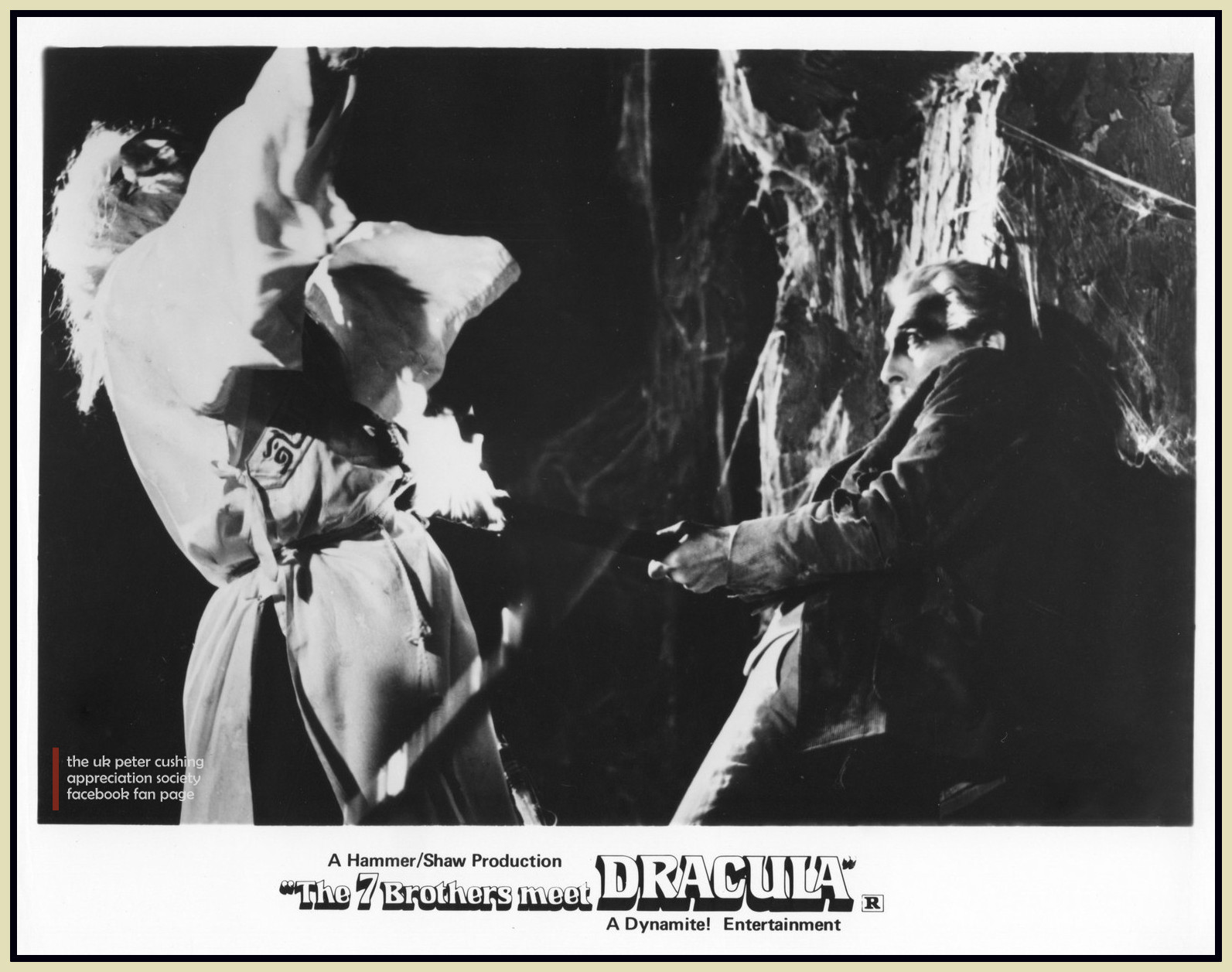
HAMMER FILMS SHAW BROTHERS VAMPIRE KUNG FU MASH UP: PETER CUSHING : THE LEGEND OF THE SEVEN GOLDEN VAMPIRES.

CAST:
Peter Cushing (Professor Lawrence Van Helsing), Robin Stewart (Leyland Van Helsing), David Chiang (Hsi Ching), Julie Ege (Vanessa Buren), Shih Szu (Mei Kwei), Chan Shen (Kah), John Forbes-Robertson (Count Dracula)

PRODUCTION:
Director – Roy Ward Baker, Screenplay – Don Houghton, Producers – Don Houghton & Vee King Shaw, Photography – Roy Ford & John Wilcox, Music – James Bernard, Music Supervisor – Philip Martell, Special Effects – Les Bowie, Makeup – Wu Hsu Ching, Art Direction – Johnson Tsau. Production Company – Hammer/Sir Run Run Shaw. 


It’s no secret that Hammer Film Productions was in deep trouble in the 1970s. Having established themselves as the premiere fright factory in the world in the 1950s, they managed to crank out a steady stream of box office hits - along with a few flops - throughout the 1960s. But by the 70s, cracks were appearing in the foundation. Audiences were growing tired of the usual run of Frankenstein and Dracula sequels, for one thing, and for another, the general attitude towards horror as a genre was beginning to change. Major studios began dipping their toe into the genre, while independents began to explore the possibility of more visceral thrills. Hammer’s product, though cutting edge in the 1950s, suddenly seemed quaint, even conservative. Sir James Carreras apparently saw the writing on the wall, and in 1971 he sold the company to his son, Michael. Long viewed as something of a whipping boy by Hammerphiles, Carreras did his damndest to bring Hammer up to date - but some of his ideas were admittedly wrong headed, while others failed to come off, due to budgetary constraints. One of his more outlandish concepts came when he struck a deal with Hong Kong-based producer Run Run Shaw, head of Shaw Brothers Productions. In theory, it seemed an ideal match - Hammer horror married to Hong Kong kung fu. Unfortunately, it would prove a hard sell - and the marriage would end almost as quickly as it began.


The screenplay by Don Houghton attempts to meld the two disparate strains, but it fails to reconcile them, thus making for an uneasy blend of Eastern and Western mythology. Nowhere is this more evident than in the attempt to shoehorn Dracula into the proceedings. By this stage in the game, Christopher Lee had had his fill of the character, however, and he remained steadfast that The Satanic Rites of Dracula (1973) would be his last crack at the character (and he arguably kept his word, though the French farce Dracula and Son, 1976, saw him offering a variation on the theme). Hammer turned instead to character actor John Forbes-Robertson, inspired, no doubt, by his silent turn as a sinister vampire figure in The Vampire Lovers (1970). Forbes-Robertson may have seemed a credible alternative to Hammer’s biggest star, but he makes for a poor replacement. Matters aren’t helped by the overdone makeup, which manages to make the King of the Vampires look a bit like a drag queen, or by the fact that the actor is dubbed throughout by another performer; Forbes Robertson wasn’t even notified of the latter, and was reportedly very unhappy when he discovered this on his own. On the upside, Dracula only factors in to the opening and closing scenes of the film - on the downside, the scenes in question feel grafted on, which they more than likely were in a bid to appeal to Warner Brothers. Having Dracula on board was one thing - but having him portrayed by somebody other than Christopher Lee didn’t help to make it more of a commercial proposition.


Fortunately, Hammer had no trouble enticing Peter Cushing back into the fold, dutifully reprising his role as vampire hunter extraordinaire, Professor Van Helsing. Cushing was older and frailer here than he was when he first portrayed the character in Dracula (1958) and The Brides of Dracula (1960), but his energy and commitment remained undiminished. Cushing once again demonstrates why he was such a tremendous asset to films such as this, as his cultured delivery helps to make even the most preposterous dialogue sound somehow intelligent. Given the addition of kung fu to the franchise, however, it is something of a relief to see that Van Helsing wasn’t expected to get in on the action himself! 


Hammer enlisted the veteran Roy Ward Baker to direct, and the director would later recall the experience as something of a disaster. Baker, who had helmed several big budget Hollywood productions (including the Marilyn Monroe noir Don’t Bother to Knock, 1952) before directing what many deem to be the best screen version of the Titanic tragedy (A Night to Remember, 1953), had become accustomed to the facilities inherent in American and British filmmaking. Thus, upon arriving in Hong Kong, to find a primitive studio without the benefit of sound proofing (like Italian productions, Chinese films were shot without direct sound), and a script that needed plenty of work, he was in the unenviable position of trying to salvage a project that had “disaster” written all over it.  


The proverbial straw that broke the camel’s back arose when producer Shaw informed Baker that he was entrusting the fight scenes to one of their in-house action specialists. Baker blew his top and insisted that if he was directing the picture, he was directing the whole thing. A standoff ensued, but Baker ultimately had his way. The fight scenes were choreographed by Liu Chia-Liang (who would later win acclaim working with Jackie Chan on the fight scenes of The Legend of the Drunken Master, 1994), but the staging and coverage was orchestrated by Baker. The director would later claim that he did a better job than the usual “specialist” because he varied the coverage; the point is debatable, but he still delivers a few rousing action scenes along the way. The experience of making the film, encumbered with so many problems (to say nothing of the obvious language barrier with a largely Chinese crew), would linger with Baker; he would direct only one more theatrical feature (the disastrous non-Amicus horror anthology The Monster Club, 1980, with Vincent Price), though he would continue to dabble in episodic television, even helming the made for TV Cushing-Sherlock Holmes feature The Masks of Death (1984). He died in 2010, at the age of 93. 


Baker is to be commended for making something watchable out of this material. The script is no great shakes, and apart from Cushing, most of the performances are stilted. Baker approaches the film with stylistic gusto, however, approaching the horror sequences with some of the stylistic bravado of Italian maestro Mario Bava. The sequences of the titular vampires and their zombie slaves shuffling through barren landscapes have a peculiar poetry, and if the impact is let down by some uncommonly bad special effects work by Les Bowie, there’s still a rousing score by James Bernard to keep things moving. Bernard would come back to Hammer to do a couple of scores for their TV series, The Hammer House of Horror, but Legend of the 7 Golden Vampires would remain his final feature score for the studio.


If Carreras really believed that tapping into the kung fu market would help to revive Hammer’s standing, he was bitterly disappointed. Warner Bros. picked the film up for distribution in the UK, where it was distributed more or less uncut (some minor gore was trimmed at the insistence of the BBFC); it did less than stellar business, however, and reviews were predictably miserable. In the US, it would suffer the same fate as The Satanic Rites of Dracula - it would sit on the shelf for years, before being drastically cut, retitled (as The Seven Brothers Meet Dracula), and trotted out by Dynamite Entertainment, who also failed to elicit much in the way of audience interest.


 Ultimately, one doesn’t want to make inflated claims for The Legend of the 7 Golden Vampires. It’s a silly film in many respects, and it’s certainly burdened with more than its faire share of flaws, but fans of Hammer horror, or of Cushing in particular, should enjoy it for offering a variation on the formula. Truly, one of the best things one can say about it is in the nature of a side note - while a comic remake (with Tim Allen!) was threatened for several years, it eventually fell through. Be grateful for small miracles, indeed!


Friday, 8 March 2013

QUICK REVIEW: STRANGE GOINGS ON: HAMMER FILMS 'THE WITCHES' 'THE DEVIL'S OWN' (1967)


QUICK REVIEW: THE WITCHES / THE DEVIL'S OWN: HAMMER FILMS (1967)

CAST:
Joan Fontaine (Gwen Mayfield), Kay Walsh (Stephanie Bax), Alec McCowen (Alan Bax), Ingrid Brett (Linda Rigg), Martin Stephens (Ronnie Dowsett), Gwen Ffangcorn-Davies (Granny Rigg), John Collin (Dowsett), Leonard Rossiter (Dr Wallis), Michele Dotrice (Valerie Creek), Duncan Lamont (Bob Curd), Carmel McSharry (Mrs Dowsett), Ann Bell (Sally Benson)
 
PRODUCTION:
Director – Cyril Frankel, Screenplay – Nigel Kneale, Based on the Novel The Devil’s Own by Peter Curtis [Norah Lofts], Producer – Anthony Nelson Keys, Photography – Arthur Grant, Music – Richard Rodney Bennett, Musical Supervisor – Philip Martell, Makeup – George Partleton, Production Design – Bernard Robinson. Production Company – Seven Arts/Hammer Films. UK. 1966.
 
SYNOPSIS:
Recovering from a nervous breakdown after being attacked during a native uprising at a mission school in Africa, Gwen Mayfield accepts a job as teacher in the sleepy English country village of Heddaby. She finds strange things happening around the village. Two of her pupils, teenagers Linda Rigg and Ronnie Dowsett, are attracted to one another but everybody seeks to keep them apart. Ronnie then has a mysterious accident and Gwen afterwards finds a voodoo doll with pins poked into it. Her insistence on trying to dig into what is happening uncovers evidence that Ronnie’s accident and other deaths may be being caused by witchcraft.
 
GALLERY AND FULL REVIEW: HERE

Monday, 7 January 2013

JESS FRANCO'S EL CONDE DRACULA : CHRISTOPHER LEE : KLAUS KINSKI STILLS GALLERY AND REVIEW

CAST:
Christopher Lee (Count Dracula), Herbert Lom (Dr Van Helsing), Frederick Williams (Jonathan Harker), Maria Rohm (Mina Murray), Soledad Miranda (Lucy Westenra), Klaus Kinski (Renfield), Jack Taylor (Quincey Morris), Paul Muller (Dr John Seward) 
PRODUCTION:
Director – Jess Franco, Screenplay – Peter Welbeck [Harry Alan Towers], Based on the Novel Dracula by Bram Stoker, Producer – Harry Alan Towers, Photography – Manuel Merino, Music – Bruno Nicolai, Art Direction – George O. Brown. Production Company – Towers of London Productions/Corona Films/Filmar Compagnia Cinematografica/Fenix Cooperative Cinematografica.  
Spain/Italy/West Germany/Liechtenstein. 1970.  
SYNOPSIS:
Lawyer Jonathan Harker travels to Transylvania to transact a property purchase in England for Count Dracula. He ignores the warnings of locals not to go to Dracula’s castle. There Dracula proves to be a vampire and nearly drinks all of Jonathan’s blood before Jonathan makes an escape. Making a recovery at Dr Seward’s sanitarium back in England, Jonathan and occult expert Dr Van Helsing discover that Dracula is living nearby and is plundering the blood of Jonathan’s fiancee Mina and her best friend Lucy Westenra.
COMMENTARY:
Count Dracula was an interesting production. It was the third official adaptation of Bram Stoker’s Dracula (1897) and was sold with the interesting notion that it was going to film Bram Stoker as written – the two previous versions, the Bela Lugosi Dracula (1931) and Hammer’s Dracula/The Horror of Dracula (1958) with Christopher Lee, had varied considerably from the text. It was certainly enough of a novelty to draw Christopher Lee to the project. Unfortunately, the notion ended about there. It was a good idea that befell bad filmmakers, in the case Harry Alan Towers, a producer responsible for a number of cheap horror films and sexploitation thrillers, and the infamous Jess Franco, a prolific exploitation director.
The film’s claim to adapting Bram Stoker is certainly accurate, although other versions since have reduced the veracity of that claim to the point that Count Dracula does the job no better or worse than they claim to. It accurately follows the Transylvanian sequences, the asylum scenes and the climactic pursuit of Dracula back to Transylvania. Characters such as Dr Seward and Quincey Morris make their first screen appearances in a film adaptation. The film even preserves some of Bram Stoker’s dialogue intact. On the other hand, there are definitely some sequences missing – the Demeter crash is absent, no doubt for budgetary reasons, as well as the eerily ambient climactic scenes where Dracula is tracked with a hypnotized Mina. Similarly, the very faithfulness to the source material leaves the film inheriting the book’s one great problem – namely that after a great opening, Dracula remains a player who only casts a shadow from off stage. Most other films pad the role out by expanding the number of Dracula’s onscreen appearances but this version does not and as a result, bar the opening, Dracula fairly much vanishes and Christopher Lee is to a large extent left in the same position he was in most of the Hammer Dracula sequels, present but with not a lot to do. Christopher Lee brings his customary dignity to the role – and is outfitted with the one novelty of any screen adaptation, playing a Dracula who progressively gets younger as Bram Stoker described in the book. 
Certainly, among Jess Franco’s extraordinarily prolific output (nearly 200 films), Count Dracula is one of his better works. The first 15-20 minutes are some of most atmospheric moments of Franco’s directorial career – the moody journey through Transylvania; the scenes with Jonathan being picked up by a coach and Dracula as the coachman stopping to ward off marauding wolves; the two of them dining in an echoingly empty hall; Dracula’s impassioned recitation of his family history. Unfortunately, Franco, as though having exhausted himself in such concerted effort, then lets the film fall away to indifference. The two next scenes, which are stand-out set-pieces in the book – where Dracula’s wives attempt to seduce Jonathan and Dracula’s wall-climbing trick – are conducted with dreary disinterest. As the film keeps going, the more Jess Franco’s usual pedestrian cheapness affects the exercise. A scene invented over the book that tries to build something threatening up out of frenetic crosscutting between closeups of stuffed birds is woeful.  
The one interesting contrast between this and the Hammer Dracula is how much of a continental Dracula rather than a specifically English Dracula that this is. Count Dracula was made as a co-production between several European countries. Hammer’s florid stagebound dramatics and even Stoker’s gloomy coastal English locations have been replaced by a distinctive Spanish Old World feel – set in and around Spanish buildings, churches and graveyards – which provides a very different atmosphere to the story. Equally noticeable is the non-Anglicised cast – most glaringly obvious being the casting of the character of the Texan Quincey with the distinctly Teutonic Jack Taylor. 
In the end, Count Dracula is a noble endeavour that has befallen a cheap producer and a hack director. Had the same exercise been made with one of the contemporary continental directors such as Mario Bava or Riccardo Freda at the helm we could have had a potential classic on our hands. 
Other adaptations of Dracula are:– Nosferatu (1922); Dracula (1931) with Bela Lugosi; the Spanish language version Dracula (1931) shot on the same sets as the Lugosi version; Hammer’s classic Dracula/The Horror of Dracula (1958) with Christopher Lee; Dan Curtis’s tv movie Dracula (1974), starring Jack Palance; the BBC mini-series Count Dracula (1977), with Louis Jourdan; Dracula (1979) with Frank Langella; Werner Herzog’s Nosferatu the Vampyre (1979) with Klaus Kinski; Francis Ford Coppola’s Bram Stoker’s Dracula (1992) with Gary Oldman; the modernised Italian-German adaptation Dracula (2002) with Patrick Bergin; Guy Maddin’s ballet adaptation Dracula: Pages from a Virgin’s Diary (2002); the BBC tv movie Dracula (2006) with Marc Warren; the low-budget modernised Dracula (2009); and Dario Argento’s upcoming Dracula 3D (2012) with Thomas Kretschmann as Dracula.      

Review: Richard Scheib
Images: Marcus Brooks

Wednesday, 2 January 2013

THE LIFE CAREER AND DISAPPEARANCE OF MILTON REID

Sometimes you’ll be watching a film and a minor supporting player will suddenly appear and command your attention in a way that is more powerful and immediate than the leading actors. It could a physical gesture they make or a line of dialogue uttered in an unusual way or simply the look of their face or body or both. Milton Reid is one of those actors. His credit is likely to be down toward the bottom of the cast list with the designated role of “The Executioner” or “The Bodyguard” or “The Club Bouncer” or “The Big Pirate” but it’s his mug that will stick in your memory long after the film fades. He appears to be of Asian descent though one biographical reference intimated that his ususual features were the result of Turner syndrome which is incorrect because that rare genetic disorder only affects about 1 out of every 2,500 FEMALE births. But it’s possible that his exotic look was the result of something other than being the son of an Irish father and Indian (as in Bombay) mother.
Strangely enough, my introduction to this imposing character actor wasn’t in a movie but in a series of trading cards issued by Universal in 1963 known as “Spook Stories” which stuck silly captions on stills from the studio’s horror films (here’s a link to an article on Monster trading cards –There were two images of Mr. Reid from the 1962 Hammer film NIGHT CREATURES that conjured up all kinds of crazy scenarios in my mind of who this character was. (The original British title of NIGHT CREATURES was CAPTAIN CLEGG which was a remake of the 1937 British feature; Walt Disney remade it in 1963 for television where it was broadcast in three parts on “The Wonderful World of Disney” as “The Scarecrow of Romney Marsh” and Patrick McGoohan played “The Scarecrow” aka Dr. Syn.)
When I finally caught up with NIGHT CREATURES years later Mr. Reid does indeed pop out of the screen during his brief scenes as “The Mulatto,” a huge mountain of a man whose tongue is cut out because of his treachery to the pirate Captain Clegg. He is later used by the relentless Captain Collier (Patrick Allen) to sniff out the incognito Clegg who is behind a smuggling operation in the village of Dymchurch. The film is a rousing and highly atmospheric period thriller with some wonderful visuals (the appearance of the marsh phantoms), and spirited performances (Peter Cushing, Patrick Allen and Oliver Reed have fun with their roles). But Milton Reid’s larger than life presence is mesmerizing. He’s like a caged wild animal here, grunting, growling and desperate, and though his part is relatively small, it’s of crucial importance to the story and leads to Clegg’s undoing.


NIGHT CREATURES, however, is probably an exception to most of the films Reid made where his on-screen time was barely more than that of an extra. And he rarely had dialogue because with a face and body like that who needs it? But even in one scene appearances or minor supporting roles you couldn’t miss the guy. He stands out the way Tor Johnson does in the Ed Wood films. You can’t look at anything else. You might not have known his name but you’ve probably seen him many times – he was the Japanese executioner in THE CAMP ON BLOOD ISLAND (1958), the big pirate in Walt Disney’s SWISS FAMILY ROBINSON (1960), a guard working for DR. NO (1962), the strong man in BERSERK! (1967), the mute dog handler in THE BLOOD ON SATAN’S CLAW (1971) which will be shown on TCM’s Underground franchise on 3/28, Biederbeck’s man servant in DR. PHIBES RISES AGAIN (1972), he played Sabbala in THE PEOPLE THAT TIME FORGOT (1977) and Sandor in THE SPY WHO LOVED ME (1977). 

According to a biography for Reid posted on IMDB by Jim Marshall, Reid was born in Bombay, India in 1917. He moved to London in 1936, married fashion illustrator Bertha Lilian Guyett in 1939 and made his first film appearance in the British propaganda film THE WAY AHEAD in 1944. Then the bio gets extremely interesting: “After the war he trained as a wrestler, turning professional in 1952, firstly as a Tarzan-like character called Jungle Boy wearing leopard skin trunks. He also continued to play small parts in films, usually as a tough guy or bodyguard, often as a cruel henchman such as the Japanese executioner in THE CAMP ON BLOOD ISLAND (1958). His break-through came in 1959 when he was required to shave his head for the role of Yen the pirate in FERRY TO HONG KONG. He remained shaven-headed for the rest of his career, also changing his wrestling image to that of “The Mighty Chang,” an oriental giant. On stage he played in pantomime at the London Palladium as the Slave of the Lamp…However, most people remember Milton Reid as the bodyguard sorting out pretty girls for his boss in a long-running pipe tobacco commercial. In 1964 Milton challenged “The Great Togo” (aka Harold Sakata) to a wrestling contest to decide who would play the coveted role of Odd-Job in G0LDFINGER. Unfortunately, Milton had already been killed off in the first Bond movie Dr No (1962), so the producers were forced to pick Sakata and the “eliminator contest” wasn’t needed.”
Reid’s film career began to wind down in the late seventies and some of his last roles were in such sleazy softcore features as CONFESSIONS FROM THE DAVID GALAXY AFFAIR (1979) and QUEEN OF THE BLUES (1979), his final credited screen appearance. According to a poster on the britmovie.co.uk forums, there is an article on Reid in the book KEEPING THE BRITISH END UP, a survey of British softcore sex comedies. However, Reid’s story becomes much more unusual after 1979. Jim Marshall’s IMDB bio states that “Milton decided to try his luck in “Bollywood” and in 1980 returned to India. However, various problems arose and in 1981 he was arrested by Indian police for “trespassing, damaging furniture and disconnecting a telephone.” The trouble started when he visited his mother and sister in Bangalore, and there was a dispute with tenants at his sister’s bungalow. Police also complained of violence and abuse when they tried to detain him, and there were accusations of a manservant being assaulted. The following year Milton was stated by some reference works to have died from a heart attack, but that was incorrect. The actor’s son (same name) was still receiving correspondence sent by his father from Bangalore up to December 1986. Significantly, nothing was heard after that date, and the present assumption is that Milton Reid died in obscurity somewhere in India during the early part of 1987, although no death certificate or confirmation has been received by the family. Sadly, Bertha died in England in 1997, at the age of 90, still not knowing what had become of her husband. However, research continues.”
Despite the above information, some internet biographical sources have maintained that Reid died of a heart attack in London in 1982 but offer no explanation or evidence of their research. Reid’s grandson, Ian Reid, in fact, has challenged this fact in a web posting that read “I would be very interested to find out where the information about his death came from as this does not agree with how my family and I believe his life came to an end. His death and the location of his death are in fact a mystery. Therefore I would be interested to hear about any proof that backs up the claim that he died in London of a heart attack in 1982.”
We may never know what happened to “The Mighty Chang” but at least we can marvel at his unique presence in more than fifty films. 

FEATURE:HERE 
IMAGES: Marcus Brooks 
Related Posts Plugin for WordPress, Blogger...