

Sunday, 17 March 2013


THE SLAYING OF CARMILLA: THE VAMPIRE LOVERS: PETER CUSHING INGRID PITT : HAMMER FILMS

CAST:
Ingrid Pitt (Carmilla Karnstein/Marcilla),
Madeleine Smith (Emma Morton), Harvey Hall (Renton), Kate O’Mara
(Mademoiselle Perrodot), Peter Cushing (General Spielsdorf), Pippa
Steele (Laura Spielsdorf), George Cole (Roger Morton), Jon Finch (Carl
Ebhardt), Douglas Wilmer (Baron Joachim von Hartog), Ferdy Mayne
(Doctor)
PRODUCTION:
Director – Roy Ward Baker, Screenplay – Harry Fox, Tudor Gates & Michael Style, Based on the Short Story Carmilla
by J. Sheridan Le Fanu, Producers – Harry Fine & Michael Style,
Photography – Moray Grant, Music – Harry Robinson, Music Supervisor –
Philip Martell, Makeup – Tom Smith, Art Direction – Scott MacGregor.
Production Company – Hammer/AIP.
SYNOPSIS:
A countess and her daughter Marcilla
attend a ball held by General Spielsdorf. When the countess is called
away by the death of a friend, the General chivalrously agrees to allow
Marcilla to stay. Soon after, the General’s daughter Laura starts waking
at night, claiming a big cat is in her room. She grows weak and dies in
a matter of days from vampire bites at her neck. Marcilla vanishes and
is next encountered by wealthy Britisher Roger Morton with a crashed
carriage in the woods, now calling herself Carmilla. Carmilla quickly
moves in on and seduces Morton’s innocent teenage daughter Emma and her
language tutor.
FULL GALLERY AND REVIEW:HERE
Saturday, 16 March 2013

HAMMER FILMS SHAW BROTHERS VAMPIRE KUNG FU MASH UP: PETER CUSHING : THE LEGEND OF THE SEVEN GOLDEN VAMPIRES.

CAST:
Peter Cushing (Professor Lawrence Van
Helsing), Robin Stewart (Leyland Van Helsing), David Chiang (Hsi Ching),
Julie Ege (Vanessa Buren), Shih Szu (Mei Kwei), Chan Shen (Kah), John
Forbes-Robertson (Count Dracula)
PRODUCTION:
Director – Roy Ward Baker, Screenplay – Don
Houghton, Producers – Don Houghton & Vee King Shaw, Photography –
Roy Ford & John Wilcox, Music – James Bernard, Music Supervisor –
Philip Martell, Special Effects – Les Bowie, Makeup – Wu Hsu Ching, Art
Direction – Johnson Tsau. Production Company – Hammer/Sir Run Run Shaw.

It’s no secret that Hammer Film Productions was in
deep trouble in the 1970s. Having established themselves as the
premiere fright factory in the world in the 1950s, they managed to crank
out a steady stream of box office hits - along with a few flops -
throughout the 1960s. But by the 70s, cracks were appearing in the
foundation. Audiences were growing tired of the usual run of
Frankenstein and Dracula sequels, for one thing, and for another, the
general attitude towards horror as a genre was beginning to change.
Major studios began dipping their toe into the genre, while independents
began to explore the possibility of more visceral thrills. Hammer’s
product, though cutting edge in the 1950s, suddenly seemed quaint, even
conservative. Sir James Carreras apparently saw the writing on the
wall, and in 1971 he sold the company to his son, Michael. Long viewed
as something of a whipping boy by Hammerphiles, Carreras did his
damndest
to bring Hammer up to date - but some of his ideas were admittedly
wrong headed, while others failed to come off, due to budgetary
constraints. One of his more outlandish concepts came when he struck a
deal with Hong Kong-based producer Run Run Shaw, head of Shaw Brothers
Productions. In theory, it seemed an ideal match - Hammer horror
married to Hong Kong kung fu. Unfortunately, it would prove a hard sell
- and the marriage would end almost as quickly as it began.

The screenplay by Don Houghton attempts to meld
the two disparate strains, but it fails to reconcile them, thus making
for an uneasy blend of Eastern and Western mythology. Nowhere is this
more evident than in the attempt to shoehorn Dracula into the
proceedings. By this stage in the game, Christopher Lee had had his
fill of the character, however, and he remained steadfast that The
Satanic Rites of Dracula (1973) would be his last crack at the character
(and he arguably kept his word, though the French farce Dracula and
Son, 1976, saw him offering a variation on the theme). Hammer turned
instead to character actor John Forbes-Robertson, inspired, no doubt, by
his silent turn as a sinister vampire figure in The Vampire Lovers
(1970). Forbes-Robertson may have seemed a credible alternative to
Hammer’s biggest star, but he makes for a poor replacement. Matters
aren’t helped by the overdone makeup, which manages to make the King of
the
Vampires look a bit like a drag queen, or by the fact that the actor is
dubbed throughout by another performer; Forbes Robertson wasn’t even
notified of the latter, and was reportedly very unhappy when he
discovered this on his own. On the upside, Dracula only factors in to
the opening and closing scenes of the film - on the downside, the scenes
in question feel grafted on, which they more than likely were in a bid
to appeal to Warner Brothers. Having Dracula on board was one thing -
but having him portrayed by somebody other than Christopher Lee didn’t
help to make it more of a commercial proposition.

Fortunately, Hammer had no trouble enticing Peter
Cushing back into the fold, dutifully reprising his role as vampire
hunter extraordinaire, Professor Van Helsing. Cushing was older and
frailer here than he was when he first portrayed the character in
Dracula (1958) and The Brides of Dracula (1960), but his energy and
commitment remained undiminished. Cushing once again demonstrates why
he was such a tremendous asset to films such as this, as his cultured
delivery helps to make even the most preposterous dialogue sound somehow
intelligent. Given the addition of kung fu to the franchise, however,
it is something of a relief to see that Van Helsing wasn’t expected to
get in on the action himself!

Hammer enlisted the veteran Roy Ward Baker to
direct, and the director would later recall the experience as something
of a disaster. Baker, who had helmed several big budget Hollywood
productions (including the Marilyn Monroe noir Don’t Bother to Knock,
1952) before directing what many deem to be the best screen version of
the Titanic tragedy (A Night to Remember, 1953), had become accustomed
to the facilities inherent in American and British filmmaking. Thus,
upon arriving in Hong Kong, to find a primitive studio without the
benefit of sound proofing (like Italian productions, Chinese films were
shot without direct sound), and a script that needed plenty of work, he
was in the unenviable position of trying to salvage a project that had
“disaster” written all over it.

The proverbial straw that broke the camel’s back arose when producer Shaw informed Baker that he was entrusting the fight scenes to one of their in-house action specialists. Baker blew his top and insisted that if he was directing the picture, he was directing the whole thing. A standoff ensued, but Baker ultimately had his way. The fight scenes were choreographed by Liu Chia-Liang (who would later win acclaim working with Jackie Chan on the fight scenes of The Legend of the Drunken Master, 1994), but the staging and coverage was orchestrated by Baker. The director would later claim that he did a better job than the usual “specialist” because he varied the coverage; the point is debatable, but he still delivers a few rousing action scenes along the way. The experience of making the film, encumbered with so many problems (to say nothing of the obvious language barrier with a largely Chinese crew), would linger with Baker; he would direct only one more theatrical feature (the disastrous non-Amicus horror anthology The Monster Club, 1980, with Vincent Price), though he would continue to dabble in episodic television, even helming the made for TV Cushing-Sherlock Holmes feature The Masks of Death (1984). He died in 2010, at the age of 93.

The proverbial straw that broke the camel’s back arose when producer Shaw informed Baker that he was entrusting the fight scenes to one of their in-house action specialists. Baker blew his top and insisted that if he was directing the picture, he was directing the whole thing. A standoff ensued, but Baker ultimately had his way. The fight scenes were choreographed by Liu Chia-Liang (who would later win acclaim working with Jackie Chan on the fight scenes of The Legend of the Drunken Master, 1994), but the staging and coverage was orchestrated by Baker. The director would later claim that he did a better job than the usual “specialist” because he varied the coverage; the point is debatable, but he still delivers a few rousing action scenes along the way. The experience of making the film, encumbered with so many problems (to say nothing of the obvious language barrier with a largely Chinese crew), would linger with Baker; he would direct only one more theatrical feature (the disastrous non-Amicus horror anthology The Monster Club, 1980, with Vincent Price), though he would continue to dabble in episodic television, even helming the made for TV Cushing-Sherlock Holmes feature The Masks of Death (1984). He died in 2010, at the age of 93.
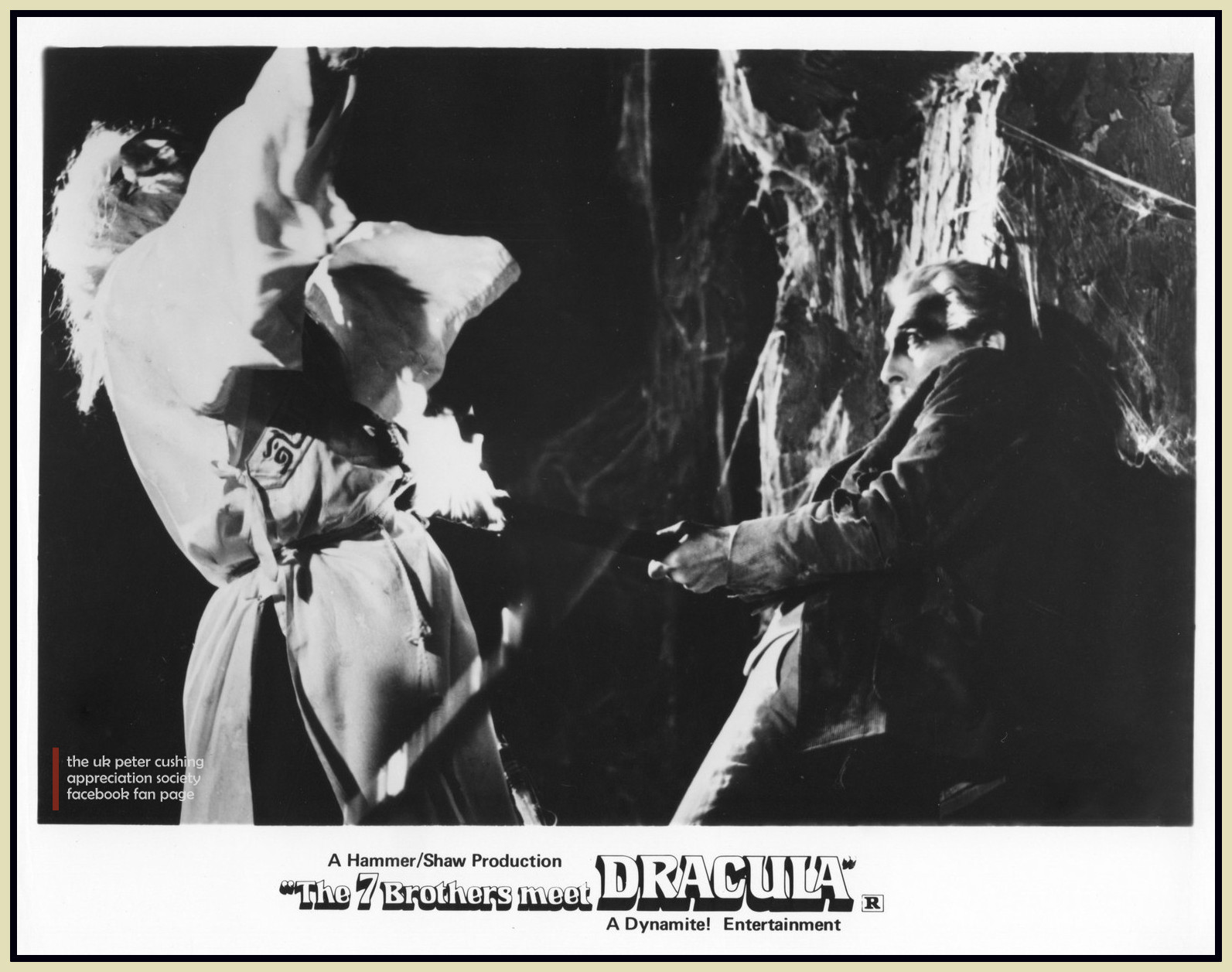
Baker is to be commended for making something
watchable out of this material. The script is no great shakes, and
apart from Cushing, most of the performances are stilted. Baker
approaches the film with stylistic gusto, however, approaching the
horror sequences with some of the stylistic bravado of Italian maestro
Mario Bava. The sequences of the titular vampires and their zombie
slaves shuffling through barren landscapes have a peculiar poetry, and
if the impact is let down by some uncommonly bad special effects work by
Les Bowie, there’s still a rousing score by James Bernard to keep
things moving. Bernard would come back to Hammer to do a couple of
scores for their TV series, The Hammer House of Horror, but Legend of
the 7 Golden Vampires would remain his final feature score for the
studio.

If Carreras really believed that tapping into the
kung fu market would help to revive Hammer’s standing, he was bitterly
disappointed. Warner Bros. picked the film up for distribution in the
UK, where it was distributed more or less uncut (some minor gore was
trimmed at the insistence of the BBFC); it did less than stellar
business, however, and reviews were predictably miserable. In the US,
it would suffer the same fate as The Satanic Rites of Dracula - it would
sit on the shelf for years, before being drastically cut, retitled (as
The Seven Brothers Meet Dracula), and trotted out by Dynamite
Entertainment, who also failed to elicit much in the way of audience
interest.

Ultimately, one doesn’t want to make inflated
claims for The Legend of the 7 Golden Vampires. It’s a silly film in
many respects, and it’s certainly burdened with more than its faire
share of flaws, but fans of Hammer horror, or of Cushing in particular,
should enjoy it for offering a variation on the formula. Truly, one of
the best things one can say about it is in the nature of a side note -
while a comic remake (with Tim Allen!) was threatened for several years,
it eventually fell through. Be grateful for small miracles, indeed!


Friday, 15 March 2013

Thursday, 14 March 2013
COUNTDOWN: JUST FOUR DAYS TO GO : PETER CUSHING AS VAN HELSING HORROR OF DRACULA / DRACULA HAMMER FILMS BLU RAY RELEASE

HAMMER FILMS RELEASES HORROR OF DRACULA / DRACULA ON BLU RAY IN JUST FOUR DAYS TIME

Wednesday, 13 March 2013
FIVE DAYS TO GO: PETER CUSHING AS VAN HELSING: 'DRACULA' / 'HORROR OF DRACULA' (1958)

Just FIVE days to go...
Tuesday, 12 March 2013
'HE WHO ROBS THE GRAVES OF EGYPT DIES!' THE MUMMY HAMMER FILMS (1959)

Hammer
Films 'The Mummy' Starring Peter Cushing as John Banning, Christopher
Lee as Kharis and Yvonne Furneaux as Isobel. Directed by Terence Fisher
and produced at Bray Studios. Shooting Production: February 25th until April 16th 1959.


Hammer
Films 'The Mummy' Starring Peter Cushing as John Banning, Christopher
Lee as Kharis and Yvonne Furneaux as Isobel. Directed by Terence Fisher
and produced at Bray Studios. Shooting Production: February 25th until April 16th 1959.


Hammer Films 'The Mummy' Starring Peter Cushing as John Banning, Christopher Lee as Kharis and Yvonne Furneaux as Isobel. Directed by Terence Fisher and produced at Bray Studios. Shooting Production: February 25th until April 16th 1959.

Monday, 11 March 2013
FEATURE AND GALLERY: 'TRUST ME, I'M A DOCTOR' PETER CUSHING AND VERONICA CARLSON : HAMMER FILMS: FRANKENSTEIN MUST BE DESTROYED (1969)

In 1969, Hammer Films was in a
precarious position. The company had long occupied a secure position in the
British film industry, with one box office success after another. They had
helped to revitalize the public’s interest in Gothic horror, and in the process
they helped to make Peter Cushing and Christopher Lee icons of the genre.
However, change was in the air - and Hammer simply wasn’t prepared to deal with
it. 1968 saw the release of two watershed horror films, each signalling a major
shift in the genre as a whole. On the one end of the spectrum, Rosemary’s Baby,
directed by Polish expatriate Roman Polanski, showed that horror was no longer
the province of B-level filmmaking.

At the opposite end, Pittsburgh-based George A. Romero demonstrated what spit, polish, no small amount of technical know-how and sheer determination could do in lieu of adequate resources with Night of the Living Dead. The former demonstrated that it was possible for horror movies to be blockbuster successes, even netting Oscar nominations (and one win) in the process. The latter signalled a new interest in graphic violence. If Hammer previously seemed edgy, they suddenly seemed quaint. Even in the UK, rival company Tigon Productions managed to out-Hammer Hammer with their brutal expose of one of the darkest chapters of British history, in Witchfinder General. Up until that point, Hammer was still espousing the natural superiority of good versus evil; these films rejected quaint moralizing in favor of painting a grimmer portrait of fate and its wrong doings. Hammer held firm in their conviction that audiences were still interested in Dracula and Frankenstein films, however, and while box office receipts would begin to taper off, they managed to deliver a late period return to form with their latest instalments in these respective franchises: Taste the Blood of Dracula and Frankenstein Must Be Destroyed. Of the two, however, only the latter seems genuinely in-tune with the pessimism of the era.

The screenplay by long time
assistant director Bert Batt, with some assistance from associate producer
Anthony Nelson Keys (as well as some uncredited input by director Terence
Fisher), is uncommonly complex, especially in light of Anthony Hinds’ more
genteel approach to the subject matter in The Evil of Frankenstein (1964) and
Frankenstein Created Woman (1966). Here, the Baron (Cushing) has been reduced
to the status of villain - but given the world he inhabits, one is reluctant to
fall back on such labels. The hypocrisy of the society at large is exposed at
every turn, with the indignant Baron seizing every opportunity to exploit those
around him in the effort to find a final validation in his work. After the more
overtly fantastical narrative leaps of Frankenstein Created Woman - wherein the
Baron is engaged in the transplantation of human souls - he is here “merely”
concerned with advanced brain surgery. Looking to pick the brain of a colleague
driven to insanity by the derision of his colleagues, the Baron determines to
abduct said colleague from the madhouse and transplant his brain into the body
of another scientist. In so doing, he hopes to cure the colleague’s insanity -
and have concrete, living proof of the validity of their research and years of
hard work. Needless to say, it does not go well…

In Hammer’s original “crack” at
Mary Shelley’s story, The Curse of Frankenstein, the Baron was presented as a
dandy with a sadistic streak - a sort of spoiled child desperate for attention
at any cost, and one who is willing to stoop to anything to prove his genius to
the world. The character evolved through the ensuing entries, with screenwriter
Jimmy Sangster bringing the story to an effective close in the very first
sequel, Revenge of Frankenstein (1958), which climaxes with the Baron - whose
close brush with the guillotine has made him a kinder, more tolerant individual
- literally becoming his own creation. Sangster refused the option to continue
writing Frankenstein sequels, and his successor, producer/writer Anthony Hinds,
really had nowhere to go - but back to the drawing board. He effectively
rebooted the series with Evil of Frankenstein, making the Baron into something
of a hero in the process. The trend continued with Frankenstein Created Woman,
but things take a far darker turn in Frankenstein Must Be Destroyed. Whether by
accident or by design, Batt and his collaborators created a take on the
character which was far more in tune with Sangster’s, and the end result can
certainly be viewed as something of a denouement to the initial saga.

Director
Terence Fisher brings his A game to the proceedings. Fisher often referred to
this as his favorite of the films he directed, and it’s easy to see why.
Despite a few narrative hiccups - more on that in a moment - he displays a
customarily sure and steady hand with plot and character development. Fisher’s
horror films work because he makes the audience believe in them - they are not
overly fantastical or even stylized in nature, and even if the situations the
characters are in are outlandish, how they react within them seems totally
credible. As a stylist, Fisher tended to be more “prosaic” than some of his
contemporaries within the genre, but his decision to foreground emotion and
characterization over baroque affect was definitely a conscious one.
Frankenstein Must Be Destroyed sees him working from a screenplay he cared
passionately about, and he responds with some of the most exquisite and
beautifully rendered staging and blocking of his career. Interestingly, the
film came at something of a lull in his life and career - he had been denied
the opportunity to continue the Dracula series with Dracula Has Risen From the
Grave (1968), owing to an alcohol-related traffic accident. After a period of
enforced rest and rehabilitation, he clearly attacked Frankenstein Must Be
Destroyed with the renewed vigor of an artist with something to say. Sadly, for
Fisher, the comeback would prove short-lived - after the release of this film,
he found himself in exactly the same position (the story goes that he had a
love of playing “chicken” with passing cars while he was drinking; advancing
age didn’t improve his speed), and he would only be able to complete one more
feature - Frankenstein and the Monster from Hell (1972) - before spending his
remaining years in enforced retirement. He died in 1980.

The cast assembled is absolutely
perfect, and Fisher definitely deserves credit in this as well. Cushing was, of
course, the only man to carry the picture - and it can be argued that this was
his finest screen performance. The character, as written, is complex and rife
with potential - and Cushing exploits every nuance to its full effect. The
Baron’s ability to turn on the charm, thus masking his moral deterioration,
comes through very strongly, notably during the scene where he puts off a
concerned woman with unctuous assurances that her husband is safe and sound -
only to close the door and turn into a steely close-up, barking orders to his
compatriots that they need to get the hell out of dodge (I’m paraphrasing, but
you get the idea). The Baron remains every bit the fastidious dandy conceived in
the initial entries, but he has no difficulty resorting the blackmail, murder,
even rape (more on that, as well!) to achieve his ends. In order to assist with
his venture, he enlists the aid of a pitiable couple played by Simon Ward and
Veronica Carlson.

The recently deceased Ward was apparently hired by Fisher
himself, who had seen the young actor in a television play. Ward brings
considerably more depth to the role than the usual bland stooge who is duped
into assisting the Baron. Carlson was then riding high as Hammer’s new “star
discovery,” having already appeared opposite Christopher Lee in Dracula Has
Risen From the Grave. In addition to possessing beautiful looks and a killer
body, Carlson also had genuine acting ability - she was used more for decorative
purposes in Risen, perhaps, but she really comes into her own here. Fisher’s
other casting master stroke was Freddie Jones, later to become something of a
favorite of iconic “cult” filmmaker David Lynch, who would cast him in The
Elephant Man, Dune, and Wild at Heart. Jones, a twitchy, idiosyncratic
character actor of the Charles Laughton school, could slice ham with the best
of them - but when properly reigned in, as he is here, he was capable of
tremendous depth. He plays the Baron’s latest “creature,” and he is arguably
the saddest and most heart-rending of them all.

The narrative proceeds smoothly,
but for the intrusion of some rather gratuitous police procedural scenes. These
scenes really seem to have no narrative justifcation beyond allowing Fisher
favorite Thorley Walters an opportunity to inject some humor into the
proceedings. True, this is a very grim film - but the scenes in question do
little but restate the obvious; tellingly, the subplot is dropped before the
climax

Much has been written about the
inclusion of a rape scene, and while it is definitely an uncomfortable
sequence, it does not feel like a hasty, last minute addition. Carlson, for her
part, has always maintained that it was added in at the behest of Hammer
executive Sir James Carreras, who felt the film needed some “sex appeal.” The
notion of adding a rape scene for sex appeal is, of course, the epitome of bad
taste. Carlson has always pointed to her character’s reactions to the Baron,
following the assault, as proof of her argument. Truthfully, her reactions seem
entirely in keeping with what has happened, as she reacts with fear and
revulsion towards the Baron from that point on. It could be that Carlson simply
wasn’t keen on the scene from the start, but it seems unlikely that it was
added in so hastily. Not only is the scene appropriately harrowing, but there
is nothing leering in how it is staged; there isn’t even any nudity on display,
and Hammer was already flirting with adding such material into their films, as
evidenced by Taste the Blood of Dracula. While the scene was removed from US
prints for a number of years, it is now visible in seemingly every home video
release of the film. One can theorize as much as one wants, but to this
reviewer the scene seems wholly consistent with the film’s depiction of the
Baron - for whom this is an act of cruelty and control, not of lust - and if
anybody had a mind to tack it on for the purposes of crass exploitation, it
does not come across that way in Fisher’s handling of the material.

In
addition to a strong script and stellar performances, the film is graced with
excellent production values. By 1970, Hammer’s QC would be on the decline - as
evidenced by such bargain basement productions as Scars of Dracula, Lust for a
Vampire and The Horror of Frankenstein - but at this stage in the game, they
were still able to offer real production gloss. The film marked the final work
of Hammer’s great production designer Bernard Robinson, whose abilities to
craft a silk purse out of the proverbial sow’s ear was as instrumental as
anything in establishing the Hammer aesthetic. He delivers some realistically
detailed sets, and the Baron’s makeshift “mad labs” are in keeping with the
more grounded approach. James Bernard contributes one of his finest soundtracks,
as well. From the pounding opening theme to the final, triumphant strains as
all hell breaks loose, he complements the mood and action beautifully.
Cinematographer Arthur Grant, normally given to the efficient rather than the
inspired, provides some excellent, low key lighting. Together with Fisher’s
keen sense of framing and camera movement, the lighting helps to give the film
a strong sense of mood and atmosphere.

Frankenstein
Must Be Destroyed may not have capped the series altogether, but it is, in a
sense, the ultimate “final word” in all things Frankenstein, at least so far as
Hammer is concerned. It remains one of the finest films they ever produced -
and arguably the apex of their Gothic movement.

Saturday, 9 March 2013
HAMMER FILMS DAMSELS: JULIE EGE, VERONICA CARLSON AND MADELINE SMITH POSE FOR PUBLICITY SHOT

Three beautiful actresses from Hammer Films, the connection Peter Cushing. Julie Ege (left) appeared with Cushing in The Legend of the Seven Golden Vampires (1974) Veronica Carlson (centre) starred with Cushing in Frankenstein Must Be Destroyed in 1969 and Madeline Smith co starred with Dave Prowse as the Monster (You can't miss him here) in Frankenstein and the Monster from Hell in (1973)
ALL SMILES FROM THE BARON: VERONICA CARLSON AND PETER CUSHING: GALLERY AND REVIEW TODAY!

NEW GALLERY AND FEATURE POSTING TODAY!
CAST:
Peter Cushing (Baron Frankentein), Freddie
Jones (Professor Richter/Dr Brandt), Simon Ward (Karl Holst), Veronica
Carlson (Anna Spengler), Maxine Audley (Ella Brandt), George Pravda (Dr
Frederick Brandt), Thorley Walters (Inspector Fritsch)
PRODUCTION:
Director – Terence Fisher, Screenplay – Ben
Batt, Story – Ben Batt & Anthony Nelson-Keys, Producer – Anthony
Nelson-Keys, Photography – Arthur Grant, Music – James Bernard, Makeup –
Eddie Knight, Art Direction – Bernard Robinson. Production Company –
Hammer.
Friday, 8 March 2013
STAR WARS: A MEETING OF EVIL MINDS ONBOARD THE DEATH STAR: TARKIN, VADER, MOTTI AND TAGGI: PHOTOGRAPH

CAST:
Mark Hamill (Luke Skywalker), Harrison Ford
(Han Solo), Carrie Fisher (Princess Leia Organa), Alec Guinness
(Obi-wan Ben Kenobi), David Prowse (Darth Vader), Peter Cushing (Grand
Moff Tarkin), Anthony Daniels (C3PO), Kenny Baker (R2D2), Peter Mayhew
(Chewbacca), James Earl Jones (Voice of Darth Vader), Phil Brown (Owen
Lars), Shelagh Fraser (Aunt Beru)
PRODUCTION:
Director/Screenplay – George Lucas,
Producer – Gary Kurtz, Photography – Gilbert Taylor, Music – John
Williams, Photographic Effects Supervisor – John Dykstra, Models – Colin
Cantwell, Animation – Peter Kuran, Computer Animation – Larry Cuba,
Stop Motion Animation – Jon Berg & Phil Tippet, Mechanical Effects –
John Stears, Makeup – Rick Baker, Doug Beswick, Graham & Kay &
Stuart Freeborn, Nick Maley & Christopher Tucker, Production Design –
John Barry. Production Company – Lucasfilm/20th Century Fox.
SYNOPSIS:
In a galaxy far, far away. The forces of
the Empire, headed by Darth Vader, capture Princess Leia Organa of the
intergalactic Rebellion. She leaves all-important information about the
flaws in the Empire’s top-secret weapon The Death Star in the company of
two droids C3PO and R2D2. The droids flee in an escape pod down to the
surface of the remote desert planet Tattooine. They are captured by
native Jawas and sold into the company of naïve young farmboy Luke
Skywalker who dreams of joining the Rebellion. Luke accidentally
uncovers a hologram left inside R2D2 by Princess Leia for former Jedi
Knight Obi-wan Ben Kenobi. Meeting Ben Kenobi, Luke realises that his
aunt and uncle have been keeping the truth about his father, who was a
Jedi Knight, from him. When Vader’s forces kill his aunt and uncle, Luke
joins Ben Kenobi as he sets out to answer the princess’s call. Ben
starts to teach Luke to understand his mystical powers as a Jedi. Hiring
the services of the space pilot Han Solo, they set off to save the
princess and stop the Death Star before it destroys the Rebel
stronghold.
'THE MAN WHO COLLECTED POE' TROY HOWARTH REVIEWS CUSHING AND PALANCE IN AMICUS FILMS 'TORTURE GARDEN'

Burgess Meredith (Dr Diablo). Enoch:- Michael Bryant (Colin Williams), Maurice Denham (Uncle Roger). Terror Over Hollywood:-
Beverly Adams (Carla Hayes), Robert Hutton (Bruce Benton), John
Phillips (Eddie Storm), David Bauer (Mike Charles), Bernard Kay (Dr
Helm). Mr Steinway:- Barbara Ewing (Dorothy Endicott), John Standing (Leo). The Man Who Collected Poe:- Jack Palance (Ronald Wyatt), Peter Cushing (Lancelot Canning)

PRODUCTION:
Director – Freddie Francis, Screenplay –
Robert Bloch, Based on his Short Stories, Producers – Max J. Rosenberg
& Milton Subotsky, Photography – Norman Warwick, Music – Don Banks
& James Bernard, Makeup – Jill Carpenter, Art Direction – Don
Mingaye & Scott Simon. Production Company – Amicus.
Given the box office success of Dr. Terror’s House of Horrors (1964), it may seem surprising that it took producers Max Rosenberg and Milton Subotsky several years to light upon the idea of delivering another horror film in the same vein. They had explored sci-fi via a pair of juvenile Dr. Who vehicles, and had explored horror in various forms via such Robert Bloch properties as The Skull (1965), The Psychopath (1966) and The Deadly Bees (1966), but somehow they had failed to capitalize upon the box office potential of the anthology format. The tide changed when they enlisted Bloch to pen a new anthology, which was then envisioned as another vehicle for Peter Cushing and Christopher Lee. Things changed a bit when Columbia Pictures was enlisted to infuse some much needed financing, but the film’s box office takings persuaded Subotsky and Rosenberg to direct much of their energy to further multi-story offerings for the remainder of their partnership.


Things kick off with a splendid slice of grotesquerie starring Michael Bryant, Maurice Denham and Niall MacGinnis. There are no end titles, and as such there are no official on camera segment titles, but this segment is known as “Enoch,” and it casts Bryant as a ne’er-do-well who seeks to cash in on his uncle’s demise by using the old man’s money to get himself out of debt. Little does Bryant realize that the money carries a witches curse, and the witches familiar - a black cat - has every intention of seeing this legacy fulfilled. Director Freddie Francis slathers on the atmosphere with moody lighting and interesting camera angles; it marks one of his most successfully realized mood pieces, and helps to get the film off on the right foot. Bryant, who had not long prior “finished” filming a lead role for Orson Welles (in a project destined to be uncompleted, unfortunately) and was already established as one of the notable “leading lights” of the British theatre, gives an excellent performance in the lead, and it’s fun to see Maurice Denham and Niall MacGinnis reunited, as it were, from Jacques Tourneur’s magnificent Night of the Demon (1957).

The quality dips sharply in the next two segments, unfortunately. First up is “Terror Over Hollywood,” in which grasping wannabe starlet Beverly Adams unwittingly sells her soul for fame and fortune, and then “Mr. Steinway” tells the tale of how Barbara Ewing (Dracula Has Risen from the Grave) falls victim to - wait for it - a possessed piano. The former is dreadfully dull, done up in a bland, smothering “lite jazz” score by Don Banks, while the latter is simply too silly for words. Kudos to Francis for trying to make the latter halfway credible, but all the gel lighting and canted angles in the world can’t shake the silliness from the basic concept

In the grand tradition of saving the best for last, the film wraps up with “The Man Who Collected Poe” - it is for this, fellow Cushing fans, that we are here assembled. The segment stars Jack Palance as the most obsessive collector this side of, well, Peter Cushing in The Skull. Determined to avail himself of some of the “treasures” of fellow fanatic Cushing, he decides to play dirty - but may or may not live to pay the price.


The segment allowed Cushing his only chance to share scenes with Hollywood heavyweight Jack Palance, who was then about to enter something of a dry spell with appearances in numerous B and Z grade productions. Even so, he already had an Oscar nomination (for Shane) under his belt, and the Golden God would become his in the future, thanks to his career-rehabilitating turn as Curly in the audience friendly family comedy City Slickers (1992). Palance was as intense as he was imposing - standing a full 6’ 4”, and built like a tank, he had been a boxer and a decorated WWII veteran before turning his sights to acting. Palance had the face of a heavy, and he knew it - far from resenting it, he capitalized on it and turned it in to an advantage. Palance wasn’t afraid of hamming it up, and it seems that on occasion a fondness for the bottle took its toll on his work (witness his turn as the head of a strange religious sect in director Jess Franco’s Justine, 1969, for a truly “bombed” appearance), but more often than not he was able to inject substance and interest into even the least defined of characterizations.


Torture Garden afforded Palance one of his few truly good horror genre roles. The character of Ronald Wyatt is a fanatic extraordinaire - his sheer giddiness and glee at handling the various items in Cushing’s collection of Poe memorabilia may seem over the top to some, but if you ever get a chance to attend, say, a horror film convention, you’ll realize it’s not far from the truth. Palance doesn’t underplay the part, but it’s not a role that calls for understatement, either. Wyatt is something of a functioning junkie, though his addiction is Poe rather than any illicit substance. Palance nails this aspect of the character with ease, and he never seems to be playing down to the audience.

As one might expect, Cushing’s performance as his “rival” collector, Lancelot Canning, is more reserved. Even so, he also manages to express the character’s almost orgasmic love of his collection - handling the items with tenderness, talking of them as one might of a lost love, and also reveling in the fact that he has the upper hand on his American colleague. The two actors also display a real chemistry, and play off of each other very well. When Palance first visits Cushing’s home, for example, the former is so overcome with excitement that he can barely focus on the formal pleasantries. Ever the gracious host, Cushing offers a choice of drinks - upon saying “whiskey,” Palance blurts out an eager “yes,” and then Cushing proceeds to offer sherry as an alternative, whereupon Palance continues with “yes, thank you!” Wyatt is clearly not even paying attention, and Cushing’s sly double take manages to convey a sense of amusement without milking the scene for laughter. The two men then proceed to virtually worship at a portait of the late author, hanging in Cushing’s salon. Canning offers a pithy analysis of Poe’s genius, while Wyatt silently, somewhat mockingly, sizes him up. It’s clear early on that he realizes that he’s bigger, tougher and more cunning than his “opponent,” and if he doesn’t exactly have murder on his mind, he is nevertheless bound and determined to see the full extent of Canning’s collection. Wyatt plies Canning with alcohol, affording Cushing a rare chance to play “drunk” on screen. Cushing does so without resorting to over the top theatrics, subtly slurring his words but not going for slapstick in the process. The episode basically plays out as something of a bizarre ritual, as the two men, unified in a common obsession, test and tease each other, each itching to come out on top as the ultimate fanatic.


Here, as elsewhere, Francis directs with a keen eye for the visual. He offers a wide variety of interesting camera set ups, ratcheting the tension as Palance’s obsession tilts from barely contained to positively dangerous. He elicits excellent performances from his actors, and the pace is taut, with no longeurs to complain of. This stands in contrast to Subotsky’s allegations that Francis was good with visuals, but lousy with story - thus prompting the producer to perpetuate the myth that he salvaged much of his work in the editing room, a claim which Francis strenuously objected to.


Interestingly, this marked the only time that Amicus hired Hammer’s in house composer James Bernard to pen the soundtrack. Bernard sat out the Terror Over Hollywood segment, allowing Don Banks to deliver a more “modern” sound apropos to the subject matter, but his contributions to “Enoch” and “The Man Who Collected Poe” are strongly felt. Perhaps because of the fact that he didn’t score the film as a whole, it’s a score that doesn’t generate much attention among his fans - but truly, it deserves more appreciation. As in the best of his Hammer scores, Bernard’s music not only complements the mood - it helps to elevate it where needed.

Ultimately, Torture Garden is an uneven picture. Two segments work, two segments don’t - and on this level, it’s hard to give it a full endorsement. Fans of British horror would be remiss to skip those two key segments that do work, however, as they offer all the attributes one associates with the golden age of British horror filmmaking.
Subscribe to:
Posts (Atom)
